

Why Claims Managers Are Turning to Automated Insurance Claims Software in 2026
Automated insurance claims software is transforming how P&C insurance carriers, TPAs, and IA firms handle everything from First Notice of Loss (FNOL) to final settlement. If you need a quick answer on what to look for, focus on these capabilities:
Top capabilities to prioritize in automated P&C insurance claims software in 2026:
| Capability | Best For | Key Strength |
|---|---|---|
| End to end lifecycle management | Large P&C insurance carriers | Connects FNOL, investigation, reserves, payments, and closure |
| No code workflow configuration | Mid size carriers and TPAs | Lets operations teams update routing and business rules quickly |
| AI triage and severity scoring | Workers' compensation and casualty teams | Helps identify complex files early |
| Smart assignment and routing | High volume claims operations | Matches claims to the right adjuster faster |
| Multi language document ingestion | Multi line P&C insurance teams | Improves intake across emails, PDFs, forms, and attachments |
| Compliance first controls | MGAs, brokers, and regulated environments | Supports auditability and oversight |
| Policy parsing and financial tracking | IA firms and field adjusting teams | Speeds coverage review and claim accounting |
Processing a P&C insurance claim the old way is slow, costly, and prone to errors. Claims teams in residential property, auto, workers' compensation, and pet insurance are often buried in manual data entry, disconnected tools, and routing bottlenecks that add days, and sometimes weeks, to settlement times. Automation can reduce claims management costs and improve processing speed by streamlining intake, routing, and document handling.
The pressure is real. P&C insurance carriers and TPAs are managing more claims volume with the same headcount, and policyholders expect faster resolutions than ever before.
I'm Alex Pezold, founder of Agentech and previously the founder of TokenEx, one of the largest technology exits in Oklahoma's history. My work building AI powered solutions for the P&C insurance industry gives me a direct view into how automated insurance claims software is reshaping operations for carriers, TPAs, and IA firms. In this roundup, I'll break down the core capabilities and evaluation criteria that matter most so you can find the right fit for your firm without the guesswork.
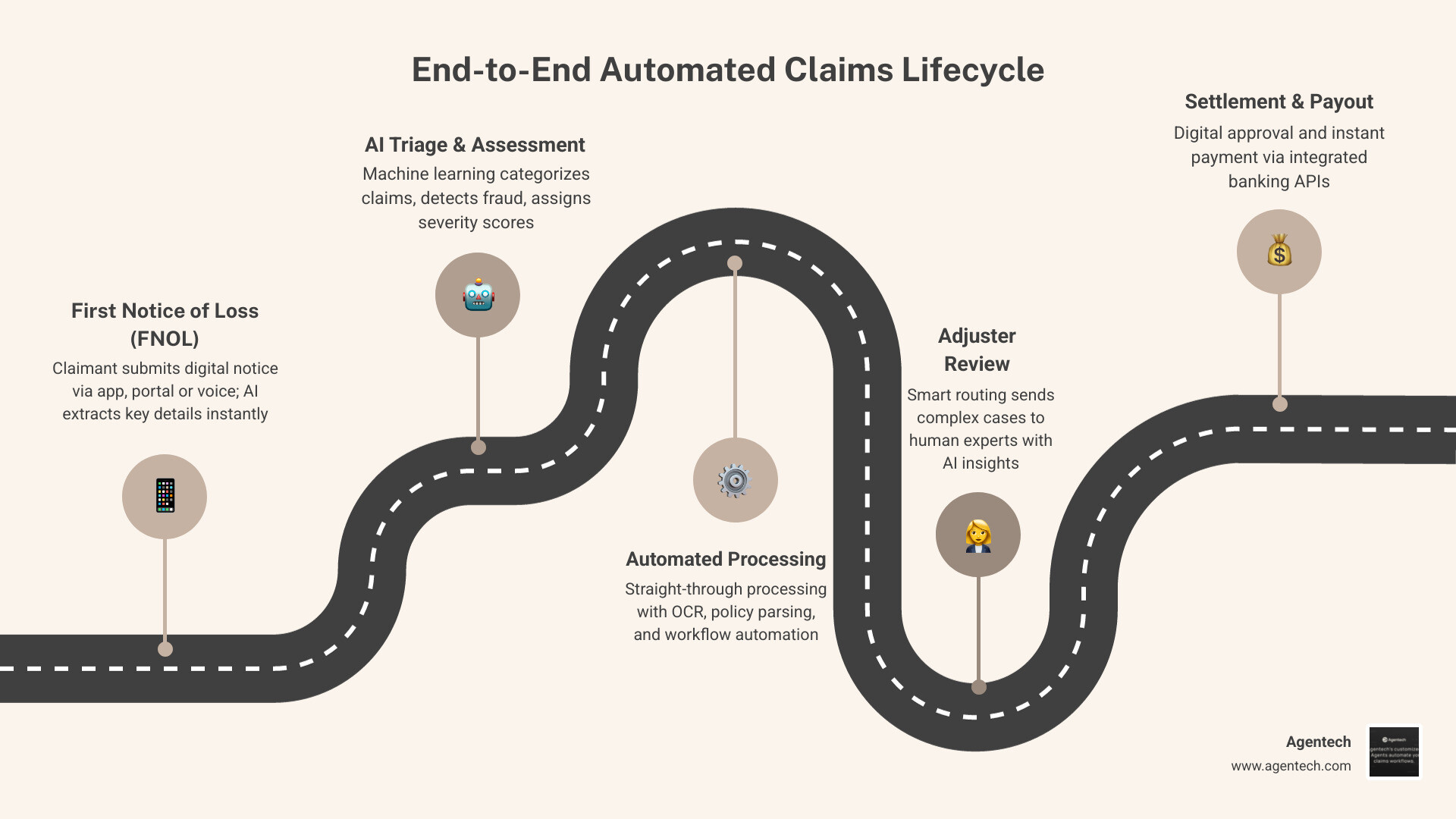
Defining Automated Insurance Claims Software for P&C Carriers
At its simplest, automated insurance claims software is a technology suite designed to minimize human intervention in repetitive, rule based tasks. For P&C insurance carriers, this means moving away from paper heavy workflows toward digital environments where data flows seamlessly from the First Notice of Loss (FNOL) to the final payment.
Modern Automated Claims Handling systems use a combination of business logic and artificial intelligence to "read" incoming documents, verify policy coverage, and route tasks to the right person. In many cases, simple claims, like a cracked windshield in an auto policy or a small medical bill in a pet insurance claim, can achieve straight through processing. This means the claims management software handles the entire lifecycle without an adjuster ever needing to touch the file.
According to Gartner research on insurance operational efficiency, the industry focus has shifted from mere revenue growth to maximizing operational efficiency. For residential property claims, this is a game changer. Instead of an adjuster spending hours manually entering data from a contractor's estimate, Automated Claims Processing tools can extract that data in seconds, cross reference it against policy sublimits, and flag any discrepancies for review.

Core Features and Technologies of Modern Claims Software
The value behind modern automated insurance claims software comes from a set of technologies working together inside a P&C insurance claims workflow. These platforms have moved beyond simple rule based automation into more intelligent claims management support.
Key Technologies Powering the Industry
- Agentic AI: This is the next step in automation. Instead of following only rigid scripts, AI agents can help complete multi step administrative tasks across a claim file.
- Natural Language Processing (NLP): This allows the AI Claims Processing System to understand the context of adjuster notes, claimant emails, and other unstructured text.
- Contextual Optical Character Recognition (OCR): Older OCR tools relied heavily on fixed layouts. Modern AI Claims Processing Complete Guide technology reads documents more contextually, helping teams identify fields such as date of loss, policy number, and insured name across forms and PDFs.
| Feature | Manual Data Entry | AI Data Extraction |
|---|---|---|
| Speed | 10 to 15 minutes per form | About 40 seconds per form |
| Accuracy | Prone to human fatigue and typos | High accuracy for typed text with human review where needed |
| Availability | Standard business hours | 24/7/365 |
| Scalability | Requires new hires for volume | Can scale more easily during CAT events |
Key Features of Automated Insurance Claims Software
When evaluating Claims Automation Software, look for these essential capabilities:
- No Code Workflow Engines: These let business teams update routing logic and claim rules without waiting on IT for every change.
- Smart Routing Logic: The claims management software should assign claims based on adjuster skill set, licensing, geography, and workload.
- Fraud Detection Support: The platform should help surface anomalies and red flags for adjuster or SIU review.
- Digital Payout Integration: Once a claim is approved, Automated Claims Adjudication Software should support faster payment workflows to improve the claimant experience.
Advanced AI Capabilities for Adjusters
The best claims software supports adjusters rather than replacing them. AI Powered Claims Automation can assist with narrative building by organizing claim facts, summarizing documentation, and helping teams prepare clearer file notes. For complex Property & Casualty insurance losses, AI can also help with policy parsing and document review. AI Driven Claims Processing can support subrogation opportunity detection by identifying patterns that may point to third party liability.

Strategic Benefits for TPAs and IA Firms
For Third Party Administrators (TPAs) and Independent Adjusting (IA) firms, the business case for automated insurance claims software is centered on margins, service quality, and scalability. When you are processing thousands of Property & Casualty insurance claims across multiple states, even small inefficiencies can create major operational leakage.
By adopting Digital Claims Processing, firms can reduce administrative effort and improve cycle times. In workers' compensation claims, for example, AI triage can help identify files that appear routine at first but show indicators of becoming more complex or more expensive. Spotting those claims earlier can help teams intervene sooner and manage outcomes more effectively.
Automating Insurance Claims Processing also helps solve the surge problem. During CAT events such as hurricanes or hailstorms, claim volumes can spike overnight. A manual operation may struggle with intake backlogs, while automated claims management software can help carriers, TPAs, and IA firms process incoming residential property claims faster, make first contact sooner, and move emergency payments or next steps forward with less delay. That speed often supports stronger customer satisfaction and retention.
Selecting the Best Automated Insurance Claims Software for Your Firm
Choosing a platform is a high stakes decision. You are not just buying a tool. You are choosing a partner that will handle sensitive claimant data and support core financial workflows.
First, check for API first architecture. You want a solution that integrates with your existing policy administration system, claims management software, or RMIS rather than requiring a full rip and replace overhaul. Second, security is non negotiable. Ensure the vendor maintains SOC 2 Type II compliance and, for teams handling workers' compensation or other regulated data, supports the relevant privacy and security standards your operation requires.
Best Automated Insurance Claims Software Categories in 2026
The market has become more specialized. Depending on your needs, you might look into:
- Intelligent Intake Engines: Best if your main bottleneck is document chaos across emails, PDFs, and forms.
- Workflow Orchestration Platforms: Best for managing complex, multi step approvals across large Property & Casualty insurance claims teams.
- AI Triage Solutions: Especially useful for casualty and workers' compensation teams looking to prioritize files by likely severity.
Using an AI Insurance Claims Processing Guide can help you map these categories to your specific business goals. Whether you are focused on AI Claims Processing Insurance for pet, auto, residential property, or workers' compensation, the goal is the same: reduce the time adjusters spend typing and increase the time they spend investigating.
Implementation Best Practices for P&C Carriers
Success does not happen overnight. We recommend a human in the loop approach. Start with a data quality review of your historical claims so your automation tools are working from clean and consistent inputs. During the first few months of using AI Claims Processing Guide tools, set high confidence thresholds. This means the system only completes tasks automatically when confidence is high, while lower confidence items are routed to a human adjuster for review. This helps build trust, supports change management, and ensures that complex claims in grey areas still receive human judgment.
Frequently Asked Questions about Claims Automation
How does automated claims software detect fraud?
The claims software uses machine learning models trained on millions of historical claims. It looks for "red flags" that a human might miss, such as document tampering in a PDF, AI generated images of property damage, or claimant patterns that match known fraud rings. By feeding claim data into a fraud evaluation model, the system can flag suspicious files for the Special Investigations Unit (SIU) before any payment is issued.
Can AI replace human P&C insurance adjusters?
No. While automated insurance claims software handles the "drudge work" like data entry and routing, human judgment remains irreplaceable. Adjusters are needed for complex negotiations, empathetic customer service during traumatic events, and interpreting ambiguous policy language. The goal of automation is to eliminate the 14+ hours a week adjusters spend searching for documents so they can focus on high value decision making.
What is the typical ROI for claims automation?
Most P&C insurance carriers see a return on investment within the first year. Common metrics include a 35% reduction in claim reassignments, a 50% increase in the speed of settlement, and significant savings in Loss Adjustment Expenses (LAE). For large carriers, automating just the routing and assignment phase can save millions of dollars annually by ensuring the claim reaches the right adjuster the first time.
Conclusion
The transition to automated insurance claims software is no longer a future trend. It is a practical requirement for P&C insurance carriers, TPAs, and IA firms that want to stay competitive in 2026. By removing administrative friction from the claims lifecycle, your team can settle claims faster, improve adjuster productivity, and deliver the service level modern policyholders expect.
At Agentech, we provide AI powered automation designed specifically for P&C insurance claims operations. Our Product offers always on AI assistants that integrate into existing claims workflows without replacing human decision making. We focus on repetitive administrative tasks such as document indexing, policy parsing, and workflow support so your team can focus on investigating claims and helping people recover after a loss.
Ready to see how much time your team could save? The right automation strategy starts with choosing a partner that understands the nuances of residential property, auto, pet, and workers' compensation claims.
Sources:
- Gartner, "Gartner Says Insurance CIO Focus Shifting to Operational Efficiency" (2024) https://www.gartner.com/en/newsroom/press-releases/2024-01-15-gartner-says-insurance-cio-focus-shifting-to-operational-efficiency
- Agentech, "Automated Claims Handling" https://www.agentech.com/resources/articles/automated-claims-handling
- Agentech, "Automated Claims Processing" https://www.agentech.com/resources/articles/automated-claims-processing
- Agentech, "Claims Automation Software" https://www.agentech.com/resources/articles/claims-automation-software
- Agentech, "AI Claims Processing Complete Guide" https://www.agentech.com/resources/articles/ai-claims-processing-complete-guide
- Agentech, "AI Claims Processing System" https://www.agentech.com/resources/articles/ai-claims-processing-system
- Agentech, "Digital Claims Processing" https://www.agentech.com/resources/articles/digital-claims-processing
- Agentech, "Automating Insurance Claims Processing" https://www.agentech.com/resources/articles/automating-insurance-claims-processing
- Agentech, "AI Insurance Claims Processing Guide" https://www.agentech.com/resources/articles/ai-insurance-claims-processing-guide
- Agentech, "AI Powered Claims Automation" https://www.agentech.com/resources/articles/ai-powered-claims-automation
- Agentech, "AI Driven Claims Processing" https://www.agentech.com/resources/articles/ai-driven-claims-processing
- Agentech, "Automated Claims Adjudication Software" https://www.agentech.com/resources/articles/automated-claims-adjudication-software
- Agentech, "AI Claims Processing Insurance" https://www.agentech.com/resources/articles/ai-claims-processing-insurance
- Agentech, "AI Claims Processing Guide" https://www.agentech.com/resources/articles/ai-claims-processing-guide
- Agentech, "Product: AI Agents" https://www.agentech.com/product/ai-agents