
The New Face of Your Workforce
Digital coworkers are AI-powered software entities that autonomously perform end to end work processes, functioning as collaborative team members rather than simple automation tools. Here's what makes them distinct:
Key Characteristics of Digital Coworkers: Their key characteristics include autonomous operation across complex, multistep workflows; natural language understanding for communication via email, chat, or messaging platforms; learning and adaptation from data and interactions over time; system integration with existing claims management software and business tools; and 24/7 availability without requiring constant human supervision.
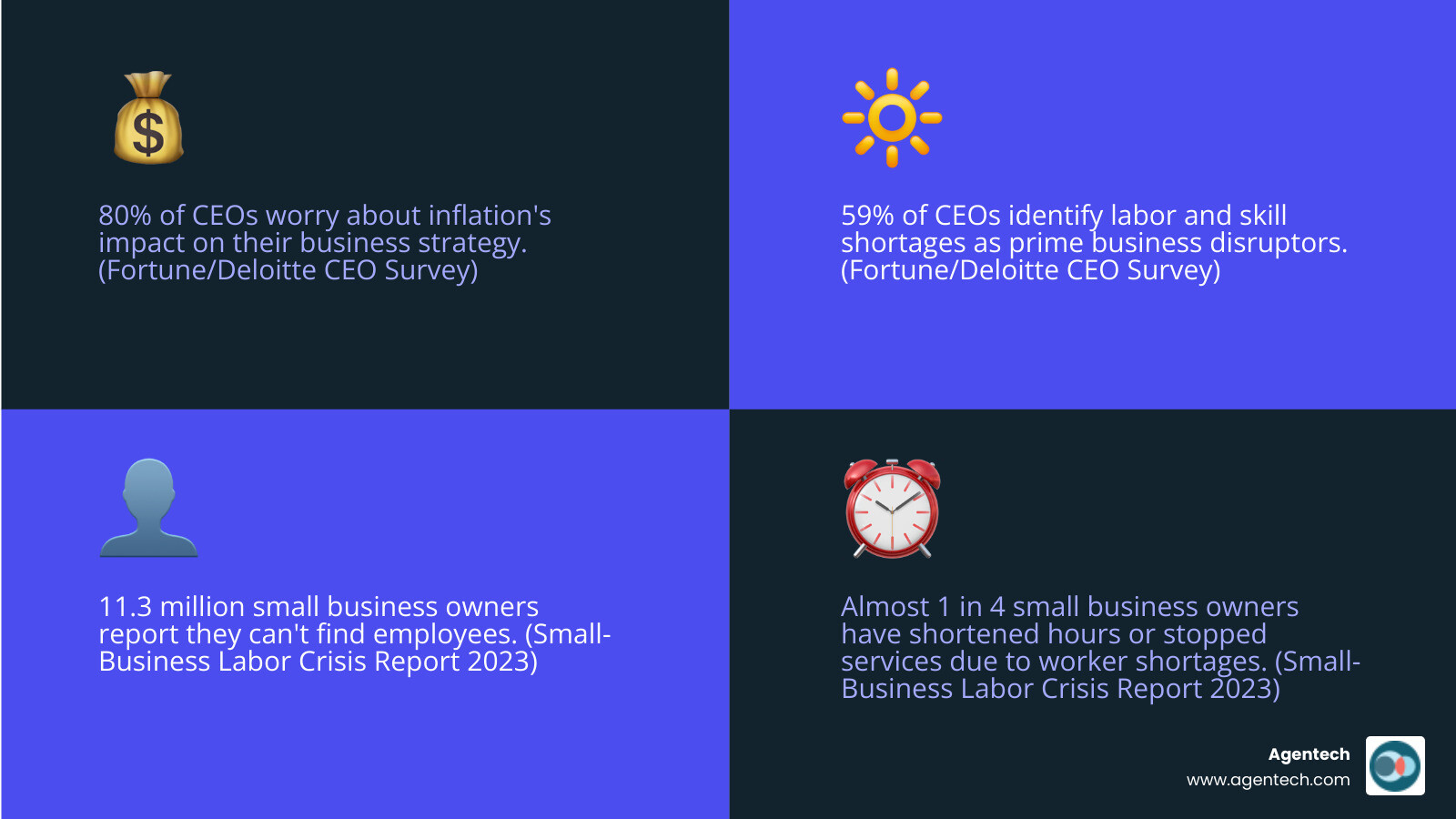
Right now, P&C insurance carriers, TPAs, and IA firms are facing unprecedented pressure. 80% of CEOs worry about inflation's impact on their business strategy, while 59% identify labor and skill shortages as prime business disruptors, according to a recent Deloitte survey. For claims managers specifically, these challenges translate to mounting backlogs, slower settlement times, and overworked adjusters struggling with repetitive data entry.
11.3 million small business owners report they cannot find employees who can do the necessary work. In the P&C insurance sector, this shortage hits particularly hard during peak claims periods following natural disasters or weather events. Almost one in four small business owners have shortened hours or stopped offering services due to worker shortages, as highlighted in a 2023 report.
Digital coworkers offer a practical solution. They handle the repetitive, time consuming tasks that bog down your claims team while your human adjusters focus on complex cases requiring judgment and empathy. This is not about replacing people. It is about giving your team the support they need to work faster and smarter.
I'm Alex Pezold, founder of Agentech AI, where we are building the AI workforce for P&C insurance through digital coworkers that transform claims processing with unprecedented speed and accuracy. After founding, scaling, and exiting TokenEx in 2021, I have focused on creating AI solutions that solve real operational challenges for P&C insurance carriers and TPAs.
Citations:
- Deloitte. (2022). Fortune/Deloitte CEO Survey. Retrieved from https://www2.deloitte.com/content/dam/Deloitte/us/Documents/about-deloitte/us-ceo-survey-overview-summer-2022.pdf
- Ramsey Solutions. (2023). Small-Business Labor Crisis Report 2023. Retrieved from https://www.ramseysolutions.com/business/small-business-labor-crisis
- Agentech. (n.d.). Explore our AI Agents. Retrieved from https://www.agentech.com/product/ai-agents/
What Are Digital Coworkers?
At its heart, a digital coworker is an advanced AI agent designed to operate as a cohesive member of your team. Unlike traditional claims software that merely executes commands, these are software-driven entities capable of autonomously performing meaningful parts of complex, end to end work processes. Think of them as highly skilled, specialized team members who understand intent, respond to questions, and act on behalf of human colleagues, all while allowing humans to retain control and authority. They are not just tools; they are collaborators, particularly valuable in the demanding environment of P&C insurance claims management.
In the context of P&C insurance, a digital coworker can be trained to handle a wide array of tasks across the claims lifecycle. This includes everything from initial notice of loss (FNOL) intake to processing routine policyholder inquiries, and even assisting with complex data analysis for fraud detection. They use a combination of intelligent automation building blocks, such as conversational intelligence and robotic process automation (RPA), to work alongside human employees. This allows them to run significant portions of claims processes independently, freeing up human adjusters for more strategic and empathetic interactions with policyholders. To learn more about how AI can specifically benefit P&C insurance agents, explore our article on AI for P&C Insurance Agents.
How Digital Coworkers Differ from Traditional Automation Tools
It is easy to confuse digital coworkers with older forms of automation. Many claims leaders are familiar with traditional claims software or basic RPA bots. While these technologies are valuable, digital coworkers represent a significant evolution.
Traditional automation, like rule based scripts or basic RPA bots, is typically designed for specific, highly repetitive tasks with fixed rules. An RPA bot, for example, might mimic keystrokes and mouse clicks to transfer data from one system to another. It follows a script precisely and requires human intervention when something deviates from the expected path. It is like a car with automated features that still requires human operation.
Digital coworkers, however, are more akin to a fully driverless car. They apply artificial intelligence capabilities such as machine learning, computer vision, and natural language processing (NLP) to perform a sequence of tasks within a workflow. They are cognitive and action oriented, able to reason through problems, evaluate alternatives, and even negotiate adjustments. They do not just provide information; they solve problems. This means they can handle more complex, variable tasks and adapt to changing conditions without constant human oversight. They are not merely following instructions; they are making decisions and coordinating tasks across departments.
Here is a quick comparison:
Traditional Automation (e.g., RPA Bot)
- Autonomy: Limited to predefined rules and scripts. Requires human intervention for exceptions.
- Learning: None. Follows a fixed set of instructions.
- Task Complexity: Best for simple, repetitive, rule based tasks.
- Interaction: Minimal. Typically interacts with systems via APIs or screen scraping.
- Scalability: Scalable, but often requires significant effort to adapt to new processes.
Digital Coworker (AI Agent)
- Autonomy: High. Can make decisions, learn from data, and handle exceptions without constant supervision.
- Learning: Continuous. Learns from new data and interactions to improve performance over time.
- Task Complexity: Capable of handling complex, multistep processes that require judgment and adaptation.
- Interaction: Conversational. Can understand and respond to human language via email, chat, and other communication channels.
- Scalability: Highly scalable and adaptable. Can be quickly trained and deployed for new tasks and workflows.
Citations:
- Gartner. (n.d.). Intelligent Agent in AI. Retrieved from https://www.gartner.com/en/articles/intelligent-agent-in-ai
- Agentech. (n.d.). AI for Insurance Agents. Retrieved from https://www.agentech.com/resources/articles/ai-for-insurance-agents
- Harvard Business Review. (2018, July). Collaborative Intelligence: Humans and AI Are Joining Forces. Retrieved from https://hbr.org/2018/07/collaborative-intelligence-humans-and-ai-are-joining-forces
What Are Digital Coworkers?
At its heart, a digital coworker is an advanced AI agent designed to operate as a cohesive member of your team. Unlike traditional claims software that merely executes commands, these are software-driven entities capable of autonomously performing meaningful parts of complex, end to end work processes. Think of them as highly skilled, specialized team members who understand intent, respond to questions, and act on behalf of human colleagues, all while allowing humans to retain control and authority. They are not just tools; they are collaborators, particularly valuable in the demanding environment of P&C insurance claims management.
In the context of P&C insurance, a digital coworker can be trained to handle a wide array of tasks across the claims lifecycle. This includes everything from initial notice of loss (FNOL) intake to processing routine policyholder inquiries, and even assisting with complex data analysis for fraud detection. They use a combination of intelligent automation building blocks, such as conversational intelligence and robotic process automation (RPA), to work alongside human employees. This allows them to run significant portions of claims processes independently, freeing up human adjusters for more strategic and empathetic interactions with policyholders. To learn more about how AI can specifically benefit P&C insurance agents, explore our article on AI for P&C Insurance Agents.
How Digital Coworkers Differ from Traditional Automation Tools
It is easy to confuse digital coworkers with older forms of automation. Many P&C insurance leaders are familiar with traditional claims management software or RPA bots. While these technologies are valuable, digital coworkers represent a significant evolution.
Traditional automation, like rule based scripts or basic RPA bots, is typically designed for specific, highly repetitive tasks with fixed rules. An RPA bot, for example, might mimic keystrokes and mouse clicks to transfer data from one system to another. It follows a script precisely and requires human intervention when something deviates from the expected path. It is like a car with automated features that still requires human operation.
Digital coworkers, however, are more akin to a fully driverless car. They apply artificial intelligence capabilities such as machine learning, computer vision, and natural language processing (NLP) to perform a sequence of tasks within a workflow. They are cognitive and action oriented, able to reason through problems, evaluate alternatives, and even negotiate adjustments. They do not just provide information; they solve problems. This means they can handle more complex, variable tasks and adapt to changing conditions without constant human oversight. They are not merely following instructions; they are making decisions and coordinating tasks across departments.
Here is a quick comparison:
Traditional Automation (e.g., RPA Bot)
- Autonomy: Limited to predefined rules and scripts. Requires human intervention for exceptions.
- Learning: None. Follows a fixed set of instructions.
- Task Complexity: Best for simple, repetitive, rule based tasks.
- Interaction: Minimal. Typically interacts with systems via APIs or screen scraping.
- Scalability: Scalable, but often requires significant effort to adapt to new processes.
Digital Coworker (AI Agent)
- Autonomy: High. Can make decisions, learn from data, and handle exceptions without constant supervision.
- Learning: Continuous. Learns from new data and interactions to improve performance over time.
- Task Complexity: Capable of handling complex, multistep processes that require judgment and adaptation.
- Interaction: Conversational. Can understand and respond to human language via email, chat, and other communication channels.
- Scalability: Highly scalable and adaptable. Can be quickly trained and deployed for new tasks and workflows.
Citations:
- Gartner. (n.d.). Intelligent Agent in AI. Retrieved from https://www.gartner.com/en/information-technology/glossary/intelligent-agent
- Agentech. (n.d.). AI for Insurance Agents. Retrieved from https://www.agentech.com/resources/articles/ai-for-insurance-agents
- Harvard Business Review. (2018, July). Collaborative Intelligence: Humans and AI Are Joining Forces. Retrieved from https://hbr.org/2018/07/collaborative-intelligence-humans-and-ai-are-joining-forces
The New Face of Your Workforce
Digital coworkers are AI-powered software entities that autonomously perform end to end work processes, functioning as collaborative team members rather than simple automation tools. Here's what makes them distinct:
Key Characteristics of Digital Coworkers: Their key characteristics include autonomous operation across complex, multistep workflows; natural language understanding for communication via email, chat, or messaging platforms; learning and adaptation from data and interactions over time; system integration with existing claims management software and business tools; and 24/7 availability without requiring constant human supervision.
Right now, P&C insurance carriers, TPAs, and IA firms are facing unprecedented pressure. 80% of CEOs worry about inflation's impact on their business strategy, while 59% identify labor and skill shortages as prime business disruptors. For claims managers specifically, these challenges translate to mounting backlogs, slower settlement times, and overworked adjusters struggling with repetitive data entry.
11.3 million small business owners report they cannot find employees who can do the necessary work. In the P&C insurance sector, this shortage hits particularly hard during peak claims periods following natural disasters or weather events. Almost one in four small business owners have shortened hours or stopped offering services due to worker shortages.
Digital coworkers offer a practical solution. They handle the repetitive, time consuming tasks that bog down your claims team while your human adjusters focus on complex cases requiring judgment and empathy. This is not about replacing people. It is about giving your team the support they need to work faster and smarter.
I'm Alex Pezold, founder of Agentech AI, where we are building the AI workforce for P&C insurance through digital coworkers that transform claims processing with unprecedented speed and accuracy. After founding, scaling, and exiting TokenEx in 2021, I have focused on creating AI solutions that solve real operational challenges for P&C insurance carriers and TPAs.
Citations:
- Deloitte. (2022). Fortune/Deloitte CEO Survey. Retrieved from https://www2.deloitte.com/content/dam/Deloitte/us/Documents/about-deloitte/us-ceo-survey-overview-summer-2022.pdf
- Ramsey Solutions. (2023). Small-Business Labor Crisis Report 2023. Retrieved from https://www.ramseysolutions.com/business/small-business-labor-crisis
- Agentech. (n.d.). The Future of Work in P&C Insurance: Embracing AI Agents as Digital Coworkers. Retrieved from https://www.agentech.com/resources/articles/the-future-of-work-in-insurance-embracing-ai-agents-as-digital-coworkers
What Are Digital Coworkers?
At its heart, a digital coworker is an advanced AI agent designed to operate as a cohesive member of your team. Unlike traditional claims software that merely executes commands, these are software-driven entities capable of autonomously performing meaningful parts of complex, end to end work processes. Think of them as highly skilled, specialized team members who understand intent, respond to questions, and act on behalf of human colleagues, all while allowing humans to retain control and authority. They are not just tools; they are collaborators, particularly valuable in the demanding environment of P&C insurance claims management.
In the context of P&C insurance, a digital coworker can be trained to handle a wide array of tasks across the claims lifecycle. This includes everything from initial notice of loss (FNOL) intake to processing routine policyholder inquiries, and even assisting with complex data analysis for fraud detection. They use a combination of intelligent automation building blocks, such as conversational intelligence and robotic process automation (RPA), to work alongside human employees. This allows them to run significant portions of claims processes independently, freeing up human adjusters for more strategic and empathetic interactions with policyholders. To learn more about how AI can specifically benefit P&C insurance agents, explore our article on AI for P&C Insurance Agents.
How Digital Coworkers Differ from Traditional Automation Tools
It is easy to confuse digital coworkers with older forms of automation. Many of us are familiar with traditional claims management software or basic RPA bots. While these technologies are valuable, digital coworkers represent a significant evolution.
Traditional automation, like rule based scripts or basic RPA bots, is typically designed for specific, highly repetitive tasks with fixed rules. An RPA bot, for example, might mimic keystrokes and mouse clicks to transfer data from one system to another. It follows a script precisely and requires human intervention when something deviates from the expected path. It is like a car with automated features that still requires human operation.
Digital coworkers, however, are more akin to a fully driverless car. They apply artificial intelligence capabilities such as machine learning, computer vision, and natural language processing (NLP) to perform a sequence of tasks within a workflow. They are cognitive and action oriented, able to reason through problems, evaluate alternatives, and even negotiate adjustments. They do not just provide information; they solve problems. This means they can handle more complex, variable tasks and adapt to changing conditions without constant human oversight. They are not merely following instructions; they are making decisions and coordinating tasks across departments.
Here is a quick comparison:
Traditional Automation (e.g., RPA Bot)
- Autonomy: Limited to predefined rules and scripts. Requires human intervention for exceptions.
- Learning: None. Follows a fixed set of instructions.
- Task Complexity: Best for simple, repetitive, rule based tasks.
- Interaction: Minimal. Typically interacts with systems via APIs or screen scraping.
- Scalability: Scalable, but often requires significant effort to adapt to new processes.
Digital Coworker (AI Agent)
- Autonomy: High. Can make decisions, learn from data, and handle exceptions without constant supervision.
- Learning: Continuous. Learns from new data and interactions to improve performance over time.
- Task Complexity: Capable of handling complex, multistep processes that require judgment and adaptation.
- Interaction: Conversational. Can understand and respond to human language via email, chat, and other communication channels.
- Scalability: Highly scalable and adaptable. Can be quickly trained and deployed for new tasks and workflows.
Citations:
- IBM. (n.d.). What is a digital worker?. Retrieved from https://www.ibm.com/resources/automate/dwg-what-are-digital-workers
- Agentech. (n.d.). AI for Insurance Agents. Retrieved from https://www.agentech.com/resources/articles/ai-for-insurance-agents
- Agentech. (n.d.). Agentic AI in P&C Insurance: When Bots Become Your Best Agents. Retrieved from https://www.agentech.com/resources/articles/agentic-ai-in-insurance-when-bots-become-your-best-agents