

The Adjuster AI Productivity Suite: Your Fast-Track to Smarter Claims Handling
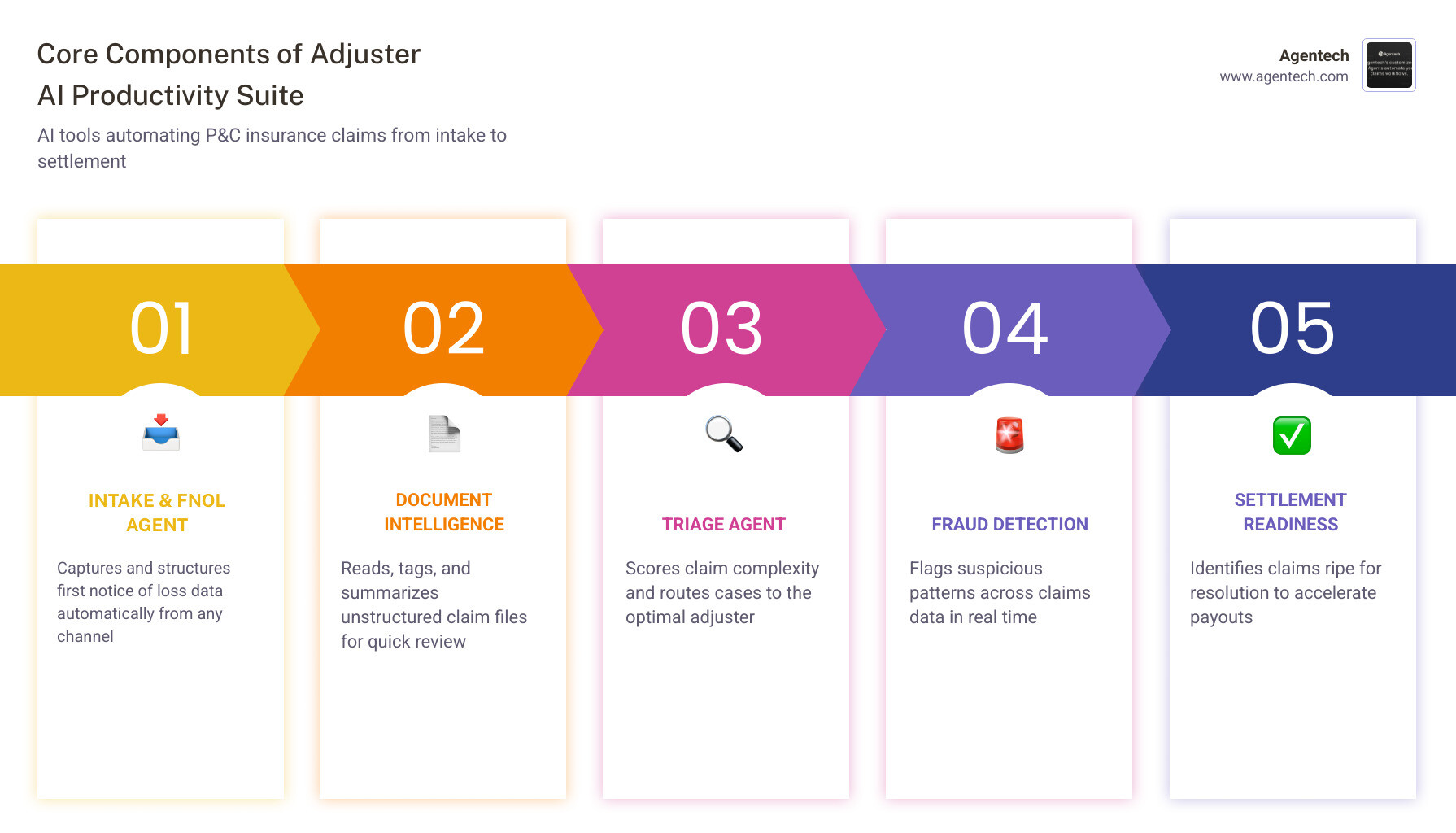
An Adjuster AI productivity suite is a set of specialized AI tools built to automate the routine, time-consuming tasks that slow down P&C insurance claims teams — from FNOL intake and document review to triage, fraud flagging, and settlement readiness.
Here is what a complete Adjuster AI productivity suite typically includes:
| AI Tool | What It Does |
|---|---|
| Intake & FNOL Agent | Captures and structures first notice of loss data automatically |
| Document Intelligence | Reads, tags, and summarizes unstructured claim files |
| Triage Agent | Scores claim complexity and routes to the right adjuster |
| Fraud Detection | Flags suspicious patterns across claims data |
| Settlement Readiness Signal | Identifies which claims are ripe for resolution |
| Compliance Monitor | Tracks regulatory requirements in real time |
The business case is hard to ignore. Claims handlers in P&C insurance currently spend roughly 30% of their time on low-value manual work like data entry and document review. AI-powered workflows have been shown to boost adjuster productivity by as much as 84%. For carriers, TPAs, and independent adjusting (IA) firms handling residential property, auto, pet, or workers' compensation claims, that time adds up fast.
The challenge is not whether AI can help. It is knowing which tools to combine, and how to build a suite that fits the way your team already works.
I'm Alex Pezold, founder of Agentech AI and a technology entrepreneur who previously built and scaled a data security platform before turning my focus to transforming P&C insurance claims through agentic AI. My work developing AI workforce solutions for carriers, TPAs, and IA firms gives me a front-row seat to what an effective Adjuster AI productivity suite actually looks like in production. In the sections below, I'll break down the tools, features, and strategies that matter most for claims teams ready to move faster without sacrificing accuracy.
Essential Features of an Adjuster AI Productivity Suite
A strong Adjuster AI productivity suite is not just one chatbot bolted onto claims software. It is a set of purpose-built tools that support the full P&C insurance claims lifecycle.
At Agentech, we think the essentials start with a few core capabilities:
- FNOL capture that turns calls, emails, forms, and attachments into structured claim data
- Document intelligence that reads unstructured files and surfaces what matters
- Triage logic that helps route claims by severity, complexity, and urgency
- Workflow orchestration that keeps tasks moving without manual chasing
- Compliance checks that reduce missed steps and inconsistent file handling
- Settlement readiness insights that help teams act sooner with better timing
If you are mapping your own suite, our AI Claims Processing Guide is a good place to start. For teams evaluating specialized tools, our AI Agents and full Product overview show how agentic AI can fit different workflows.

One important point: most claims data is messy. Adjusters work with photos, PDFs, repair documents, emails, recorded statements, handwritten notes, estimates, medical records, and policy language. A useful suite has to make sense of that chaos without forcing adjusters to become part-time data janitors.
That is where document intelligence matters. Good AI can extract fields, summarize long files, tag evidence, and point out missing information. Great AI does that in context, so an adjuster sees not just a document summary, but why it matters to coverage, liability, next steps, or settlement posture.
Settlement readiness is another underrated feature. Many teams move fast at intake but slow down later because they lack a clear signal for when a case is ready for action. Specialized tools such as Immediator for Claims Adjusters | AI Settlement Readiness Platform highlight why this layer matters: it helps claims teams make more defensible timing decisions instead of relying only on gut feel.
Maximizing Efficiency with an Adjuster AI Productivity Suite
The biggest productivity gains come from orchestration, not just automation.
In plain English: it is nice if AI can summarize one document. It is much better if AI can summarize the document, trigger the next task, update the file, draft a communication, and tee up the adjuster for the decision only a human should make.
That is the difference between isolated features and a real productivity suite.
Our resources on AI Assistant Productivity, AI Designed with Adjusters in Mind, and Agentic AI Tools all point to the same lesson: adjusters gain the most when AI removes administrative drag from the entire day, not just one task at a time.
Here are the core AI agent functions we see matter most for P&C insurance adjusters:
- Intake automation for FNOL data capture and claim setup
- Document reading, classification, and summarization
- Task creation and workflow follow-up
- Triage and routing recommendations
- Evidence gathering support
- Fraud and anomaly flagging
- Compliance reminders and audit trail support
- Communication drafting for policyholders, vendors, and internal teams
- Estimate and file prep support
- Settlement timing and next-best-action recommendations
A good suite gives adjusters administrative relief. A great one gives them their afternoons back.
Solving P&C Claims Challenges with Agentic AI
Claims teams do not need more dashboards to admire. They need fewer bottlenecks.
Manual paperwork remains a major issue across residential property, auto, pet, and workers' compensation claims. Intake data gets rekeyed. Documents get reviewed multiple times. Notes live in several places. Simple requests still require several clicks and a little patience bordering on spiritual practice.
That is why agentic AI matters. Instead of acting like a passive search tool, it works more like a digital co-worker. It can monitor for triggers, complete repetitive tasks, and keep processes moving in the background.
Our articles on Virtual AI Assistants for Insurance: Meet Your New Best Friend, Always-On AI Assistant, and Insurance Claims Adjuster Software explore this shift in more depth.

Here is how AI addresses the biggest claims pain points:
| Challenge | How AI Helps |
|---|---|
| Manual intake and data entry | Extracts and structures data from forms, emails, calls, and attachments |
| Paperwork overload | Reads and summarizes documents faster than manual review |
| Accuracy issues | Applies consistent rules, prompts for missing fields, and reduces rework |
| Fraud detection | Flags unusual patterns and inconsistencies across files |
| Claims leakage | Surfaces missed requirements, incomplete documentation, or weak file support |
| Slow cycle times | Moves routine work forward without waiting for manual touchpoints |
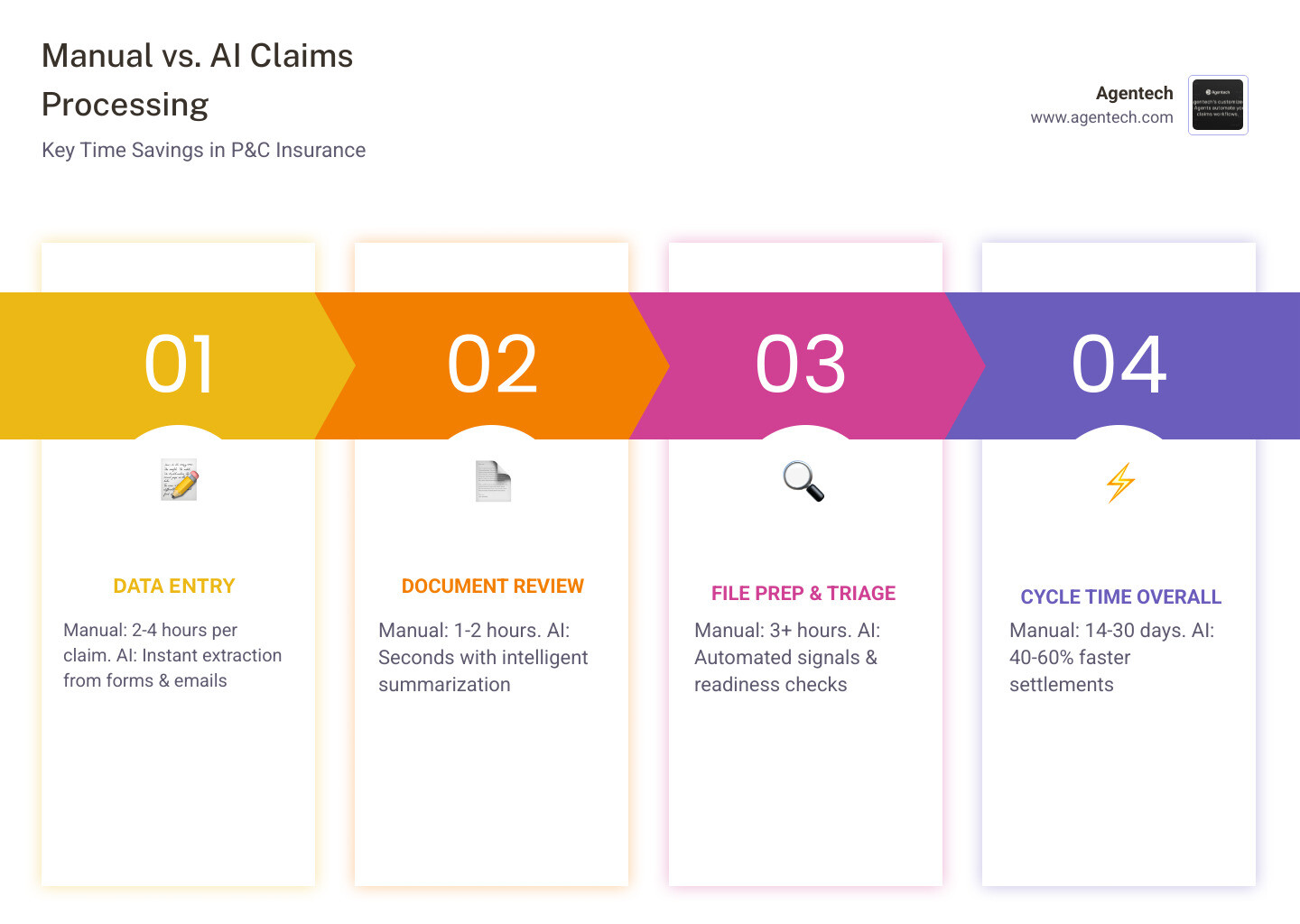
This matters because file quality and speed are connected. Poor documentation creates leakage. Leakage creates rework. Rework slows settlements and raises loss adjustment expense.
AI also supports fraud detection, especially when suspicious patterns are too subtle to spot in a single file. Research cited in our source set notes that about 10% of P&C claims are estimated to involve fraud. Humans are still essential for investigation and judgment, but AI is extremely useful as a screening layer that spots anomalies, cross-file patterns, and missing evidence.
Strategic Benefits of an Adjuster AI Productivity Suite
When teams implement the right suite, the benefits compound.
First comes time savings. Then better file consistency. Then lower cycle times. Then lower administrative costs. And then everyone starts wondering why they tolerated the old workflow for so long.
Based on the research, measurable gains from AI in claims operations can include:
- Up to 84% productivity improvement in AI-powered workflows
- 20% to 25% lower loss-adjusting expense potential from generative AI
- Major reductions in manual review time
- Lower error rates across the claims lifecycle
- Faster handling speeds and improved customer response times
For claims leaders focused on operating margin, those are not vanity metrics. They are real levers for reducing LAE and improving service at the same time.
Our guides to Claims Management Tools, AI for Insurance Agents, and AI Claims Agents show how these gains translate into practical workflows.
For policyholders, the experience also improves. Residential property claimants get quicker updates. Auto claimants spend less time waiting for status clarity. Pet claims can move faster through document-heavy review. Workers' compensation teams can handle routine file tasks more consistently while reserving human attention for complex claimant needs.
That is the sweet spot: lower cost, faster handling, better file quality, and a less frustrating experience for everyone involved.
Seamless Integration and Scalability for IA Firms, TPAs, and Carriers
No claims team wants an AI rollout that requires ripping out the current claims management software and starting from scratch. That is the technology version of replacing your roof because you needed a new gutter.
The good news is that modern agentic AI is typically designed to work with existing environments through APIs, workflow connectors, and embedded experiences.
That matters for teams using established claims management software and estimating tools. In practice, adjusters need AI to fit alongside the systems they already use for claim files, estimates, communications, and reporting. That may include enterprise claims platforms and property estimating tools used widely across P&C insurance operations.
When evaluating integration, we recommend asking:
- Can the AI read and write data to our claims management software?
- Can it work with existing document repositories and communication channels?
- Can it support estimate-adjacent workflows tied to platforms such as Xactimate, CCC One, or Guidewire ClaimCenter?
- Can it preserve audit trails and user permissions?
- Can it scale during catastrophe events without adding headcount?
For IA firms, TPAs, and carriers, scalability is where the business case gets even stronger. During CAT surges, claim volumes spike fast. Hiring and training enough temporary staff is expensive and rarely neat. AI helps absorb the administrative surge by handling first-pass intake, document sorting, summary generation, task routing, and communication support at scale.
That does not mean every catastrophe claim should be automated end to end. It means your experienced adjusters are no longer buried under repetitive file prep while the queue keeps growing.
This is especially useful in high-volume workflows, including pet insurance claims, where document-heavy intake and repetitive status handling can overwhelm teams. Enterprise-grade reporting also becomes more important as volume grows. Leaders need visibility into queue status, turnaround times, exception rates, and compliance exposure without waiting for manual reports.
Human Augmentation and the Future of Adjusting
Let us say the quiet part out loud: no serious claims leader wants an AI that replaces good adjusters.
The best use of an Adjuster AI productivity suite is augmentation. AI handles repetitive administrative work. Human adjusters handle empathy, judgment, negotiation, and complex decision-making.
That distinction matters because claims are not only operational events. They are human events. A family with water damage, a driver after an accident, a worker managing an injury claim, or a pet owner dealing with unexpected costs does not want to feel like they are trapped in a vending machine with a FAQ page.
AI cannot replace these core claims handling skills:
- Empathetic communication
- Credibility and trust building
- Complex coverage interpretation
- Negotiation strategy
- Ethical judgment
- Escalation handling
- Nuanced liability assessment
- Relationship management with claimants, repair partners, and counsel
What AI can do is free adjusters to use those skills more often.
This is why we consistently describe AI as a co-pilot, not a replacement. Our articles on AI Designed with Adjusters in Mind and Always-On AI Assistant explain that model well.
Looking ahead, the trend line is clear. Low-severity, rules-based claims will become more automated. Hyper-personalized communication will improve. Claims operations will rely more on AI-generated summaries, predictive triage, and next-best-action recommendations. But human-in-the-loop oversight will remain critical, especially for disputed, severe, sensitive, or high-value claims.
In other words, the future adjuster probably does less copying and pasting and more actual adjusting. Frankly, that sounds overdue.
Frequently Asked Questions about Adjuster AI
How does an Adjuster AI productivity suite improve ROI?
It improves ROI by saving adjuster time, reducing rework, improving file quality, lowering loss adjustment expense, and shortening claim cycle times.
The research is compelling: AI-powered workflows can boost productivity significantly, and generative AI may reduce loss-adjusting expenses by 20% to 25%. Even conservative gains matter. If a suite saves each adjuster several hours per week, reduces documentation errors, and speeds resolution, the return adds up quickly across a carrier, TPA, or IA firm.
The best ROI usually comes from:
- Faster file review
- Lower administrative workload
- Better compliance consistency
- Reduced leakage
- Better prioritization of high-impact claims
- More claims handled without proportional headcount growth
Can AI integrate with existing claims management software?
Yes, in many cases it can.
Modern AI tools are often deployed through APIs and connectors that allow them to sit on top of existing claims management software rather than replace it. That is important for carriers, TPAs, and IA firms that already rely on established systems for file handling, estimating, and reporting.
When evaluating fit, look for:
- API flexibility
- Real-time or near-real-time synchronization
- Support for role-based permissions
- Auditability
- Modular deployment options
- Compatibility with your current workflow and data structure
A phased rollout usually works best. Start with one friction point, such as intake, document review, or triage, then expand.
Does AI replace human adjusters in P&C insurance?
No. It should not, and in practice it does not.
AI is best used to automate administrative tasks, support analysis, and recommend next steps. Human adjusters still own final decisions, claimant interactions that require empathy, complex investigations, negotiation, and ethical judgment.
A strong co-pilot model means:
- AI handles repetitive work
- Humans review important outputs
- Adjusters stay in control of final decisions
- Teams gain speed without losing accountability
That is the model we believe in because it reflects how real claims operations work.
Conclusion
Building a high-performing Adjuster AI productivity suite is really about one thing: removing friction from the claims process without removing the human strengths that make adjusting work.
For P&C insurance carriers, TPAs, and IA firms, the practical path is clear. Start with the biggest bottlenecks. Add AI where manual work is eating time. Integrate with your existing claims management software. Keep humans in the loop. Then expand from isolated automation to a connected, always-on productivity layer.
That is the approach we take at Agentech. We build AI tools for operational excellence in P&C insurance claims, with seamless integration and digital co-workers that help teams move faster, stay more consistent, and scale without chaos.
If you are ready to modernize your claims operation, explore our AI Agents and see how agentic AI can help your team handle more claims with less friction.
Citations
- AI Claims Processing Guide
- AI Agents
- Product
- AI Assistant Productivity
- AI Designed with Adjusters in Mind
- Virtual AI Assistants for Insurance: Meet Your New Best Friend
- Always-On AI Assistant
- Insurance Claims Adjuster Software
- Claims Management Tools
- AI for Insurance Agents
- Agentic AI Tools
- AI Claims Agents
- Immediator for Claims Adjusters | AI Settlement Readiness Platform