

Why the P&C Insurance Industry Is Racing to Adopt AI
AI for insurance claims processing is changing how P&C insurance carriers, TPAs, and Independent Adjusting firms manage the entire claims lifecycle. By leveraging AI, these organizations can automate data entry, accelerate processing through intelligent triage, detect fraud with greater accuracy, and reduce operational costs. AI augments adjusters by handling routine tasks, freeing them to focus on complex cases that require human judgment.
Key technologies like Machine Learning, Natural Language Processing (NLP), Computer Vision, and Generative AI are at the core of this shift.
For P&C insurance carriers, traditional manual processes create bottlenecks that frustrate customers and drain resources. Claims handlers often spend a third of their time on low value administrative work. This inefficiency contributes to customer dissatisfaction, with many policyholders citing slow settlement times as a primary issue.
The financial impact is significant. Poor claims experiences could put up to $170 billion in global P&C insurance premiums at risk by 2027 [1], while fraudulent claims cost the U.S. P&C insurance industry over $45 billion annually. While traditional automation has helped, it cannot handle the unstructured data common in claims files.
AI changes this equation. Insurers adopting claims management powered by AI are seeing significant cost savings, processing claims in minutes instead of weeks, and dramatically improving customer satisfaction.
I'm Alex Pezold, founder of Agentech AI. We're building the AI workforce for P&C insurance, starting with *AI for insurance claims processing in the pet insurance sector and expanding across Property & Casualty lines such as residential property, auto, and workers' compensation. After building and exiting TokenEx, I'm now focused on solving the P&C insurance industry's most pressing operational challenges.*
This guide explains how AI is reshaping P&C insurance claims, the technologies involved, the benefits carriers are seeing, and how to implement these solutions without disrupting existing systems.
The Bottleneck: Why Traditional P&C Claims Processing Is Broken
The traditional P&C insurance claims process is often burdened by manual, inefficient workflows. This reality creates significant challenges, impacting operational costs and customer satisfaction.

At the core of the problem is the high volume of manual tasks. Claims professionals working in P&C insurance carriers, TPAs, and IA firms dedicate much of their day to low value work like data entry and document review [24]. This administrative load increases operational costs and leads to slow settlement times.
Industry reports show that many policyholders are dissatisfied with their Property & Casualty claims experience, with settlement speed being a primary complaint [1]. This frustration stems directly from inefficient processes, causing policyholders to grow impatient and carriers to risk losing business.
Furthermore, manual processes are susceptible to human error, which can lead to inconsistent decisions and claims leakage. Fraudulent claims, a problem costing multiple billions of dollars, can be missed during manual reviews [13]. These challenges are intensified by labor shortages in P&C insurance operations, making it difficult to manage growing claim volumes [16]. The result is a system that is expensive, slow, and fails to meet customer expectations, highlighting the need to reduce administrative burden.
The Solution: How AI for P&C Insurance Claims Processing Works
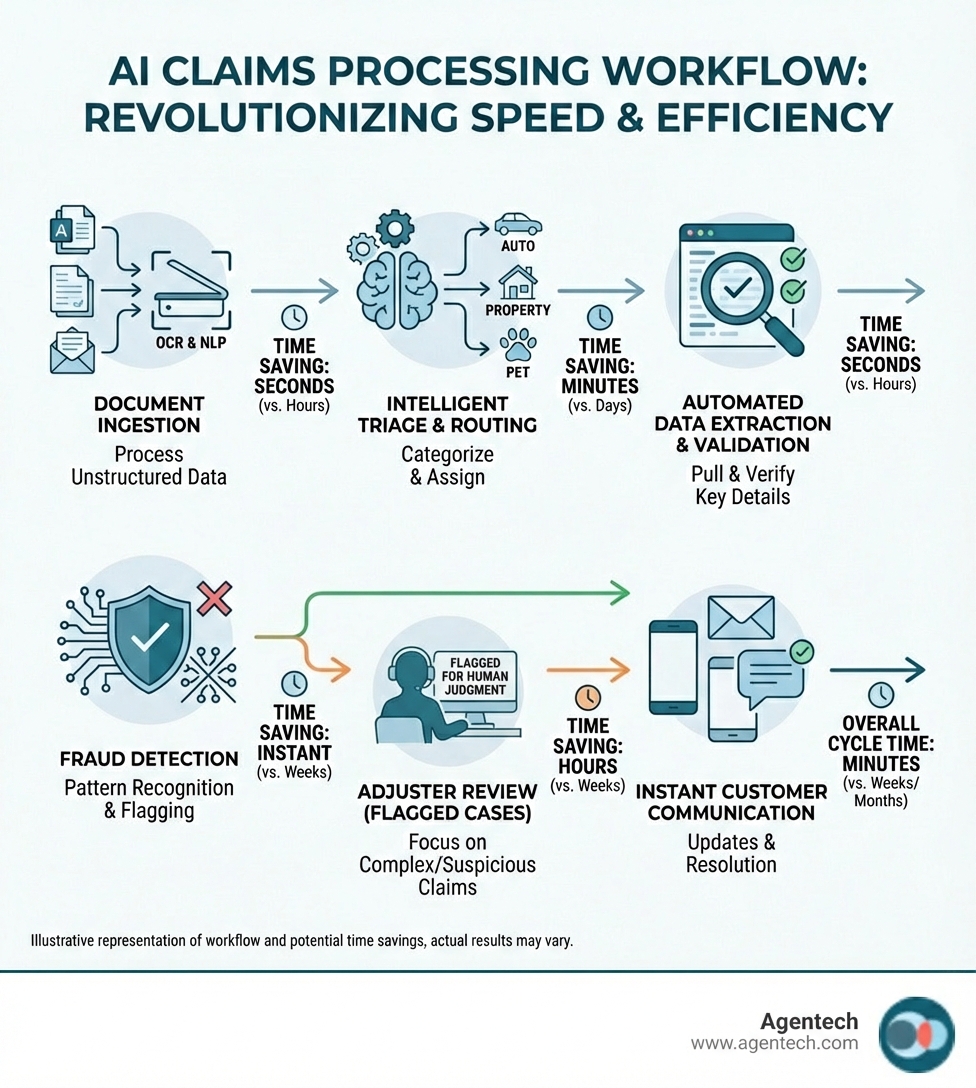
Enter AI for insurance claims processing, a solution that transforms bottlenecks into streamlined workflows. Platforms driven by AI bring intelligent automation to every stage of the P&C claims lifecycle, from data ingestion to final adjudication.
At its core, AI combines with technologies like Robotic Process Automation (RPA) and machine learning (ML) to automate business processes. This allows AI agents to handle repetitive digital tasks, freeing human adjusters for more complex, empathetic work.
For example, when a First Notice of Loss (FNOL) is received for a residential property, auto, pet, or workers' compensation claim, AI can immediately begin processing. It ingests data, triages the claim based on severity, and can even initiate automated claims adjudication software for simple cases. The goal is faster, more accurate P&C claims resolution. Our Agentech Claims Adjustment Agent is designed to do just this.
From Rules to Intelligence: AI vs. Traditional Automation
To appreciate AI's power, it is useful to compare it with traditional automation based on rules.
Rules based systems use static, predefined logic. They work well for simple, consistent tasks but struggle with the unpredictable nature of P&C claims data. Because most claims information is unstructured, these systems cannot easily adapt to nuances in a police report or interpret a handwritten note.
Systems based on AI, however, use machine learning to make dynamic decisions. They learn from vast datasets to identify patterns and continuously improve. This allows them to handle unstructured data, analyze context, and make recommendations. It is the difference between following a script and understanding a conversation. This distinction is crucial, as many traditional claims software solutions rely on automation based on rules, while true AI offers a more intelligent, adaptive approach [6].
Here is a quick comparison:
| Feature | Rules Based Automation | AI Based Automation (Machine Learning) |
|---|---|---|
| Data Handling | Structured data only; struggles with variations | Handles structured and unstructured data; adapts to variations |
| Decision Making | Static, predefined rules; "if then" logic | Dynamic, learned patterns; predictive and adaptive |
| Learning | No learning; requires manual updates | Continuous learning from new data; self improving |
| Scalability | Limited; complex rules can become unmanageable | Highly scalable; handles increasing complexity efficiently |
| Error Handling | Fails on unexpected inputs; high manual intervention | More robust to variations; reduces manual intervention |
| Use Case | Repetitive, highly predictable tasks | Complex, variable tasks requiring interpretation and prediction |
Key AI Technologies Changing P&C Claims
The power of AI for insurance claims processing comes from a suite of technologies working together to solve challenges for P&C insurance carriers, TPAs, and IA firms.
- Predictive Analytics: Uses historical P&C claims data to forecast events, such as predicting claim severity, estimating settlement costs, or identifying fraud risks.
- Chatbots and Virtual Assistants: Provide 24/7 customer support, answer common questions, and guide policyholders through P&C claims submission, offering instant, personalized assistance [15].
- Image Recognition and Computer Vision: Analyze photos and videos of damage in residential property and auto claims to identify damage types, estimate repair costs, and detect inconsistencies [26].
- Natural Language Processing (NLP): Enables AI to understand and interpret human language from unstructured sources like adjuster notes, medical reports, and customer communications to extract key information.
- Generative AI: Creates new content, such as claim summaries or draft communications, to accelerate the claim lifecycle [26].
- Agentic AI: Represents autonomous AI agents that perform multistep tasks and make decisions to achieve a goal. These digital coworkers can handle complex workflows from start to finish [8], representing the cutting edge of AI applications in P&C insurance claims processing.
Taming the Chaos: How AI Processes Unstructured Data
A challenge in P&C claims is the volume of unstructured data, including police reports, adjuster notes, photos, invoices, and emails. Extracting information from these sources has traditionally been a manual and process prone to error.
AI excels at this. It uses a combination of technologies to make sense of this data:
- Optical Character Recognition (OCR): Converts scanned documents and images into machine readable text.
- Natural Language Processing (NLP): After OCR, NLP understands the content, identifying key entities and extracting relevant facts.
- Computer Vision: For visual data, algorithms can identify objects, assess damage, and flag inconsistencies.
This combination transforms unstructured documents into actionable, structured data. For example, an AI system can digitize a police report with OCR, then use NLP to extract the date of loss and a summary of the incident. It can also perform image cleansing to improve file quality [25]. This process is central to P&C insurance document processing automation, allowing for rapid integration of diverse information into P&C claims management software.
The Tangible Impact: Core Benefits of AI in P&C Claims Management
Adopting AI for insurance claims processing delivers measurable benefits that improve the bottom line and the customer experience. For P&C insurance carriers, TPAs, and IA firms, these advantages are too significant to ignore.
The core benefits center on operational efficiency, accuracy, and customer satisfaction. AI enables efficient claims handling, leading to significant cost reductions. Studies show that P&C insurers can achieve millions in annual savings through improved claims processing and fraud detection by automating tasks and reducing manual intervention.
Accuracy is another major win. AI's ability to analyze vast datasets surpasses human capabilities, leading to more precise claim validations and reduced leakage. This helps with customer retention, as fair and accurate settlements build trust.
Accelerating Resolution and Slashing Costs
One of the most immediate benefits of AI in P&C claims is the dramatic acceleration of resolution times and the associated cost savings.
- Straight Through Processing (STP): AI enables a much higher percentage of P&C claims to be processed without human intervention, reducing processing times from weeks to minutes for many claims.
- Reduced Cycle Times: Claims that once took days can now be settled in hours. For example, some insurers using AI have reduced average settlement times to less than 24 hours [13]. This speed is crucial for customer satisfaction.
- Lower Administrative Overhead: By automating repetitive tasks like data entry and initial triage, AI reduces the administrative burden on P&C claims teams. This is a key aspect of automated claims processing.
- Optimized Resource Allocation: AI can prioritize claims based on severity and complexity, ensuring human adjusters focus where they are most needed.
Overall, time savings for P&C claims professionals can be substantial, depending on the claim type [26]. These efficiencies lead to cost reductions and faster outcomes for policyholders, delivered by faster claims resolution tools.
Enhancing Accuracy and AI-Powered Fraud Detection
Fraud is a persistent, costly problem in the P&C insurance industry, costing insurers billions annually [13]. AI offers powerful capabilities in fraud detection and prevention.
- Anomaly Detection and Pattern Recognition: AI models analyze data from various sources to identify unusual patterns and inconsistencies that may indicate fraud, going beyond what simple checks based on rules can uncover.
- Data Enrichment: AI can cross reference internal P&C claims data with external sources to verify information and identify red flags.
- Reduced Leakage: By accurately detecting fraudulent claims, AI significantly reduces claims leakage, which refers to overpayments or payments on invalid claims.
- Subrogation Identification: AI can also identify subrogation opportunities by analyzing claim details to pinpoint liable third parties, helping insurers recover costs.
Fraud detection driven by AI is highly effective, with studies showing it can improve detection rates significantly compared to traditional systems [13]. This precision, powered by P&C insurance claims machine learning, helps P&C insurance carriers protect their assets.
Creating a Superior Customer Experience with AI for P&C Claims Processing
In the competitive P&C insurance market, customer experience is paramount. AI for insurance claims processing is a powerful tool for exceeding policyholder expectations.
- 24/7 Support and Chatbots: Chatbots powered by AI provide immediate, round the clock support, answering questions and guiding users through the P&C claims process [15].
- Personalized Communication: AI can tailor communications, ensuring policyholders receive relevant and empathetic messages.
- Proactive Updates: AI systems can proactively send notifications about claim progress, keeping customers informed and reducing anxiety.
- Faster Payments: By accelerating the entire process, AI leads to faster settlements, a key factor for policyholder satisfaction [1].
- Increased Transparency: AI can provide clear explanations for decisions, building confidence in the insurer's fairness.
By streamlining the P&C claims journey, AI helps carriers deliver a superior level of service and frees up human adjusters for more empathetic engagement.
The Human Element: Navigating Risks and the Future of Adjusters
While the benefits of AI for P&C insurance claims processing are immense, the narrative is not one of replacement, but of augmentation. AI is a copilot designed to empower adjusters to focus on higher value work.
However, integrating AI comes with responsibilities. P&C insurance carriers, TPAs, and IA firms must manage risks related to data security, ethics, and compliance. Successful adoption also requires change management and a commitment to upskilling the workforce. With an aging P&C insurance workforce, AI can make existing staff more productive and attract new talent to a modern, technology forward industry [16, 25].
AI as a Copilot: The Role of Human Expertise
In P&C claims, AI functions as an intelligent assistant, a digital coworker, designed to augment human expertise, not render it obsolete.
- Augmentation, Not Replacement: AI handles repetitive, tasks that are data intensive like data entry and document review. This frees up adjusters to focus on tasks requiring human judgment, empathy, and negotiation [17].
- Complex Claims: For intricate Property & Casualty cases, including residential property, auto, pet, and workers' compensation claims, human adjusters remain indispensable. AI provides data summaries and flags issues, but the final strategic decisions and nuanced negotiations are best handled by a seasoned professional.
- Empathy and Negotiation: AI lacks the capacity for human empathy, which is crucial when dealing with policyholders in distress. The art of negotiation and building rapport are uniquely human strengths.
- Upskilling the Workforce: As AI takes over routine tasks, adjusters can evolve into more strategic roles. This requires training to leverage AI insights effectively, moving them toward oversight and complex problem solving.
Mitigating Risks: Data Security, Ethics, and AI Regulation
Adopting AI for P&C insurance claims processing requires addressing critical considerations around data security, ethics, and regulatory compliance to build trust and ensure responsible deployment.
- Data Privacy and Security: P&C claims data is highly sensitive. Implementing AI requires robust data encryption, secure storage, and strict access controls to protect against breaches and comply with regulations like GDPR and CCPA.
- AI Bias: AI models learn from data, and if that data is biased, the AI can produce unfair outcomes. Mitigation strategies include using diverse training data, fairness aware algorithms, and continuous monitoring.
- Model Explainability: For AI to be trustworthy, its decisions must be explainable. This means understanding why an AI reached a conclusion, ensuring transparency and auditability.
- Regulatory Compliance and Governance: The regulatory landscape for AI in P&C insurance is evolving. Insurers must stay current on guidelines from bodies like the NAIC [19] and establish strong internal governance frameworks to ensure compliance [20].
Proactively addressing these risks is essential for the long term, responsible use of AI.
The Next Wave: Emerging Trends in AI for P&C Claims Processing
The evolution of AI for P&C claims processing is ongoing. Staying ahead of these trends is key to maintaining a competitive edge.
- Generative AI: Beyond analysis, Generative AI is used to create content, such as drafting FNOL reports, summarizing medical records, or generating personalized customer communications for P&C claims [21, 26].
- Agentic AI: This is an exciting frontier where Agentic AI systems can autonomously perform multistep tasks. Imagine an AI agent that not only identifies damage but also orders repairs and updates policyholders through your claims management software.
- Hyperautomation: This trend combines AI, RPA, and other technologies to automate as many P&C claims processes as possible, creating end to end workflows with minimal human touchpoints.
- IoT Integration and Telematics: Data from IoT devices and telematics provides rich new information for P&C claims. AI can analyze this real time data to accelerate FNOL, verify claims, and predict losses.
These trends point to a future where Property & Casualty claims processing is more intelligent, proactive, and seamlessly integrated.
Frequently Asked Questions about AI in P&C Claims
How does AI handle complex P&C claims that require human judgment?
AI automates the routine, tasks that are data intensive, freeing up human adjusters to focus on high value activities. For complex Property & Casualty cases like liability determination in a workers' compensation claim, the AI acts as a digital coworker, summarizing evidence and flagging key points, but the final strategic decision remains with the experienced professional.
What is the difference between generative AI and agentic AI in claims?
Generative AI, like the technology in ChatGPT, is excellent at creating content, such as summarizing adjuster notes or drafting customer communications. Agentic AI takes this a step further; it can autonomously perform multistep tasks and make decisions to complete a process, like creating a P&C claim profile, ordering a police report, and scheduling an inspection.
How can our firm get started with AI without replacing our core systems?
The best approach is to adopt AI solutions that integrate seamlessly with your existing P&C claims management software. Look for platforms that use APIs to connect to your systems, allowing you to augment your current workflows with AI capabilities rather than undergoing a costly and disruptive "rip and replace" project.
Conclusion
The shift toward AI for P&C insurance claims processing is not about replacing human expertise but augmenting it. By automating repetitive administrative work, AI empowers adjusters to focus on what they do best: managing complex claims, negotiating settlements, and providing empathetic customer service. This human centric approach to automation drives massive gains in efficiency, accuracy, and policyholder satisfaction. For P&C carriers, TPAs, and IA firms, embracing this technology is no longer a future consideration but a present necessity for staying competitive. Agentech is at the forefront of this revolution, providing the tools to make this change a reality.
Discover how AI Agents can become your digital coworkers
Citations
- Accenture. (2022). Poor claims experiences could put up to $170B of global insurance premiums at risk by 2027. Link
- Agentech. Reduce Administrative Burden. Link
- Agentech. Insurance Workflow Automation Software. Link
- Agentech. Automated Claims Adjudication Software. Link
- Agentech. Agentech Claims Adjustment Agent. Link
- Agentech. SaaS vs. AI. Link
- Agentech. AI Applications in Insurance Claims Processing. Link
- Agentech. Agentic AI Definition. Link
- Agentech. Insurance Document Processing Automation. Link
- Agentech. Efficient Claims Handling. Link
- Agentech. Faster Claims Resolution Tools. Link
- Agentech. Automated Claims Processing. Link
- Association of British Insurers. (2024). Fraudulent claims cost insurers billions. Link
- Agentech. Insurance Claims Machine Learning. Link
- Agentech. AI Customer Service Insurance. Link
- Agentech. Solving the Insurance Labor Crisis with AI-Driven Innovation. Link
- Agentech. AI Designed With Adjusters in Mind. Link
- Agentech. The Future of Work in Insurance: Embracing AI Agents as Digital Coworkers. Link
- Agentech. NAIC AI Model Guidance. Link
- Agentech. AI in Insurance: Balancing Innovation and Regulation. Link
- BCG. (2023). GenAI Will Write the Future of Insurance Claims. Link
- Agentech. Changing Insurance Claims: The Evolution from Generative AI to Agentic AI. Link
- Agentech. Insurance Claims Solutions. Link
- J.D. Power. (2024). Claims handler productivity and policyholder satisfaction research.
- EY. (2022). Changing Insurance Claims Processing with AI-Powered Document Intelligence.
- Oliver Wyman. (2024). Generative AI and the Future of Claims Management. Link