

Moving Beyond the Paperwork Pile
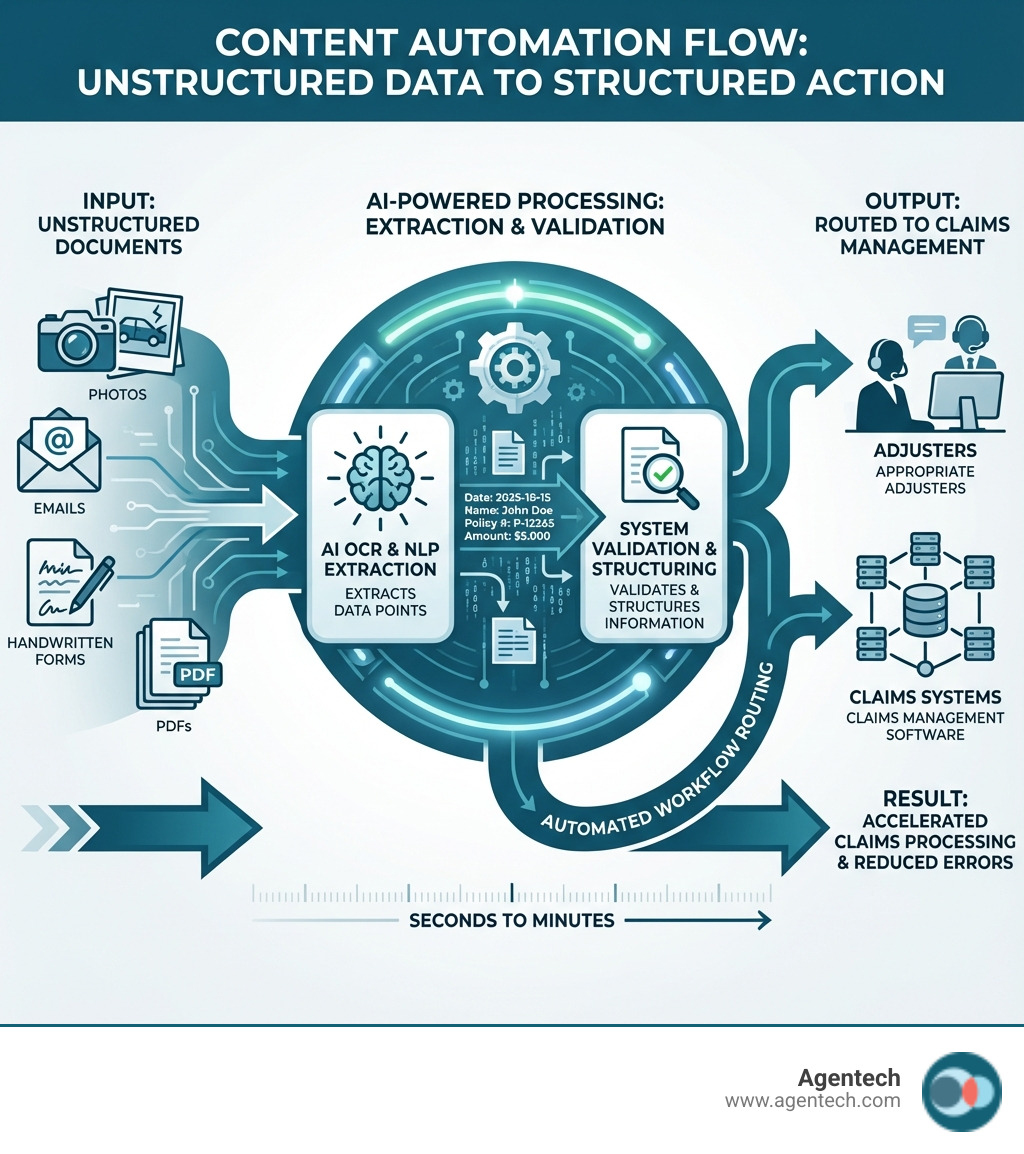
Content automation in insurance services industry transforms how Property & Casualty (P&C) carriers, Third-Party Administrators (TPAs), and Independent Adjusting (IA) Firms handle documents and data. At its core, it uses artificial intelligence and software to automatically process, extract, validate, and route information from claims forms, policy applications, photos, emails, and other documents without manual intervention.
Here's what content automation delivers for P&C insurance operations:
- Document Processing: AI extracts data from unstructured sources like handwritten claims forms, damage photos, medical reports, and scanned PDFs
- Workflow Automation: Software automatically routes documents, assigns tasks, triggers approvals, and manages the entire claims lifecycle
- Data Validation: Systems verify information against policy details and flag inconsistencies for review
- Communication: Automated generation of status updates, claim summaries, and customer notifications
- Speed and Accuracy: Claims processing times drop from days to minutes while reducing errors by up to 40%
The P&C insurance industry is awash in documents. Handwritten claims, policy applications, medical reports, emails, and compliance records pour into P&C carriers daily. For decades, manually processing this content has been a bottleneck that slows down claims and frustrates customers. Claims managers, adjusters, and back office teams spend up to 40% of their time on activities that are not core like data entry, document sorting, and verification rather than actually evaluating claims and serving policyholders.
Traditional manual processing creates real problems:
- Slow turnaround times that damage customer satisfaction
- High error rates from repetitive data entry
- Inability to scale during catastrophic events when claim volumes spike
- Compliance risks from missed information or delayed regulatory reporting
- Premium leakage from inaccurate data capture
Content automation in insurance services industry addresses these challenges directly. It turns unstructured content like photos of vehicle damage or handwritten incident reports into structured data that flows automatically into your claims software. This change enables straight through processing for routine claims, frees adjusters to focus on complex cases, and delivers the speed customers now expect.
I'm Alex Pezold, founder of Agentech AI, where we're building the AI workforce for P&C insurance by deploying content automation in insurance services industry specifically designed for claims processing. After founding and successfully exiting TokenEx in 2021, I've focused on applying AI to solve the document and data challenges that have long plagued P&C insurance operations.
The Core of Content Automation in P&C Insurance Services: Benefits and Types
The landscape of Property & Casualty (P&C) insurance is undergoing a significant change, driven by an increasing demand for efficiency, accuracy, and superior customer experience. At the heart of this evolution is content automation in insurance services industry, a powerful suite of technologies designed to streamline operations and open up new levels of productivity. As we've seen, manual processing of documents in P&C insurance is not only slow but has become a liability, often leading to high maintenance costs, frequent data loss, and workflow interruptions [1]. Implementing document automation is becoming essential for all P&C insurance businesses [1].
The Primary Benefits for P&C Carriers, TPAs, and IA Firms
For P&C carriers, TPAs, and IA firms, the benefits of embracing content automation are multi-faceted and impactful:
- Reduced Manual Effort and Operational Costs: Automation completely replaces manual data entry when processing submissions, eliminating the need for tedious, repetitive tasks [1]. This frees up human resources for more strategic activities, leading to significant cost savings. Case studies have shown up to a 200% increase in ROI within the first year of RPA deployment in financial services [4].
- Fewer Errors and Improved Data Accuracy: Manual processes are inherently prone to human error, which can lead to costly mistakes, compliance gaps, and penalties. Automated systems, especially those powered by AI, ensure consistent data capture and validation, drastically reducing inaccuracies. For example, some carriers using digital automation have experienced accuracy rates of over 99% when extracting policy level data from submissions.
- Improved Compliance and Risk Management: Automated document processing promotes compliance by consistently capturing accurate, complete data and creating audit trails. This minimizes the risk of missed information or delayed regulatory reporting, which is crucial in a heavily regulated industry. Data breaches remain a significant threat to the P&C insurance industry, with 1,832 incidents and 480 confirmed data disclosures in 2023 alone [3]. Automation can improve data security by implementing robust protocols.
- Faster Claims Cycles and Scalability During CAT Events: Document generation and template based automation are useful for tasks with sensitive turnaround times, reducing manual effort and saving time [1]. Automated workflows expedite the claims resolution process, leading to improved customer satisfaction. This speed is particularly critical during catastrophic events, allowing P&C insurers to handle surges in claim volumes without being overwhelmed.
- Better Customer Experience and Satisfaction: Customers expect speed and transparency. Automation enables P&C insurers to conduct risk assessments quickly and accurately, making the customer onboarding experience far smoother. Automated workflows expedite claims resolution, leading to improved customer satisfaction. As the industry shifts toward AI driven efficiency, those who accept document automation will gain a significant edge in speed, accuracy, and customer service [1]. We believe that customer satisfaction scores can rise significantly after sales automation change [3].
- Increased Adjuster Productivity: By handling bulk, simpler document reviews, automation frees up employees to focus on more sensitive or unique issues. This means adjusters can dedicate their expertise to complex cases, negotiations, and providing empathetic service, rather than getting bogged down in paperwork. Our AI powered tools are designed with adjusters in mind, boosting their productivity without replacing their critical human decision making.
For more insights into how automation can revolutionize your back office, explore our resource on Insurance Back Office Automation.
Key Types of Content Automation
Content automation in insurance services industry isn't a single solution but a spectrum of technologies working in concert. Here are the key types relevant to P&C insurance:
- Document Generation: This involves the automatic creation of standardized insurance documents such as quotes, binders, policies, and endorsements. It often uses templates with dynamic fields, pulling data from existing systems to populate documents accurately and quickly [1]. This is essential for tasks with sensitive turnaround times, reducing manual effort and saving precious time [1].
- Data Extraction Automation: This powerful type of automation turns unstructured content into structured data using AI [1]. It employs technologies like Optical Character Recognition (OCR), Natural Language Processing (NLP), and machine learning to ingest, interpret, and extract critical data points from a wide range of formats, including scanned documents, handwritten forms, emails, and even photos of vehicle damage. This completely replaces manual data entry when processing submissions, handling time sensitive tasks accurately and quickly [1].
- Workflow Automation: This orchestrates the flow of documents and tasks through various stages of a process. It defines sequences of actions or tasks within P&C insurance software that are triggered automatically based on specific conditions or events [2]. Workflow automation speeds up and tracks all operations in the P&C insurance industry, making the route of a document easily traceable [1]. This can include automatically routing submissions to the right underwriter, escalating claims, or triggering compliance reviews.
- Document Assembly Automation: Typically used for complex documents such as legal documents or comprehensive P&C policies, this automation allows P&C insurers and underwriters to create and deliver intricate documents by assembling multiple input components without spending hours on it [1]. It ensures consistency and accuracy across complex policy wordings and clauses.
- Template based Automation: Similar to document generation, this focuses on managing and distributing templates for commonly used documents. It empowers non technical teams to create advanced documentation efficiently, ensuring brand consistency and regulatory compliance across all communications [1].
Our AI solutions are designed with the adjuster in mind, leveraging these automation types to improve their capabilities. Learn more about our approach to AI Designed With Adjusters In Mind.
How AI Lifts Automation Across the P&C Insurance Value Chain
Artificial Intelligence (AI) is not just a buzzword; it is the engine powering the most advanced forms of content automation in insurance services industry. AI improves predictive modeling, automates complex tasks, and significantly improves customer interactions [1]. It reduces manual effort, meets turnaround times, and allows experts to focus on their expertise instead of paperwork [1].
The integration of AI technologies like Machine Learning (ML), Natural Language Processing (NLP), and Optical Character Recognition (OCR) is fundamental to this advancement. OCR converts images of text into machine readable text, while NLP allows computers to understand, interpret, and generate human language. ML enables systems to learn from data and improve performance over time. Together, these technologies allow AI powered platforms to automatically classify documents and extract critical data points from a wide range of forms, both structured and unstructured.
A more recent development is the emergence of Agentic AI and Generative AI. Generative AI, with its ability to generate text, images, or other content, can be applied across five key domains in P&C insurance: summarization, classification, generation, extraction, and question answering [6]. This means it can summarize policy documents, classify claims requests, generate marketing content, extract information from reports, or answer policy related questions [6]. Agentic AI takes this a step further. It uses large language models (LLMs) and intelligent agents to break down complex tasks into manageable actions, plan their implementation, and adapt strategies in real time [5]. This is a quantum leap from traditional AI, offering systems that can independently reason, plan, learn from outcomes, and adapt strategies, essentially acting as virtual coworkers [5].

AI driven automation reduces the need for human intervention and increases processing speed. Modern automated document processing platforms can handle unstructured documents like emails, letters, photos, handwritten forms, and scanned PDFs, changing them into actionable data.
To understand how AI is specifically revolutionizing claims processing, dig into our insights on AI Claims Processing System.
Key Use Cases for Content Automation in P&C Insurance Services
Content automation, boosted by AI, is reshaping every stage of the P&C insurance value chain, delivering tangible benefits to carriers, TPAs, and IA firms.
- Underwriting: This is a critical area for P&C insurance, where accurate risk assessment is paramount. AI driven automation helps conduct risk assessments quickly and accurately, making the customer onboarding experience far smoother. It can automatically collect data from multiple sources for more objective pricing, reduce time needed to validate brokers and submissions, and triage new business to allow underwriters to prioritize value creating work. For example, some P&C insurers have seen their ACORD form processing time drop from over ten minutes to less than two minutes per document. AI also enables the adoption of usage based insurance (UBI) by keeping up with daily adjustments in how customers use their insurance.
- Claims Processing: From the First Notice of Loss (FNOL) to final resolution, automation streamlines the entire claims journey. It removes friction from key steps such as intake, validation, adjudication, and resolution. Automated document processing helps your company reduce its reliance on manual tasks, improves processing speed, and reduces inaccuracies. Most P&C insurers in the Nordic region have already automated their "volume claims" such as theft, minor property damage, or travel losses, demonstrating proven efficiency [1]. The automation of complex claims holds the promise of greater efficiency, increased accuracy, and reduced processing times [1]. Our AI powered agents are designed to handle the tedious, time consuming tasks in claims processing, allowing adjusters to focus on what they do best.
- Policy Management: This encompasses a broad range of activities from issuance to renewals and modifications. Automation can handle various tasks efficiently, reducing manual intervention and potential errors. It streamlines administrative tasks, ensures compliance, and provides 24/7 customer access to policy documentation and service requests [2]. This includes auto generating quotes, binders, policies, and endorsements [1].
- Customer Service: Automation significantly improves customer interactions. Automated workflows enable P&C insurers to provide immediate or near immediate responses, which customers increasingly expect. Chatbots and virtual assistants can handle simple inquiries, answer FAQs, and provide 24/7 support, freeing human agents to focus on complex, empathetic interactions [2, 7]. Generative AI can assist contact center agents by reducing document search time and summarizing information, leading to increased productivity [7].
Our agentic AI solutions are changing how P&C insurers operate, with bots becoming true digital agents. Find more about Agentic AI in Insurance: When Bots Become Your Best Agents.
Navigating the Path to Implementation: Challenges and Strategic Solutions
While the benefits of content automation in insurance services industry are clear, the path to implementation isn't always smooth. P&C insurers face several problems, from integrating with existing systems to ensuring data security and managing employee adoption.
Addressing Legacy Systems and Integration
One of the most significant challenges for P&C insurers is the prevalence of legacy systems. Many P&C insurers have been hamstrung by traditional systems that might date back to the 1960s and 1970s [7, 8]. These monolithic platforms were so mission critical that it became nearly impossible to make changes in the ensuing decades. Making a single digit change within pricing in a legacy system can take weeks or even months to complete. These systems come with downsides, including high maintenance costs, frequent data loss, and workflow interruptions [1].
However, modern automation offers solutions. By automating various processes, P&C insurers can deconstruct these systems into more composable elements, paving the way for digital change. Cloud based systems are increasingly replacing legacy systems due to their flexibility and scalability [1]. A key enabler for this is API driven integration. Leading automation platforms integrate with existing claims software and other core systems through APIs and connectors, allowing for a seamless flow of information without a complete overhaul. Robotic Process Automation (RPA) can also bridge the gap between disparate legacy systems by processing actions at the mouse and keyboard level, effectively extending their life until new systems are implemented [4].
The decision of whether to buy an off the shelf SaaS solution or build custom automation tools is also critical. While building offers customization, buying often provides faster implementation and access to proven technologies. For a deeper dive into this strategic choice, refer to our guide on Buy vs. Build: Navigating the SaaS AI Technology Decision.

Overcoming Challenges in Content Automation in P&C Insurance Services
Beyond legacy systems, P&C insurers must strategically address other challenges to ensure successful content automation adoption:
- Starting with a Proof of Concept (PoC): To mitigate risk and demonstrate value, begin with a small scale implementation designed to validate your architecture and technology stack for a specific use case. The goal is to learn and improve, not achieve perfection.
- Moving onto a Lighthouse Project: After a successful PoC, undertake a more ambitious task with a broader scope and realistic setting. This "lighthouse project" should aim to solve a real business problem, serving as a guide for future automation initiatives and demonstrating value to stakeholders.
- Establishing an Automation Center of Excellence (CoE): As you progress on your automation journey, a guiding force is essential. A CoE is a dedicated team responsible for assessing current solutions, evaluating tools, providing training, and assisting teams with their use cases. It empowers teams to drive automation efforts rather than becoming a bottleneck.
- Ensuring Data Security and Compliance: With increased automation comes a greater need for robust data security. According to the 2023 DBIR by Verizon, data breaches remain a significant threat to the P&C insurance industry [3]. Automation can improve data security by implementing robust security protocols and ensuring end to end protection. Automated document processing promotes compliance by ensuring that you can consistently capture accurate, complete data.
- Employee Adoption and Change Management: Technology change isn't just about tools; it's a cultural shift. P&C insurers must invest in adoption and change management, fostering a culture of innovation and continuous improvement. Employees need to view AI assistants as core to their jobs, taking ownership of suboptimal AI results rather than blaming developers [3].
For a comprehensive understanding of the technological backbone required for these advancements, explore our resources on Insurance IT Systems.
Measuring Success and Looking to the Future
To truly understand the impact of content automation in insurance services industry, P&C carriers, TPAs, and IA firms need clear metrics to measure success and ROI.
Key Performance Indicators (KPIs) and ROI
Measuring the success of content automation initiatives involves tracking several key performance indicators:
- Processing Time Reduction: This is a direct measure of efficiency gains. Automated document processing helps your company reduce its reliance on manual tasks and improves processing speed.
- Error Rate Decrease: Reduced inaccuracies in documents and minimized rework are critical benefits. Automation helps eliminate human errors that often lead to costly mistakes.
- Straight Through Processing (STP) Rates: This measures the percentage of transactions that can be completed without human intervention. Higher STP rates indicate greater efficiency and automation maturity.
- Return on Investment (ROI): Your return on investment will vary based on the size of your organization and the complexity of your current document management workflows. However, case studies have shown up to a 200% increase in ROI within the first year of RPA deployment in financial services [9]. This significant return often comes from reduced operational costs, increased accuracy, and improved customer satisfaction.
The Future of Content Automation and Work
The future of content automation in insurance services industry is dynamic and promising. Key market trends include the increasing use of artificial intelligence (AI) and machine learning (ML) to bridge the P&C insurance protection gap and improve customer experience [1]. AI was one of the top areas that brokers were planning to pursue in 2025 [2].
- Hyper personalization: AI will enable P&C insurers to offer hyper personalized products and services, tailoring coverage and pricing based on individual customer behavior and risk profiles [3]. This extends to personalized communications and service interactions.
- Predictive Analytics for Risk and Claims: Advanced AI will further improve predictive modeling, allowing for more accurate risk assessments and proactive claims management [1]. This includes identifying potential fraud more effectively and predicting claims severity.
- The Rise of Digital Coworkers: The concept of AI agents acting as virtual coworkers is rapidly gaining traction. These digital assistants can perform a wide array of tasks, from data ingestion and risk profiling to pricing and compliance, acting as an extension of your human workforce [3]. This frees up employees from time consuming manual tasks, driving efficiency [4].
- Agentic AI for Complex Decision Support: Agentic AI, with its ability to reason, plan, and adapt, will move beyond simple task automation to provide complex decision support, guiding adjusters and underwriters through intricate scenarios [5]. This will amplify human potential rather than limit it, ushering in a future where customer service becomes truly personal, but delivered at an unprecedented scale [5].
The future of work in P&C insurance is not about replacing humans but embracing AI agents as digital coworkers. Learn more about The Future of Work in Insurance: Embracing AI Agents as Digital Coworkers.
Frequently Asked Questions about Content Automation in P&C Insurance
How does automation handle unstructured documents like photos or handwritten notes?
Modern automation uses AI technologies like Optical Character Recognition (OCR) and Natural Language Processing (NLP) to read, interpret, and extract relevant data from various formats, including scanned PDFs, images, and handwritten forms, turning them into structured, usable information for your claims software. AI powered platforms can automatically classify documents and extract critical data points from a wide range of forms.
Will automation replace claims adjusters?
The goal of advanced automation is not replacement but augmentation. By handling repetitive, low value administrative tasks, AI powered tools free up claims adjusters and other professionals to focus on high value activities that require human expertise, such as complex negotiations, customer empathy, and strategic decision making. Automation can handle bulk yet simpler document reviews, freeing up employees to focus on more sensitive or unique issues.
How does content automation integrate with our existing claims software?
Leading automation platforms are designed for seamless integration. They use APIs and prebuilt connectors to communicate with your existing claims software and other core systems, ensuring a smooth flow of data without requiring a complete overhaul of your current IT infrastructure. This integration eliminates bottlenecks and ensures documents move effortlessly through each stage of the workflow.
Conclusion: Your Next Step Towards an Automated Future
The journey towards comprehensive content automation in insurance services industry is no longer optional; it's a strategic imperative for P&C carriers, TPAs, and IA firms. We've seen how automation can transform operations, from reducing manual effort and errors to dramatically improving claims cycles and customer satisfaction. The integration of AI, particularly agentic and generative AI, is pushing the boundaries of what's possible, creating a future where efficiency, accuracy, and hyper personalization are the norm.
Embracing content automation provides a significant competitive advantage in a rapidly evolving market. It empowers your workforce, allowing adjusters, underwriters, and customer service teams to focus on high value tasks that require their unique human skills and empathy. The future is not about replacing humans but augmenting them with powerful AI Agents.
We encourage you to take the next step. Evaluate your current workflows, identify areas ripe for automation, and explore how our specialized AI solutions can integrate seamlessly with your existing claims software to deliver immediate and lasting impact. The future of P&C insurance is automated, and we are here to help you lead the way.
Citations:
- oipinsurtech.com - Insurance Document Automation: Changing the Industry
- insurancetimes.co.uk - Automated Workflows and AI: Driving Intelligent Insurance Automation
- mckinsey.com - The Impact of AI on the Future of Insurance
- ibm.com - The Case for Robotic Process Automation (RPA) in Insurance
- pwc.com - Agentic Automation in Insurance
- ibm.com - Core Modernization and Digital Change with AI
- ibm.com - How generative AI delivers value to insurance companies and their customers
- financierworldwide.com - The legacy dilemma: can insurers upgrade to digital without losing their legacy investments
- mckinsey.com - The value of robotic process automation