
Why P&C Insurance Claims Need Investigation
The P&C insurance claim investigation process is a critical safeguard for policyholders and carriers. When a claim is filed for property damage, an auto accident, a pet's treatment, or a workplace injury, the insurer performs a systematic review to verify its legitimacy, confirm policy coverage, and determine the correct settlement.
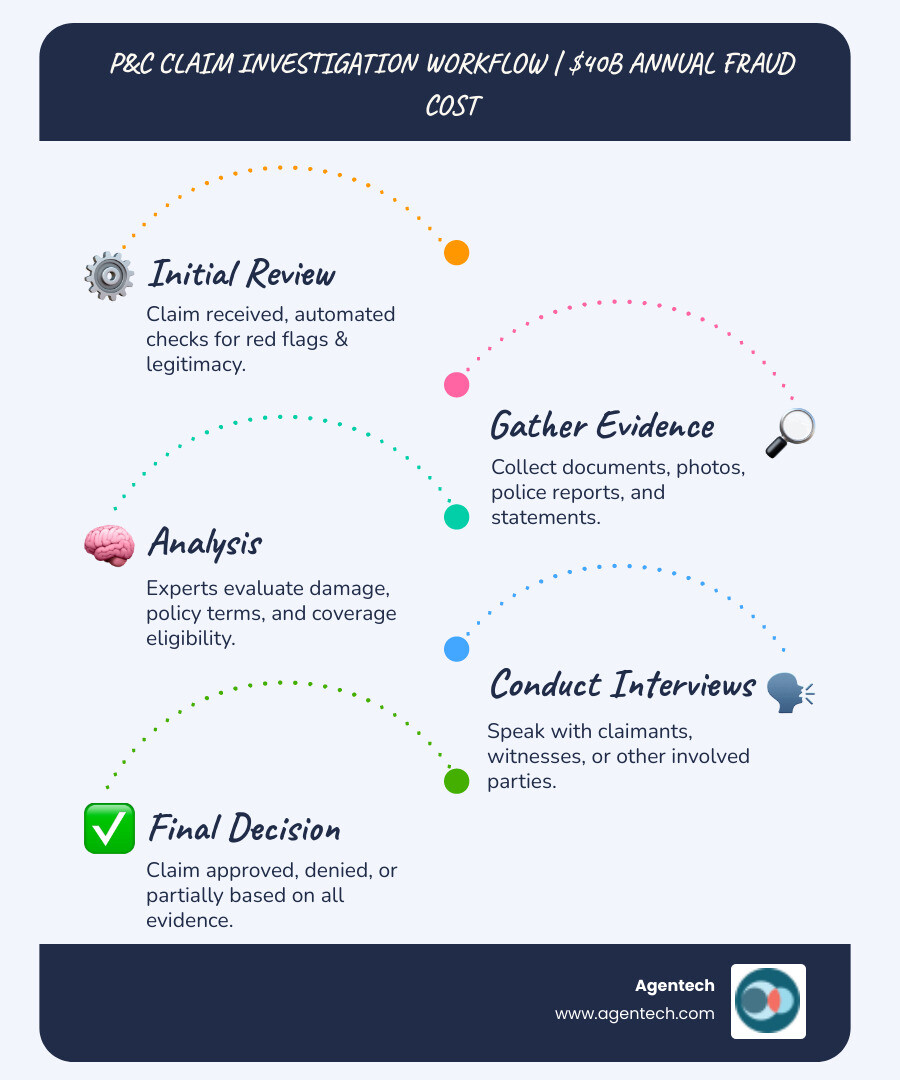
Here's what happens during a P&C insurance claim investigation:
- Initial Review: The claim is received and automatically checked for red flags.
- Evidence Gathering: Adjusters collect documents, photos, reports, and statements.
- Analysis: Experts evaluate damage and review policy terms for coverage.
- Interviews: The insurer may speak with the claimant, witnesses, or others.
- Decision: The claim is approved, denied, or partially paid based on the findings.
Why is this process necessary? The Federal Bureau of Investigation estimates that illegitimate insurance claims cost about $40 billion every year. This isn't just a problem for P&C insurance companies; when fraud goes undetected, everyone pays through higher premiums. Insurance fraud is not a victimless crime.
Investigations also ensure accuracy, protect policyholders from unfair denials, and maintain accountability. A thorough process benefits honest policyholders by keeping premiums fair and ensuring legitimate claims are paid promptly.
I'm Alex Pezold, and at Agentech AI, we're building AI-powered solutions that transform how P&C insurance carriers, TPAs, and Independent Adjusting firms handle claim investigations. Our tools make the process faster and more accurate without replacing the essential human judgment complex claims require. My experience has shown me how the right technology can eliminate manual bottlenecks while preserving the integrity of critical processes.
The Anatomy of a P&C Insurance Claim Investigation Process
This section details the structured approach P&C insurers take to validate claims, ensuring fairness and accuracy from initial review to final decision. We cover the typical stages of the P&C insurance claim process, from the first report of a loss to the final decision.

Step 1: The Initial Trigger and Automated Review
The P&C claim investigation begins with the First Notice of Loss (FNOL), when a policyholder requests compensation for a covered loss. This could be for a car accident, a burst pipe, a pet's vet bill, or a workplace injury.
Once reported, the claim enters an automated review. Claims management software with AI tools scans for red flags that suggest fraud or require deeper investigation. Common indicators include claims filed immediately after a policy purchase, discrepancies in damage descriptions, or a history of similar claims. For workers' compensation, a claim filed on a Monday morning or just before a layoff might trigger scrutiny. This initial screening, or "desk review," determines if a claim can be fast-tracked or needs a full investigation. Agentech's AI solutions excel at this, helping carriers efficiently identify claims that warrant a closer look.
Step 2: Evidence Gathering and In-Depth Analysis
If a claim is flagged or complex, the investigation moves to a comprehensive evidence gathering phase. Adjusters and investigation teams collect and examine all pertinent information.
This stage involves reviewing official records like police reports, repair invoices, medical notes, and veterinary records. The investigator also analyzes the policy to confirm the loss is covered. For property and auto claims, a physical inspection is common, sometimes involving appraisers or engineers. For workers' compensation or personal injury claims, this involves medical evaluations. Policyholders should keep damaged items and all receipts for cleanup.
Investigators may also conduct interviews with the claimant, witnesses, and other involved parties to clarify details and identify inconsistencies. In some cases, on-site surveys are conducted, and where fraud is suspected, surveillance may be used within strict legal and ethical boundaries. For complex or high-value claims, specialized fraud investigation teams with forensic or accident reconstruction skills may be brought in.
Throughout this stage, our claims management software assists adjusters by centralizing documents and analyzing data, allowing human experts to focus on critical thinking rather than administrative tasks.
Step 3: The Final Decision and Communication
After the analysis is complete, the P&C insurance claim investigation concludes with a decision that is clearly communicated to the policyholder. There are three potential outcomes:
- Claim Approval: If the investigation confirms the claim is legitimate and covered, the insurer arranges payment to compensate the policyholder.
- Claim Denial: A claim may be denied if the loss is not covered, there is evidence of fraud, or the policyholder failed to meet policy conditions.
- Partial Denial: Sometimes, only a portion of a claim is approved if some damages are covered while others are not, or if the amount claimed exceeds the verified loss.
Regardless of the outcome, the insurer provides a detailed settlement letter. This document outlines the decision and the reasons behind it. If a claim is denied, the explanation must be thorough and inform the policyholder of their right to appeal. Policyholders have the right to be informed throughout the process and should contact their P&C insurer with any questions.
Navigating the Legal and Ethical Maze of Investigations
Investigations must balance thoroughness with strict adherence to legal and ethical standards, protecting both the P&C insurer and the policyholder.
Upholding Privacy and Regulatory Compliance
In P&C insurance claims, especially those involving personal injury or workers' compensation, upholding privacy and regulatory compliance is a legal imperative. The investigation process must steer data privacy laws, consent requirements, and security protocols to protect sensitive information.
Principles of confidentiality are vital across all Property & Casualty lines, especially when an insurer requests medical records for a workers' compensation or personal injury claim. In these cases, they must obtain proper authorization. Key considerations include:
- Consent Requirements: Investigators must obtain explicit, documented consent before accessing personal information like medical records. The consent should be limited to only the information necessary for processing the claim. For example, when asked to verify claim information, a provider must first confirm the client's consent to share sensitive medical information.
- Data Security: P&C carriers must use robust security measures, including secure document transmission and strict access controls, to prevent data breaches.
- Legal Boundaries: Investigators must operate within their jurisdiction's legal boundaries, understanding what information they can request and what methods are permissible.
- Regulatory Compliance: P&C insurers are subject to state or provincial regulations governing claims handling, which often dictate timelines for acknowledging, investigating, and communicating decisions.
Agentech's AI solutions are built with compliance in mind, helping carriers manage consent, secure data, and adhere to regulatory guidelines, ensuring ethical conduct throughout the P&C insurance claim investigation process.
Common Challenges in the P&C Insurance Claim Investigation Process
Even with advanced tools, the P&C claim investigation process faces challenges that can extend timelines and increase costs.
- Complexity of Information: Claims involving significant damage or complex injuries generate vast amounts of information. Sifting through reports, medical records, and policy documents for crucial details can be overwhelming and lead to delays.
- Documentation Discrepancies: Inconsistencies between a claimant's statement and documented evidence are common. These require further investigation to determine if they are honest mistakes or indicators of fraud.
- Cooperation from Involved Parties: Investigators rely on the cooperation of policyholders, witnesses, and third parties. Delays in receiving documents or scheduling interviews can significantly prolong the investigation.
- Unjustified Delays: While insurers must handle claims efficiently, high claim volumes or extensive information gathering can lead to delays. Policyholders may become concerned when an investigation takes longer than expected.
- Managing Expectations: Policyholders often expect a quick resolution. Managing these expectations with clear, consistent communication about the investigation's progress is essential for maintaining trust.
Our AI-powered solutions help P&C carriers tackle these challenges by automating information analysis, flagging discrepancies, and streamlining workflows, empowering adjusters to resolve claims faster and more accurately.
The Aftermath of a Denial: Navigating the Appeals Process
A P&C claim denial is not the end of the road. Policyholders have established rights and a clear path to appeal decisions they believe are incorrect.
Understanding Your Rights During the P&C Insurance Claim Investigation Process
Facing a denied P&C insurance claim is frustrating, but policyholders have rights to ensure a fair process. Understanding these rights is key to challenging an unjust decision.
- Right to Information: You have the right to be informed about the investigation. If your claim is denied, the insurer must provide a written explanation detailing the specific reasons and referencing the relevant policy language.
- Right to a Fair Assessment: Insurers are legally obligated to conduct a fair and impartial assessment of your claim, considering all available evidence without bias.
- Right to Appeal: If your claim is denied, you have the right to appeal the decision. This typically starts with an internal appeal to the insurer, with the option for an external review if the first appeal is unsuccessful.
- Policyholder Obligations: To ensure a smooth process, you must report incidents promptly, provide accurate information, cooperate with the investigation, and keep detailed records of all correspondence, including your denial letters and appeal letters.
From Internal Appeals to External Review: A Step-by-Step Guide
If your P&C claim is denied, the appeals process offers a structured path to challenge the decision, starting with an internal appeal and potentially escalating to an external review.
- Filing an Internal Appeal:
- The first step is to file an appeal with your P&C insurance company, usually by writing a formal letter requesting reconsideration. Include your claim number and explain why you believe the denial was incorrect.
- Support your appeal with any new evidence, such as updated repair estimates, additional medical reports, or witness statements.
- Insurers have specific timeframes for filing an appeal, often around 180 days from the denial notice. The insurer also has a deadline to respond.
- Escalating to an External Review:
- If your internal appeal is denied, you generally have the right to request an external review by an independent third party.
- These reviews are conducted by Independent Review Organizations (IROs), whose experts make impartial decisions that are often legally binding on the insurance company.
- The specific process varies by location. For P&C insurance, you would typically contact your state's Department of Insurance or a similar regulatory body for guidance on external review options.
The Future of Investigations: How Technology is Changing the Game
Technological advancements are revolutionizing how P&C insurance claim investigations are conducted, increasing speed, accuracy, and efficiency across all lines of P&C insurance.
The Role of AI and Data Analytics in Modern Investigations
The traditional P&C claim investigation process is being transformed by Artificial Intelligence (AI) and data analytics. These tools are fundamentally changing how P&C insurers detect fraud, assess claims, and make decisions.
- AI for Fraud Detection: AI algorithms analyze vast datasets to identify patterns and anomalies indicative of fraud. This goes beyond simple red flags to detect sophisticated schemes that human investigators might miss, such as fraudulent networks of providers or suspicious links between claimants.
- Pattern Recognition and Predictive Modeling: AI's ability to recognize complex patterns allows insurers to predict the likelihood of fraud or claim complexity early on. Our AI Claims Processing for P&C Insurance solutions leverage these models to help adjusters allocate resources more effectively.
- Data-Driven Insights: Data analytics provides adjusters with deeper insights into claims data. By visualizing trends and identifying root causes, adjusters can make more informed decisions. Our Insurance Claims Analytics Software for P&C Insurance turns raw data into actionable intelligence.
At Agentech, we believe in augmenting human expertise with AI. Our AI-powered digital agents handle repetitive, data-intensive tasks, allowing human adjusters to focus their valuable time on the nuanced aspects of claims that require empathy and critical thinking.
Streamlining Operations with Claims Management Software
Technology also streamlines the entire P&C claim investigation process through advanced claims management software. This software automates routine tasks, reduces administrative burden, and accelerates claims resolution.
- Reducing Administrative Burden: Manual processes like checking claim statuses and gathering documents are time-consuming and costly. Our claims management software automates these tasks, freeing up adjusters to focus on high-value work.
- Automating P&C Insurance Claims Processing: From intake to settlement, our Automated P&C Insurance Claims Processing solutions streamline workflows. This includes automated data entry, intelligent document routing, and adherence to regulatory guidelines, which reduces errors and ensures consistency.
- Faster Claims Resolution: By automating tasks and providing adjusters with immediate access to data, claims management software significantly accelerates the resolution timeline. This means policyholders get their claims processed faster, improving satisfaction.
- Human in the Loop Decision Making: While automation handles data processing, the ultimate decisions remain with human adjusters. Our Claims Adjuster Software for P&C Insurance is designed to support, not replace, these professionals by providing them with comprehensive data and analytical insights.
- Improving Adjuster Productivity: By offloading administrative tasks, our AI-powered digital agents work alongside human adjusters to boost their capabilities, reduce backlogs, and improve overall operational efficiency.
Frequently Asked Questions about Claim Investigations
What is the primary purpose of a claim investigation?
The primary purpose of a P&C insurance claim investigation is to verify the legitimacy and accuracy of a claim. It involves gathering facts to confirm the loss occurred as reported, is covered under the policy, and to determine the appropriate compensation. This process helps prevent fraud and ensures fairness for all policyholders.
How long can a P&C insurance company investigate a claim?
The duration of a P&C claim investigation varies based on claim complexity, evidence gathering, and party cooperation. There is no universal time limit, but insurers are legally obligated to handle claims efficiently and provide an approximate timeframe. If an investigation extends for an unreasonably long period (e.g., over 90 days in some jurisdictions), policyholders have the right to inquire and escalate concerns to regulatory bodies.
What are the consequences of insurance fraud?
Insurance fraud is a serious crime with severe consequences. For those who commit it, penalties can include:
- Claim Denial: The fraudulent claim will be denied.
- Policy Cancellation: The P&C insurer may cancel the policy, making it difficult to get future coverage.
- Fines and Penalties: Fraud can be a misdemeanor or a felony, with fines ranging from thousands to over $100,000.
- Jail Time: Convictions can lead to jail time, from less than a year to over 20 years for serious offenses.
- Permanent Record: A fraud conviction results in a permanent criminal record, impacting future employment and housing.
For the industry and honest policyholders, the main consequence is higher premiums, as the multi-billion dollar cost of fraud is passed on to everyone.
Conclusion: Building a More Efficient and Fair Claims System
The P&C insurance claim investigation process is a cornerstone of the P&C insurance industry, vital for maintaining trust and ensuring financial stability. A robust investigation is crucial for verifying legitimacy, preventing fraud, and ensuring accurate settlements for property, auto, pet, and workers' compensation claims. It protects P&C insurers from financial loss and honest policyholders from paying for fraud through higher premiums.
While the investigation process can be complex, the future is bright thanks to transformative technology. At Agentech, we are at the forefront of this evolution. Our AI-powered tools and claims management software are designed for P&C insurance carriers, Third Party Administrators (TPAs), and Independent Adjusting (IA) Firms.
We streamline operations by automating repetitive tasks, enhancing fraud detection with sophisticated analytics, and accelerating claims resolution. Our unique approach ensures human expertise remains central, empowering adjusters with always-on AI assistants that boost productivity and accuracy without replacing their invaluable judgment. By embracing AI, we are helping the P&C industry build a more efficient, transparent, and fair claims system.
Citations:
- Federal Bureau of Investigation. "Insurance Fraud."
- Marathon Insurance. "How Long Does an Insurance Company Have to Investigate a Claim in Ontario?"
- Northbridge Insurance. "Navigating the Insurance Claim Process: A Step-by-Step Guide."