
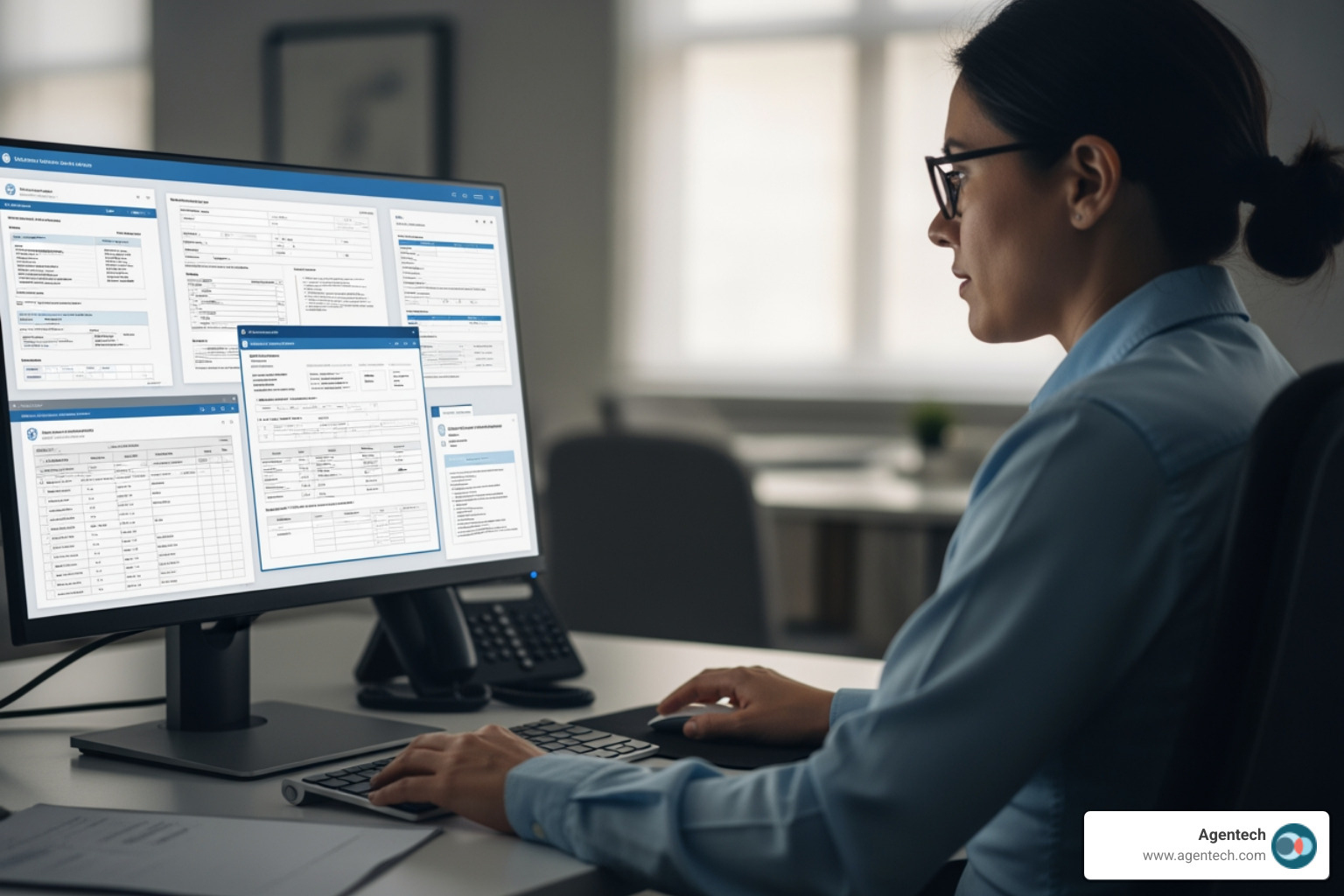
Why Speed Matters in Property & Casualty Claims Processing
Faster claims resolution tools are changing how P&C insurance carriers, TPAs, and IA firms handle claims. AI-powered solutions automate manual work like document review and data extraction, cutting processing times from weeks to minutes and boosting accuracy.
Top tools include:
- AI document processing to extract data from medical records and reports with high accuracy.
- Straight Through Processing (STP) to automate routine claims from FNOL to settlement.
- Fraud detection systems to flag suspicious claims using photo and data analysis.
- Claims management platforms for workflow automation and real-time dashboards.
- Generative AI assistants to create summaries and draft communications for adjusters.
Research shows 31% of policyholders are dissatisfied with their claims experience, with 60% blaming slow settlements (1). This leads to customer churn. Meanwhile, claims handlers spend about 30% of their time on low-value administrative work, leaving less time for complex cases.
Traditional processing is plagued by bottlenecks like manual data entry, fragmented systems, and slow document review. These issues worsen during catastrophic events, making it impossible to scale when policyholders need you most.
The solution is intelligent automation that integrates with your existing claims management software. Modern tools use AI to handle unstructured data like handwritten notes and medical records, integrating via flexible APIs without replacing your core systems.
I'm Alex Pezold, founder of Agentech AI. We're building the AI workforce for P&C insurance, focusing on pet insurance and workers' compensation claims, to deliver measurable results for carriers and TPAs.
The High Cost of Slow Claims: Why Traditional Methods Fall Short
For many P&C insurance carriers and TPAs, the claims process is a tangled, inefficient operation. The cost of this inefficiency goes beyond processing time, hitting your profitability and frustrating policyholders.

Research confirms that 31% of policyholders are dissatisfied with their claims experience, and 60% blame slow settlement speeds (1). This is a clear sign that traditional processing cannot meet modern expectations.
Manual document review is a core problem. Adjusters spend about 30% of their time on low-value, repetitive tasks like sifting through paperwork. This is time that faster claims resolution tools could automate, freeing adjusters for complex cases and customer service.
Data silos compound the issue. When information is scattered across non-communicating systems, it's hard to get a complete view of a claim. This fragmentation can lead to inconsistent injury evaluations, especially in workers' compensation, causing claims leakage where you pay more than necessary.
The Bottlenecks in Manual Processing
Several key bottlenecks slow down the claims journey:
- Claims Handler Workload: Overburdened adjusters are more prone to making costly errors. A missed detail in a medical record or a data entry mistake can cost thousands.
- Document Review: Reviewing medical records in workers' compensation and bodily injury claims is notoriously slow. This single task can delay a claim for days or weeks, but intelligent automation can cut this time by up to 90%.
- Lack of Real-Time Communication: Relying on phone, email, and physical mail creates delays and information gaps. Policyholders are left waiting for updates.
- Fragmented Systems: Legacy systems that don't integrate force manual data transfer, increasing inefficiencies and errors. For a deeper look at solving these backend challenges in P&C insurance, our article on Insurance Back Office Automation explores practical solutions.
The Impact on Your Business and Customers
These bottlenecks directly harm your business and erode policyholder trust:
- Increased Operational Costs & Claims Leakage: Manual work and inefficiencies drive up expenses. Missed subrogation opportunities or overpayments hurt your bottom line.
- Customer Churn: Slow, frustrating claims experiences cause policyholders to switch carriers. Acquiring new customers is far more expensive than retaining existing ones.
- Negative Impact on Combined Ratio: Higher costs and leakage push your combined ratio in the wrong direction, making your business less competitive.
- Difficulty Scaling: During catastrophic events, claims volume can spike. Manual processes cannot scale to meet this demand, leading to massive backlogs and frustrated customers.
Opening up Speed and Accuracy with AI Powered Faster Claims Resolution Tools
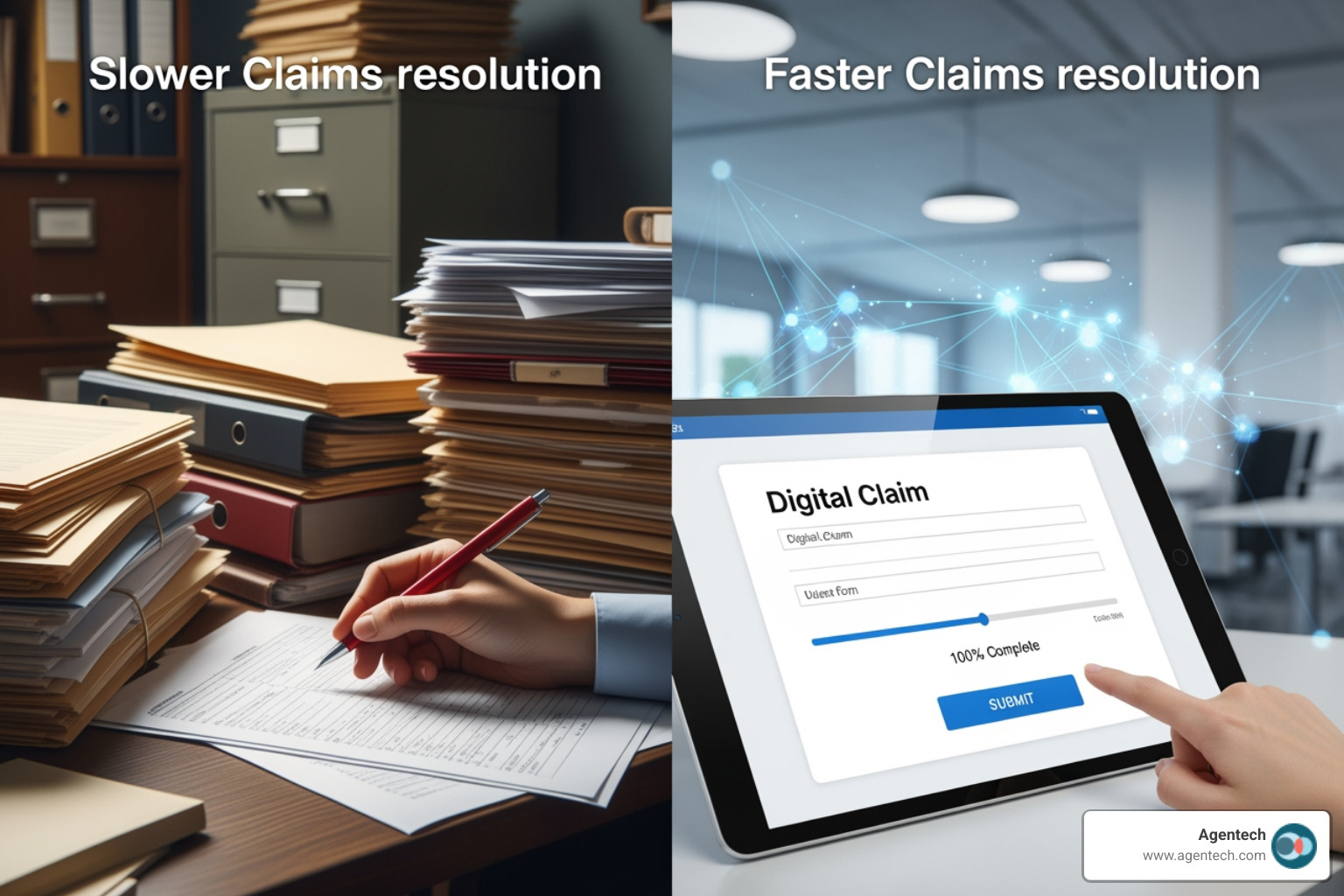
The key difference is the shift from rigid, rules-based automation to flexible AI and machine learning models. Rules-based systems struggle with unstructured data like handwritten notes or medical reports. AI excels at this, as it is trained to understand context and extract information with high accuracy. This is critical for complex P&C insurance claims. The best tools also integrate with your existing claims management software, adding automation without replacing core systems. For a deeper dive into P&C insurance, explore The Future of Insurance: How AI is Changing the Game.
Automating the Core: From First Notice of Loss to Settlement
Straight Through Processing (STP) is one of AI's most transformative applications. It automates the claim lifecycle from submission to resolution and can handle more claim types than rules-only approaches.
At Agentech, our AI Agents automate FNOL intake, document classification, and data extraction. The system immediately begins classification and capture, reducing cycle time and letting adjusters focus on high-value work. You can learn more in our AI Claims Processing System overview.
For example, automated medical record review can dramatically reduce processing time while improving accuracy. Agentech AI Agents accelerate data capture and summarization so adjusters can spend more time on decision-making and customer communication rather than manual review.
Advanced Analytics: AI for Fraud Detection and Risk Assessment
AI brings new sophistication to fraud detection. It uses advanced analytics for anomaly detection, identifying unusual patterns in claims data that could indicate fraud. Predictive analytics can assess the likelihood of a claim becoming litigated early in the process, allowing for proactive intervention.
AI can also analyze photos and videos, detecting reused images or inconsistencies in property and auto claims. By flagging suspicious cases for human review, AI reduces claims leakage and makes your team more effective. For more on this, read our article on AI in the P&C insurance industry, AI in Insurance: Balancing Innovation and Regulation.
The Next Frontier: How Generative and Agentic AI are Revolutionizing Claims
Generative AI can create summaries of complex documents or draft communications to policyholders, saving adjusters hours of work.
Agentic AI goes further. As we explain in our Agentic AI Definition, these AI agents act as digital coworkers, autonomously completing complex tasks like assessing claims for coverage, liability, and fraud. Instead of automating a single step, Agentic AI can orchestrate entire workflows, breaking down goals into subtasks for autonomous completion. This represents a meaningful shift, as discussed in Transforming Insurance Claims: The Evolution from Generative AI to Agentic AI. Our AI Agents are designed to work with human adjusters, augmenting their capabilities by handling repetitive work.
Key Features to Look for in Modern Claims Management Software
When shopping for faster claims resolution tools, look beyond the AI hype. You need a solid, user-friendly platform that fits your P&C insurance operation.
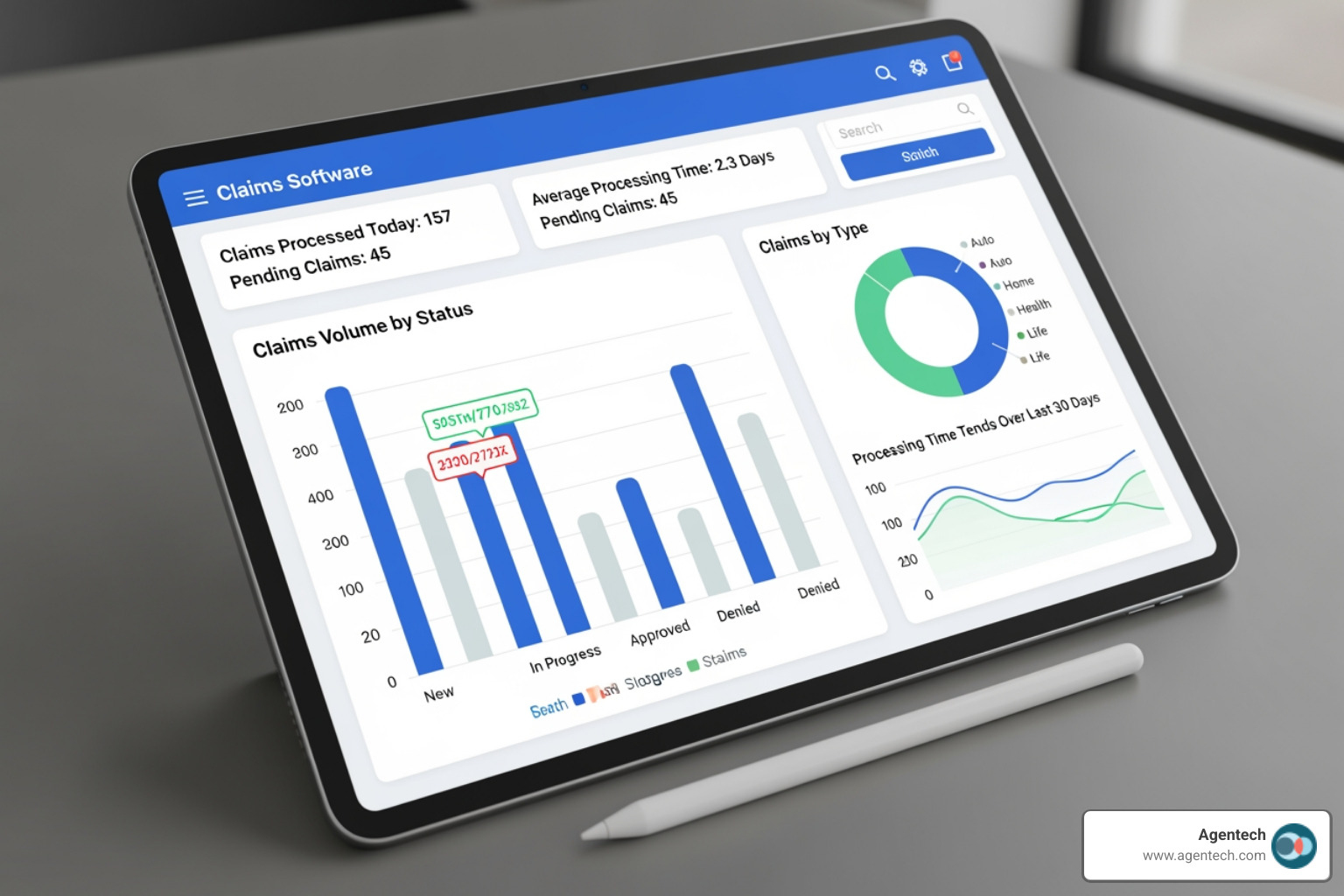
Look for a platform that is flexible enough to adapt to your unique workflows, whether for workers' compensation, pet insurance, or property damage. Key features include:
- No-code platforms that let business leaders tweak workflows without IT support.
- Workflow customization to tailor processes for different claim types.
- Scalability to handle sudden surges in claim volume during catastrophic events.
- API integration to connect seamlessly with your policy, accounting, and communication systems for a unified data view.
- Data security with advanced encryption, access controls, and certifications like SOC 2 Type 2 to protect sensitive policyholder information.
Enhancing Adjuster Productivity with the right faster claims resolution tools
The best faster claims resolution tools give your adjusters superpowers by freeing them from tedious busywork. AI assistants can process documents and generate summaries with 98% accuracy in minutes, giving adjusters back nearly a third of their day.
A centralized data view brings everything into one place, so an adjuster immediately sees the complete picture, including policy details, claim history, and AI analysis. This enables faster, better-informed decisions.
This is human-in-the-loop augmentation: AI handles the data processing, and the adjuster applies their experience and empathy to make final decisions. It's a partnership where technology and people do what they do best. We built our platform with this philosophy, which you can read about in AI Designed with Adjusters in Mind. The result is a more engaged, effective team focused on strategic work and building policyholder relationships.
Ensuring Compliance and Data Security in Claims Software
In P&C insurance, compliance and security are non-negotiable. Your claims management software should make them easier to manage. Look for:
- Audit trails that log every action for transparency and process improvement.
- Data encryption for information both in transit and at rest to protect against cyber threats.
- Support for regulatory standards like those from the National Association of Insurance Commissioners (NAIC) and GDPR.
- Certifications like SOC 2 compliance to provide independent verification of a vendor's security controls.
A proactive approach to compliance, with regular updates, protects your business, policyholders, and reputation.
Implementing New Technology: A Roadmap for Success
Adopting new faster claims resolution tools doesn't have to be an overwhelming overhaul. With the right roadmap, implementing AI-powered claims automation can be a smooth process.
A common concern is legacy system integration. Modern AI solutions are built for this. Flexible APIs allow them to connect with your existing claims management software and databases without a complete rip-and-replace. This hybrid approach lets you layer AI capabilities onto your current infrastructure, preserving investments while open uping new efficiencies. Our philosophy is detailed in A Hybrid AI Solution for Claims Automation: How Agentech Combines Out-of-the-Box Efficiency with Custom QA Precision.

Change management and employee training are just as critical. It's essential to communicate that AI is here to augment, not replace, your team. These tools handle tedious tasks, freeing adjusters to focus on decision-making, negotiation, and customer support.
Comprehensive training programs build confidence. Starting with a pilot program on a specific claim type allows you to demonstrate early wins, gather feedback, and build internal support. When your team sees the benefits firsthand, resistance fades.
Measuring ROI for your faster claims resolution tools
Investing in faster claims resolution tools must deliver measurable results. Track these Key Performance Indicators (KPIs) to build your business case:
- Reduced processing time: Measure the average time from FNOL to closure, and benchmark before and after rollout. Many P&C carriers move key steps from days to hours with automation.
- Lower claims leakage: Improved accuracy and fraud detection reduce overpayments and save money.
- Cost per claim: Automation reduces manual labor. Programs often yield double-digit cycle-time improvements and material reductions in operating costs.
- Customer satisfaction scores (CSAT): Faster, more transparent resolution leads to happier, more loyal policyholders.
- Return on investment (ROI): Quantify financial benefits against costs. Medical record automation frequently delivers strong ROI.
- Cycle time reduction: Track time spent on specific stages, like document review, to pinpoint where AI has the biggest impact.
Monitoring these metrics tells a compelling story about how automation is changing your claims operation.
Frequently Asked Questions about Faster Claims Resolution
Here are answers to the questions we hear most often from P&C insurance carriers, TPAs, and IA firms considering faster claims resolution tools.
How does AI improve the accuracy of claims processing?
AI improves accuracy by reducing human error in repetitive tasks. It performs consistent data analysis on every claim, cross-references vast datasets to spot inconsistencies a human might miss, and automatically validates information against policy rules. The result is fewer errors, more precise evaluations, and fairer outcomes. Learn more in our article on AI claims processing for the P&C insurance industry, AI Claims Processing Insurance.
Will automation replace claims adjusters?
No. Our philosophy is augmentation, not replacement. Faster claims resolution tools are designed to handle repetitive tasks like data entry and document sorting. This frees adjusters to focus on complex work that requires human judgment, empathy, and critical thinking. AI improves decision-making by providing better data and insights, allowing your team to be more effective and engaged. We explore this partnership for P&C insurance in The Future of Work in Insurance: Embracing AI Agents as Digital Coworkers.
What is the first step to automating our claims workflow?
Start by conducting a process audit to identify bottlenecks in your current workflow. Where do claims get stuck? What tasks are most time-consuming? These pain points are your best opportunities for automation.
Next, choose a scalable solution that prioritizes integration capabilities to work with your existing claims management software. Start with high-volume, low-complexity tasks like FNOL intake to demonstrate quick wins and build team confidence. A great starting point is automating the creation of the initial claim profile, a tedious but critical task. We wrote about this in We Made AI Do the Most Tedious, Time-Consuming Task in Claims Processing: Creating the Claim Profile.
Conclusion
The change of P&C insurance claims processing is happening now. Manual, paper-heavy methods are being replaced by intelligent faster claims resolution tools that leverage AI. This shift is essential for survival and success in a competitive market.
A report by McKinsey suggests that over 50% of core claims activities will be automated by 2030 (2). For P&C insurance carriers, TPAs, and IA firms, the time to act is now. Companies that accept automation today will lead the industry tomorrow.
This future means improved efficiency, reduced operational costs, and less claims leakage, directly boosting your combined ratio. Most importantly, it means happier policyholders who receive faster, fairer settlements. Across the industry, carriers are reporting shorter processing times and lower operating costs as they scale automation.
At Agentech, we understand this change can feel daunting. Our AI Agents are designed to work alongside your teams and systems, augmenting their capabilities, not replacing them. We empower your people with tools that make them more effective and their jobs more satisfying.
The future of P&C insurance claims is automated, efficient, and customer-centric. Are you ready to be part of it? Discover our AI Agents today and take the first step toward a smarter claims operation.
Citations:
- Accenture. (2022). Poor Claims Experiences Could Put Up to $170B of Global Insurance Premiums at Risk by 2027. Retrieved from https://newsroom.accenture.com/news/2022/poor-claims-experiences-could-put-up-to-170b-of-global-insurance-premiums-at-risk-by-2027-according-to-new-accenture-research
- McKinsey & Company. Insurance 2030: The impact of AI on the future of insurance. Retrieved from https://www.mckinsey.com/industries/financial-services/our-insights/insurance-2030-the-impact-of-ai-on-the-future-of-insurance