Why SaaS vs AI is Reshaping the Software Industry
SaaS vs AI represents a significant shift in business software. Here’s a quick breakdown:
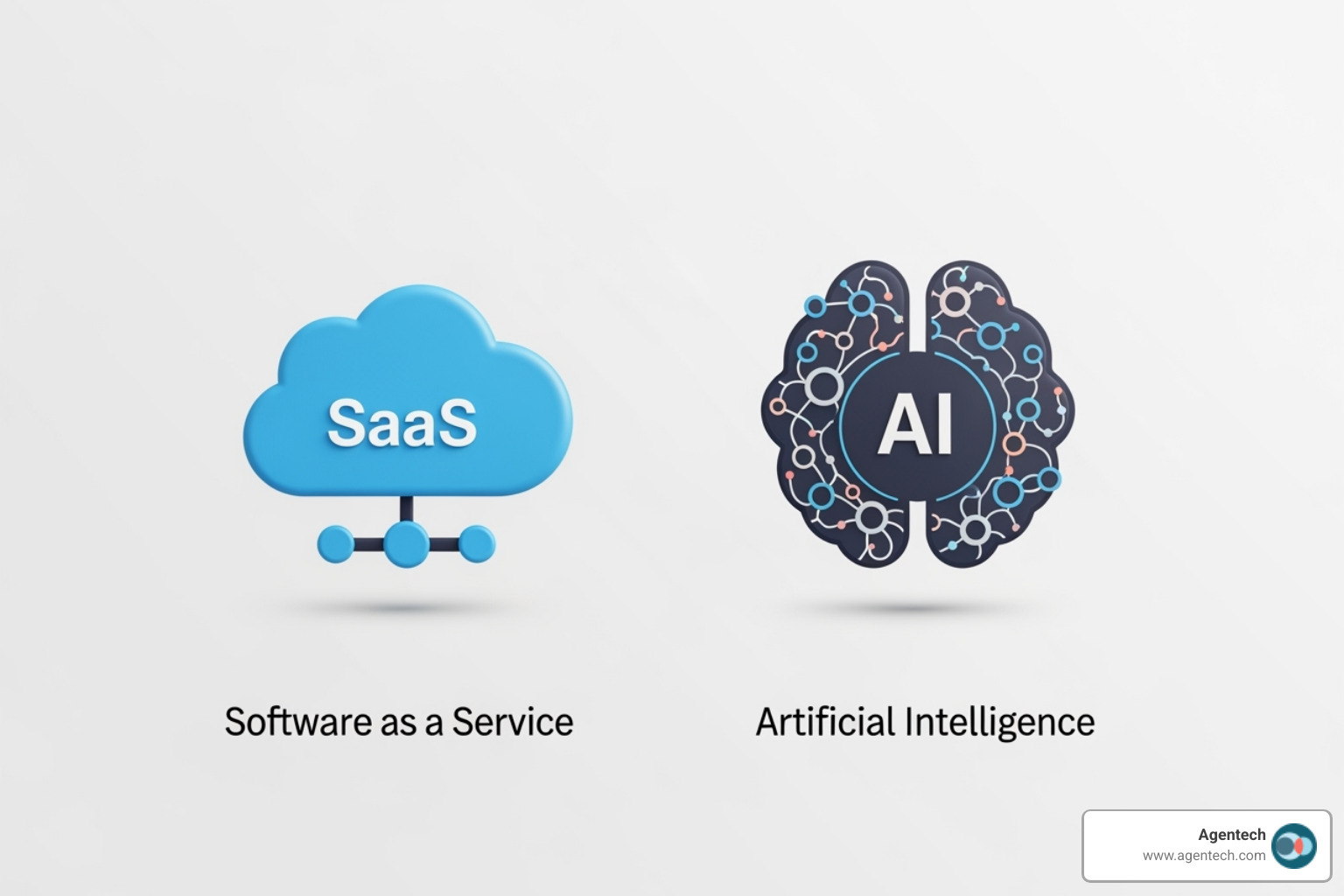
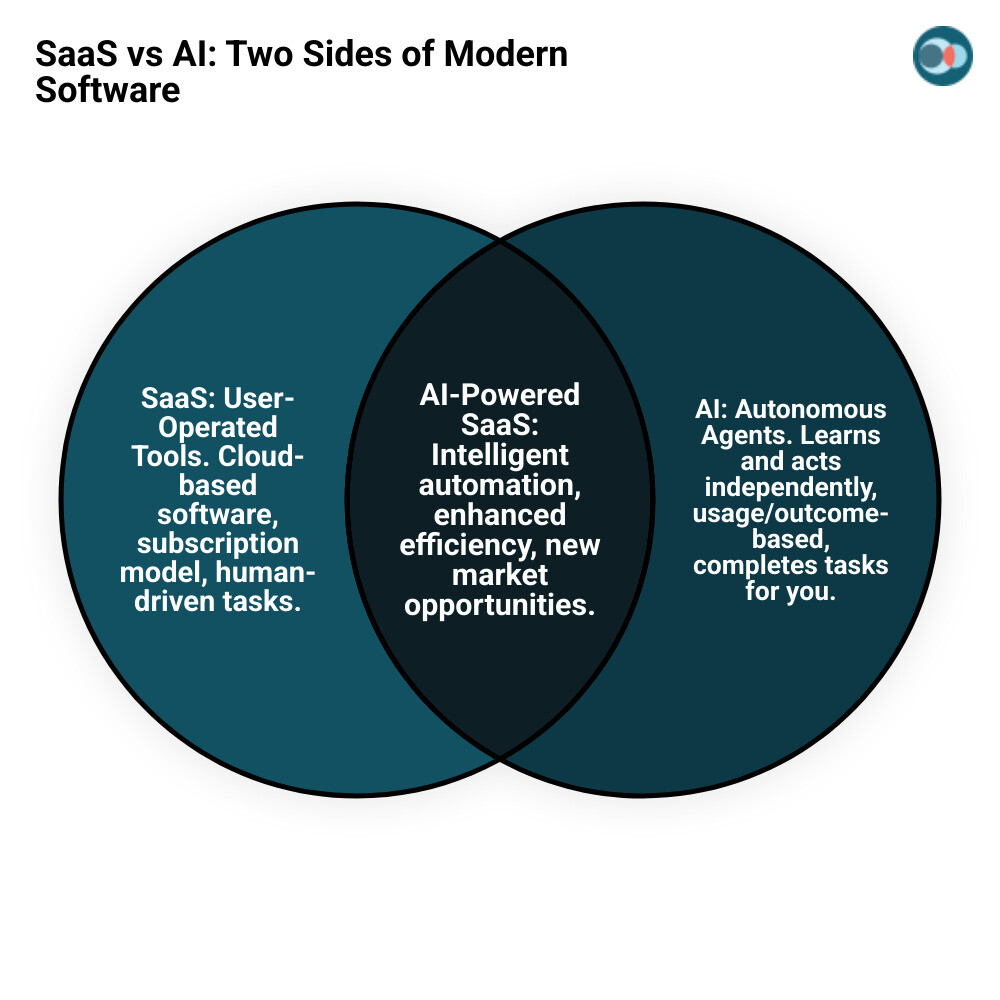
SaaS (Software as a Service) Cloud based software accessed via a browser. Subscription pricing (per user per month). You operate the software to complete tasks. Examples: Salesforce, Slack, Microsoft 365.
AI (Artificial Intelligence) Software that thinks and acts autonomously. Usage or outcome based pricing. The software completes tasks for you. Examples: ChatGPT, AI agents, automated assistants.
The key difference is that SaaS gives you tools, while AI does the work for you.
In 2023, the global SaaS market hit $197 billion. The AI market is projected to reach $826.70 billion by 2030, with AI startups scaling five times faster than traditional SaaS companies.
This isn't about one technology replacing another, but a merger creating something new. Traditional SaaS platforms are embedding AI, while AI native companies build software that can think, learn, and act without human intervention. For insurance professionals, this means moving from using software to manage claims to having intelligent agents process them automatically.
I'm Alex Pezold, and I've spent years building and scaling technology businesses. At Agentech AI, I've seen how the SaaS vs AI evolution is changing industries, particularly in insurance where we're building AI agents that handle complex claims processing autonomously.
What is SaaS? The Foundation of Modern Software
When you check email or update a spreadsheet online, you're likely using Software as a Service (SaaS). SaaS has revolutionized work by changing software from a product you own to a service you use. It's like using a ride sharing service instead of owning a car; you get the benefit without the overhead.

In this cloud delivery model, the provider manages servers, updates, and maintenance. You just log in and work. The subscription model, usually per user per month, makes powerful software affordable.
The "Pizza as a Service" analogy explains it well. Traditional software is like making a pizza from scratch at home. You control everything, but it's a lot of work. SaaS is like ordering pizza delivery. Someone else handles the complexity, and you just enjoy the result.
The SaaS market has grown 500 percent over seven years, reaching $197 billion in 2023 and is expected to hit $232 billion this year. This growth shows how much businesses value this approach.
Key Characteristics of Traditional SaaS
Traditional SaaS platforms are user driven tools that put you in control. You click buttons and enter data to get things done. Per seat pricing makes budgeting simple, with a monthly fee for each user. They offer predefined workflows for common business needs, like customer relationship management systems or project management tools. Finally, centralized updates mean everyone gets new features automatically, without IT intervention.
How SaaS Transformed Business Operations
SaaS transformed business by making applications universally accessible from anywhere with an internet connection. This brought cost efficiency through affordable monthly payments and reduced IT overhead. Finance teams love the predictable spending, and companies can focus on core business instead of software maintenance. Data centralization in the cloud provides secure, enterprise level access to claims data, client information, and analytics.
This change set the stage for the SaaS vs AI evolution. While SaaS gave us powerful tools, the next wave brings intelligence that can use those tools for us.
What is AI? The New Intelligence Layer
If SaaS provides the tools, Artificial Intelligence (AI) provides the brain. Traditional software waits for commands, while AI software can act on its own. It's the difference between a simple calculator and a smart assistant that solves the problem for you.
AI systems perform tasks that normally require human intelligence, such as learning, problem solving, and decision making. Instead of following rigid rules, AI adapts and learns from experience in real time.
The AI market is projected to reach $184 billion in 2024 and grow to 826.70 billion US dollars by 2030. This growth reflects AI's ability to transform entire workflows, not just automate tasks. While SaaS gives you the steering wheel, AI can drive the car.
Types of AI in Business Software
AI is a suite of tools for different jobs. Predictive analytics forecasts future trends from historical data. Natural Language Processing (NLP) allows computers to understand and generate human language for chatbots and document analysis. Computer vision gives software the ability to "see" and interpret images, useful for analyzing damage in insurance claims. AI powered chatbots handle complex conversations and complete transactions. The most exciting development is autonomous agents, which operate independently to achieve goals without human intervention.
In industries like insurance, AI is creating remarkable changes. Learn how AI is changing industries like insurance to see these changes in action.
How AI Learns and Improves
Unlike static software, AI gets smarter over time. The process begins with data ingestion, where AI systems consume vast amounts of information as an experience base. During model training, algorithms analyze this data to identify patterns and relationships. Feedback loops are crucial, as they help the system learn from the outcomes of its decisions. This enables continuous learning, where AI constantly refines its understanding. Through pattern recognition and algorithm refinement, the underlying technology keeps improving, allowing AI to identify opportunities and implement changes automatically.
The Great Debate: SaaS vs AI
The SaaS vs AI conversation is more than a technical debate; it's a fundamental shift in business operations and the future of work. It's about understanding how these technologies are reshaping industries.
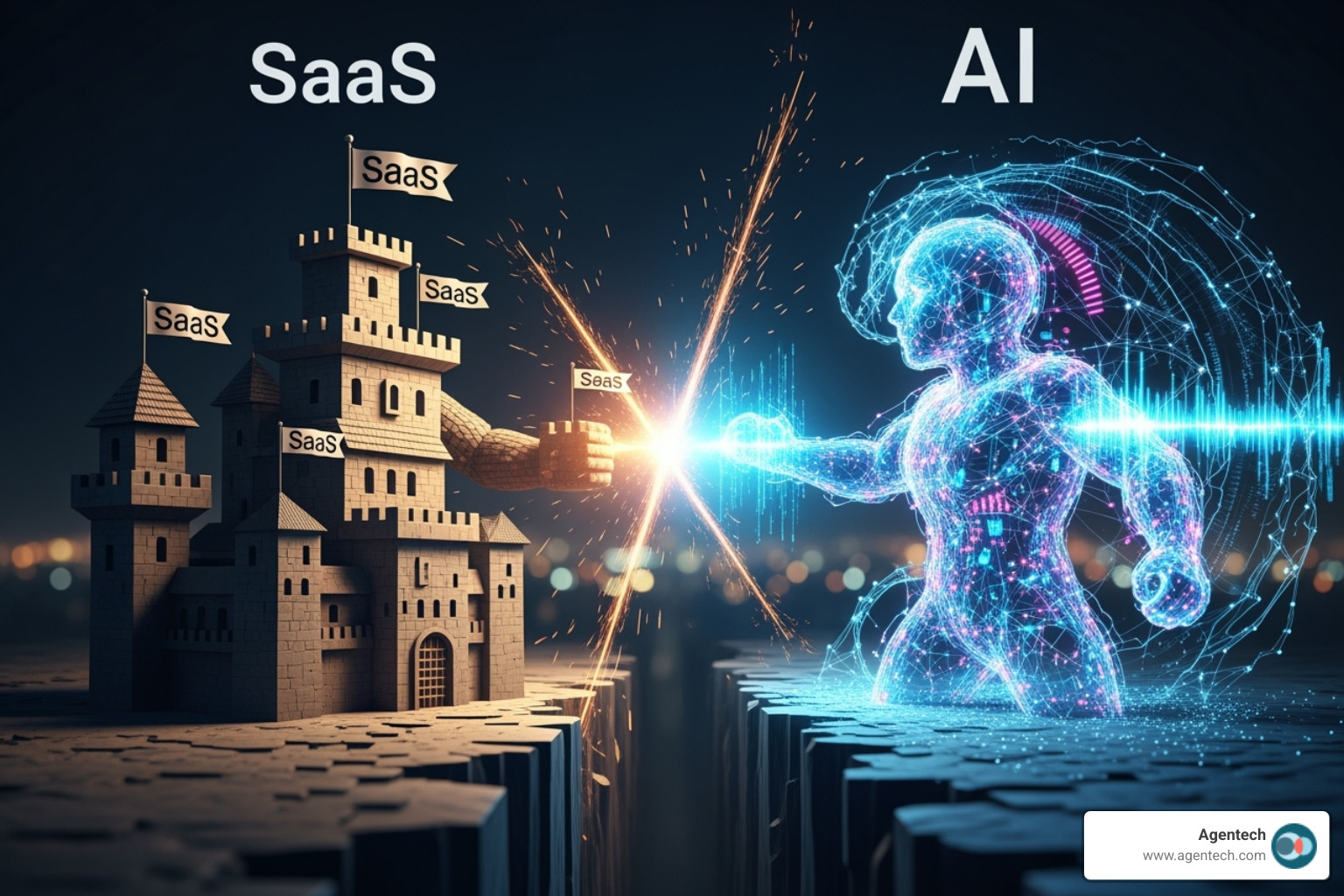
Traditional SaaS gave us tools to work with, while AI is creating software that can do the work for us. It's the difference between a great calculator and a mathematician who solves problems while you sleep.
Fundamental Differences in the SaaS vs AI Showdown
The core differences reveal why this debate matters. SaaS is a tool; AI is a task doer. With SaaS, you actively manage the work. With AI, you can delegate the task and return to find it completed. Human involvement is high in SaaS, while AI aims for autonomous operation. SaaS follows predefined workflows, whereas AI uses dynamic problem solving. SaaS design prioritizes the user experience, while AI focuses on outcomes.
Business and Revenue Models: A New Economic Equation
The economics of SaaS vs AI reveal different operational models.
| Feature | Traditional SaaS | AI Companies |
|---|---|---|
| Pricing Model | Subscription (per seat, per user, per month/year) | Usage based or outcome based pricing |
| Cost Structure | Software development, sales, marketing | High compute costs, data, specialized talent |
| Revenue Growth | Steady, predictable recurring revenue | Faster initial growth, often exponential |
| Key Value Driver | Access to software and features | Automated outcomes and intelligence |
Traditional SaaS relies on predictable subscription revenue. AI companies face different economics, with high compute costs for training and running models. However, AI startups are scaling much faster than their SaaS predecessors. They reach $1 million in revenue in 11 months (vs. 15 for SaaS) and scale from $1 million to $30 million five times faster. This speed comes from AI's ability to deliver immediate value through automation, with pricing often tied to results.
The Evolving Landscape of SaaS vs AI
Rather than a replacement, we're seeing a merger. AI powered SaaS is the new standard, with more than 53 percent of SaaS businesses plan to integrate AI this year. Your CRM predicts leads, and your project management tool suggests tasks. AI native companies are building new solutions from the ground up, creating possibilities traditional software couldn't offer. Hybrid models are emerging, combining SaaS reliability with AI's autonomous capabilities. For businesses, the choice is no longer about which technology to use, but how to integrate them. Explore the buy versus build decision for AI tech to see how leading companies approach this challenge.
The Rise of Agentic AI: A New Software Paradigm
The SaaS vs AI debate evolves with Agentic AI. This isn't just about adding smart features; it's about intelligent software agents that can think, act, and solve problems autonomously.

Instead of you logging into five systems to process an insurance claim, an AI agent does it for you. It reviews documents, validates coverage, calculates payouts, and sends notifications. This is autonomous task execution. These agents reason through problems and orchestrate multiple systems like a skilled human worker.
Agentic AI shifts software from reactive to proactive. While SaaS tools wait for your input, agentic AI agents monitor situations, identify problems, and take action. The evolution from Generative to Agentic AI is reshaping entire workflows.
Essential Components of Agentic Software
For agents to work effectively, they need several critical components:
Decision Context: The agent must understand the 'why' behind a task, including its importance, constraints, and overall context, not just the 'what'.
Continuous Feedback Loop: Agents use feedback from their actions to refine decision making, similar to how an experienced professional learns over time.
Trust Layer: This is critical for autonomy. It ensures agents operate within ethical and regulatory boundaries, maintaining audit trails for compliance.
Agent to Agent Communication: This allows different agents to coordinate directly. Imagine a claims agent and a billing agent resolving payment issues without human intervention.
The AIXP Protocol is making this possible. It's a universal language allowing different AI agents to collaborate. You can explore the AI Exchange Protocol on GitHub to see how this standard is developing.
This shift amplifies human capabilities by handling routine tasks, freeing professionals to focus on high value work like complex investigations and customer relationships.
The Future: Coexistence or Obsolescence?
The key question in the SaaS vs AI discussion is whether AI will make SaaS obsolete. History suggests that new technologies rarely eliminate their predecessors but instead push them to adapt and find complementary roles.
Historical Parallels
Technology disruptions are more like renovations than demolitions.
- Client server vs. mainframes: Client server was predicted to replace mainframes, but mainframes evolved and still power critical infrastructure today.
- Cloud vs. on premise: The cloud didn't eliminate on premise systems; most organizations now use a hybrid model, leveraging the best of both.
- Mobile vs. PC: Smartphones didn't make PCs obsolete. They coexist, with each excelling in different areas.
These patterns show that new technologies tend to foster adaptation, not complete replacement.
Will AI Make SaaS Obsolete?
No, AI will not make SaaS obsolete. We are witnessing the birth of a powerful partnership. AI improves SaaS value by making platforms smarter and more efficient. A CRM with predictive lead scoring becomes more useful, not obsolete. SaaS provides the perfect distribution channel for AI, offering access to users and real world data. This collaboration opens new market opportunities by making it possible to address more complex problems than either technology could handle alone.
Challenges and Opportunities on the Horizon
This convergence presents both challenges and opportunities.
AI native companies face high compute costs, data privacy concerns, and the need to build trust and manage integration complexity.
Traditional SaaS companies adopting AI have advantages like an established customer base, existing distribution channels, deep industry expertise, and proprietary data for training specialized AI models.
The regulatory landscape adds another layer of complexity, requiring a balance between innovation and compliance. The future belongs to organizations that can steer these challenges, understanding that SaaS vs AI is not a choice but a partnership.
Frequently Asked Questions about SaaS and AI
Will AI completely replace SaaS products?
No. The SaaS vs AI debate is about evolution, not replacement. AI is changing SaaS by adding intelligent features that automate tasks and provide insights, making the original software more powerful. The future is AI powered SaaS, which augments familiar platforms rather than replacing them.
What is the main advantage of an AI native company over a traditional SaaS company?
AI native companies are built for speed and autonomy. They can tackle complex, dynamic problems that go beyond the predefined workflows of traditional SaaS. This focus on delivering intelligent outcomes, rather than just user interfaces, allows them to scale much faster. As noted, AI startups are growing five times faster than their SaaS counterparts.
How can a business start using AI if they are not tech experts?
You don't need to be a tech expert to use AI. Start by identifying specific pain points in your daily operations, such as repetitive data entry or common customer inquiries. Then, look for AI powered SaaS tools designed to solve those specific problems. Many advanced AI capabilities are available "as a service," so you can leverage them without building anything from scratch. The key is to find the right problem for AI to solve. For more guidance, check out our guide: Not Sure Where to Start with AI?
Conclusion
The SaaS vs AI debate concludes not with a winner, but with a partnership. These are complementary forces: SaaS provides the reliable platform, and AI delivers the intelligence to transform those platforms into powerful problem solvers. SaaS built the highway, and AI is adding the self driving car.
The future belongs to businesses that understand this partnership. Companies that successfully merge SaaS platforms with AI capabilities will open up new levels of productivity, automating routine tasks and empowering teams to focus on strategic work.
In the insurance industry, this change is already happening. AI agents handle the repetitive administrative tasks in claims processing, working alongside human adjusters. This amplifies human capability, allowing experts to focus on complex decisions and customer care.
This convergence creates exciting opportunities. AI powered SaaS solutions can tackle problems that were previously too complex or time consuming, all while maintaining the user friendly interfaces and reliable infrastructure of SaaS.
The companies that thrive will be those that recognize SaaS vs AI is not about choosing sides but about integration. By combining these technologies, businesses can position themselves at the forefront of digital change.
To see how AI powered automation can transform your insurance operations, find how Agentech can transform your operations.