

Moving Beyond Traditional Claims Processing
Intelligent claims software is an AI-powered claims management platform that automates and improves the entire P&C insurance claims lifecycle, from intake and data extraction to adjudication and fraud detection, reducing manual work and accelerating settlements.
Key capabilities of intelligent claims software include:
- Automated data capture from emails, photos, and documents using AI-OCR and Natural Language Processing
- Straight-through processing (STP) for routine claims without human intervention
- AI-assisted decision support providing recommendations and insights for complex cases
- Fraud detection using predictive analytics and anomaly identification
- Seamless integration with existing claims management systems via APIs
For P&C insurance carriers, TPAs, and Independent Adjusting Firms, traditional claims processing is a source of significant pain. Manual data entry, growing backlogs, and slow settlements lead to rising operational costs and falling customer satisfaction. Legacy claims management software, not designed for a digital world, forces adjusters to manually review documents. This is a major time sink, with research showing handlers spend up to 48% of their time on document review alone [2], leaving little time for complex claims requiring human expertise.
The P&C insurance industry faces immense pressure for faster, more accurate claims outcomes. Today's policyholders expect resolutions in hours, not weeks. A poor claims experience is a primary driver of customer churn, with one in three dissatisfied claimants switching carriers. Winning them back costs seven to nine times more than retention [2]. Findings from McKinsey & Company underscore how digitization and automation are reshaping claims economics and customer expectations in Property & Casualty lines [9]. Concurrently, rising fraud and increasing claim complexity place more demands on already stretched teams.
Intelligent claims software marks a fundamental shift. By using machine learning, NLP, and automation, these platforms handle the repetitive administrative tasks that bog down adjusters. They provide smart tools and insights for cases that require judgment and expertise. Insurers using AI-powered claims software report instant settlement on more than 67% of claims and up to 48% reduction in operating costs [2]. To see how end-to-end AI automation can reshape your operations, explore our overview of AI-Powered Claims Automation.
I'm Alex Pezold, founder of Agentech AI, where we're building the AI workforce for P&C insurance, starting with pet insurance claims processing and expanding across residential property, auto, and workers' compensation. After founding and successfully exiting TokenEx in 2021, I've focused on leveraging intelligent claims software and agentic AI to transform how carriers, TPAs, and adjusting firms handle claims with unprecedented speed and accuracy.
What is Intelligent Claims Software and How Does It Work?
Choosing the right intelligent claims software can feel like navigating a maze. It's a significant investment, and the options are evolving rapidly. This guide will explain the technology, explain its profound benefits, highlight essential features, and prepare you for a smooth adoption. Our goal is to empower P&C insurance carriers, TPAs, and Independent Adjusting Firms to make informed decisions that drive efficiency, accuracy, and policyholder satisfaction.

What is Intelligent Claims Software and How Does it Differ?
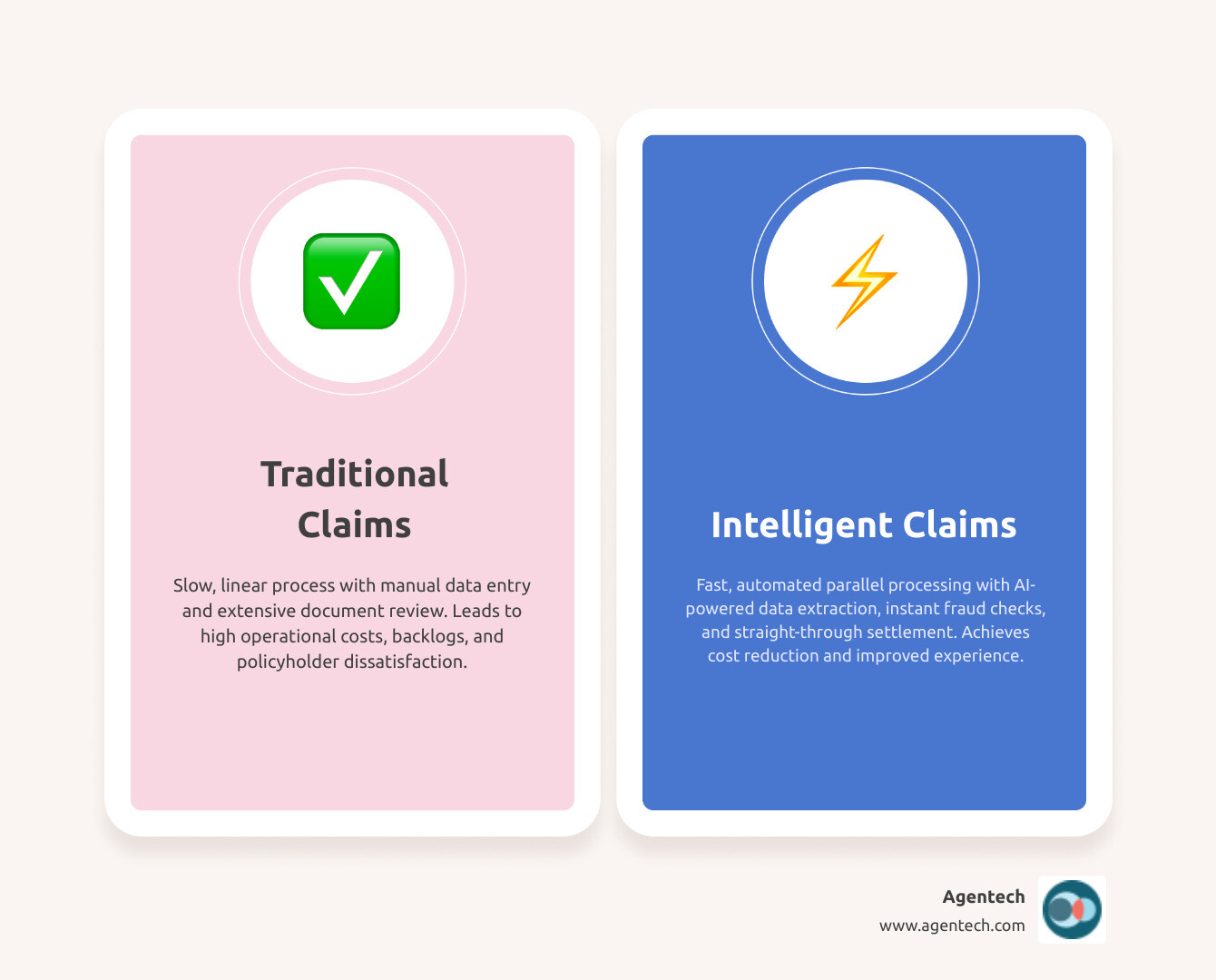
At its core, intelligent claims software uses artificial intelligence (AI) and automation to manage the P&C insurance claims lifecycle. Unlike traditional claims management systems that rely on manual data entry and rigid workflows, intelligent claims software leverages advanced technologies to learn, adapt, and make informed decisions. While traditional systems are reactive data recorders, intelligent claims software acts as a proactive data interpreter and decision-maker.
It incorporates key technologies:
- Artificial Intelligence (AI) & Machine Learning (ML): AI enables machines to simulate human intelligence, while its subset, ML, allows systems to learn from historical claims data to identify patterns, predict outcomes, and refine decisions without explicit programming [1]. You can learn more about this at Machine Learning in Claims Processing.
- Natural Language Processing (NLP): This AI component allows the software to read and extract relevant information from unstructured documents like emails, reports, and estimates, turning them into structured, actionable data [1, 2].
- Automation: Intelligent claims software automates repetitive tasks, workflow routing, data validation, and even adjudication for simple cases, freeing up adjusters for more complex work [1, 2].
How AI Improves the P&C Claims Process
AI and automation improve several stages of the P&C claims process:
- Claim Intake: AI streamlines claim reporting. Policyholders can submit information through various channels, and AI tools instantly capture and categorize the data, ensuring all necessary details are collected upfront [4, 6].
- Data Extraction: Using AI-OCR (Optical Character Recognition) and NLP, the software quickly reads and codifies information from forms, invoices, and photos, changing paperwork into clean, structured data for analysis [1, 2].
- Adjudication: For straightforward claims, AI can perform automated adjudication and settlement, a concept known as Straight Through Processing (STP) [1, 5]. For complex claims, AI acts as a "co-pilot," providing adjusters with recommendations and insights to make faster, more accurate decisions [3, 2].
- Fraud Detection: AI's ability to analyze vast datasets helps it flag suspicious claims by identifying inconsistencies, cross-referencing data, and detecting anomalies that a human might miss, significantly reducing leakage [1, 2].
- Reduced Human Error: By automating routine tasks, AI minimizes the chance of human error, leading to more accurate payouts and fewer processing mistakes [1].
These advancements not only accelerate the claims process but also ensure greater consistency and fairness. To dive deeper into how AI is revolutionizing this area, check out our article on AI Claims Processing for P&C Insurance.
Core Benefits of Adopting an Intelligent Claims Platform
The adoption of intelligent claims software is not merely a technological upgrade; it's a strategic move that delivers tangible benefits across the entire P&C insurance enterprise.
Boost Operational Efficiency and Reduce Costs
One of the most immediate benefits is a dramatic improvement in operational efficiency and cost reduction.
- Automate Repetitive Tasks: Intelligent claims software automates administrative processes like data entry and document classification, freeing up skilled adjusters to focus on complex cases requiring their expertise [2, 4].
- Faster Cycle Times: Automation and AI-driven insights drastically speed up the claims journey. Claims that once took weeks can be settled in hours or even minutes, especially simple claims eligible for straight-through processing [1, 4].
- Significant Cost Reduction: By reducing manual labor and optimizing workflows, P&C insurers can achieve substantial cost savings. Studies show companies can reduce claims journey costs by up to 30% [4] and achieve up to a 48% reduction in operating costs [2], directly lowering loss adjustment expenses (LAE).
- Increased Adjuster Productivity & Scalability: With AI handling routine work, adjusters can manage more claims. Cloud-based solutions also scale seamlessly to handle claim volume spikes during catastrophic events without needing extra staff [1, 2].
To learn more about how we help reduce administrative burdens, visit Reduce Administrative Burden.
Improve Accuracy and Mitigate Fraud
Accuracy and fraud mitigation are two critical areas where intelligent claims software truly shines.
- Reduced Data Entry Errors: Automating data extraction and validation drastically reduces manual errors, ensuring more accurate claim information from the start [1].
- Consistent Decision-Making: AI algorithms apply rules consistently, eliminating human bias and ensuring fair, compliant, and predictable outcomes [2].
- Predictive Analytics & Fraud Detection: Intelligent software uses predictive analytics to anticipate issues like litigation risk [3]. Its ability to analyze vast amounts of data helps identify complex fraud patterns that might escape human detection, significantly reducing leakage from incorrect or fraudulent payments [2].
For more on how machine learning specifically aids in this, explore Insurance Claims Machine Learning.
Lift the Policyholder Experience
In today's competitive P&C insurance market, customer experience is paramount. Intelligent claims software plays a pivotal role in elevating policyholder satisfaction and building trust.
- Faster Claims Resolution: For policyholders, the most significant benefit is speed. AI-driven automation means quicker processing and rapid payouts, which is what customers want most during a claim [1].
- Proactive Communication & Transparency: Intelligent systems can automatically keep policyholders informed at every step through their preferred channels, reducing anxiety and building confidence [4].
- Higher Satisfaction and Retention: A fast, accurate, and transparent claims experience leads to happier, more loyal policyholders. A superior claims experience is a key factor in retention, which is far more cost-effective than customer acquisition [2].
- Trust Building: Efficiently delivering on the promise of coverage reinforces the value of the policy and strengthens the P&C insurer-policyholder relationship.
Find how AI can improve customer service in insurance by reading AI Customer Service in P&C Insurance.
Key Features to Look for in Intelligent Claims Software
When evaluating intelligent claims software, certain features stand out as essential for maximizing efficiency, accuracy, and policyholder satisfaction in P&C insurance.

Automated Data Intake and Document Processing
Robust intake and processing capabilities are critical for handling varied claim data.
- Multi-Channel Intake: The claims software must ingest claims data from diverse sources like emails, mobile apps, web portals, and paper documents [4, 6].
- AI-OCR and Unstructured Data Extraction: AI-powered Optical Character Recognition (OCR) and Natural Language Processing (NLP) are vital for automatically extracting and digitizing information from unstructured documents, including scanned forms and handwritten notes, converting them into structured data [1, 2].
- Automated Profile Creation and Triage: The system should use extracted data to automatically create a claim profile, then triage and assign it to the most appropriate adjuster or team based on complexity and type, optimizing resource allocation [1, 4].
For a deeper understanding of how automation transforms document handling, check out Insurance Document Processing Automation.
Smart Adjudication and Workflow Automation
The heart of an intelligent claims software lies in its ability to automate decision-making and streamline workflows.
- Rules-Based Engines & STP: These engines apply predefined business rules to automate decisions. For simple, low-complexity claims, the software can achieve full Straight Through Processing (STP), settling the claim without any human touch [1, 5].
- Customizable Workflows: The claims software must offer flexible workflows that can be configured to match an insurer's specific processes across various P&C lines of business [4, 6].
- AI as a Co-Pilot: For complex claims requiring human judgment, the AI should act as a co-pilot. It provides adjusters with summarized data, actionable insights, and recommendations, empowering them to make faster, more confident decisions [2, 3].
Learn more about automated adjudication at Automated Claims Adjudication Software.
Actionable Analytics and Reporting
Data is powerful, but only if it's translated into actionable insights.
- Real-Time Dashboards and Metrics: The claims software should provide intuitive, real-time dashboards showing claim statuses, volumes, and key performance indicators like cycle times, settlement costs, and customer satisfaction [4].
- Trend and Bottleneck Identification: Analytics should identify emerging trends and pinpoint bottlenecks in the claims process, helping managers optimize workflows and allocate resources effectively [4].
- Data-Driven Insights: The data generated can provide deeper risk insights for loss prevention, product development, and pricing strategies.
For a closer look at how data drives better outcomes, see Insurance Claims Analytics Software.
Seamless Integration and Security
An intelligent claims software is only as good as its ability to connect with your existing ecosystem and protect sensitive data.
- API Framework: A robust API framework is crucial for seamless integration with existing core systems like policy administration, billing, and CRM platforms, ensuring consistent data flow [4, 6].
- Integration with Core Systems: The solution should complement, not replace, established core systems. It should improve their capabilities by automating tasks and providing intelligence without disrupting operations [2].
- Cloud-Based and Secure: Modern solutions are typically cloud-based for scalability and accessibility [6]. Top-tier security is non-negotiable, with features like encryption, access controls, and compliance with standards like SOC II to protect sensitive data [1, 4].
Understanding the landscape of insurance software systems is key; explore InsureTech Made Easy: Understanding Insurance Software Systems. We also prioritize Security in all our solutions.
Implementation, Challenges, and Future Trends
Adopting intelligent claims software is a journey, not a destination. Understanding the path ahead, potential problems, and emerging innovations is crucial for success.
Navigating Adoption and Integration
Implementing new P&C claims technology, especially claims management software that reshapes core operations, requires careful planning.
- Implementation Timeline: Timelines vary based on complexity, but vendors should offer clear roadmaps, with some solutions deploying in just a few weeks [3, 4]. For many P&C insurance carriers, TPAs, and IA firms, a phased rollout by line of business or region helps manage risk and demonstrate early wins.
- Data Migration and Change Management: Moving historical claims data requires robust tools and support [3]. Equally important is change management: employees need training and a clear understanding of the benefits to ensure successful adoption. Aligning underwriting, claims, and IT stakeholders early in the process reduces resistance and clarifies ownership.
- Vendor Selection and ROI: Choose a partner with proven industry expertise and a track record of delivering a clear Return on Investment (ROI) through cost savings and efficiency gains [1, 4]. Look for case studies in Property & Casualty lines similar to your own mix of residential property, auto, pet, and workers' compensation claims.
- Mitigating Tech Debt: Modern, cloud-based claims software helps alleviate "tech debt"—the cost of maintaining outdated legacy systems—by providing a more sustainable platform [6]. Deciding whether to buy or build your own AI components is a strategic choice; we cover the tradeoffs in detail in Buy vs. Build: Navigating the SaaS AI Technology Decision.
For additional context on how global carriers are modernizing claims platforms, the Insurance Information Institute provides helpful industry background on Property & Casualty market trends [9].
The Future of Intelligent Claims Software
The evolution of intelligent claims software is relentless, driven by advancements in AI and the increasing demands of the P&C insurance market.
- Agentic AI: The P&C insurance industry is moving into the "Agentic Insurance era." Agentic AI systems can autonomously plan and execute multi-step tasks, reasoning over context to select the optimal strategy for a claim, similar to a human specialist [2].
- Hyperautomation: This trend combines AI, machine learning, and other technologies to automate as many business processes as possible, creating a seamless, end-to-end P&C claims experience that connects intake, coverage analysis, investigation, and payment.
- AI as Digital Co-Workers: The future sees AI agents working alongside adjusters as "digital co-workers." These AI assistants handle routine tasks and provide recommendations, allowing human staff to focus on empathy, negotiation, and complex problem-solving.
- Predictive and Proactive Capabilities: AI's ability to predict claim outcomes, fraud, or litigation risk will become more sophisticated, enabling P&C insurers to manage exposure proactively. These insights will also inform broader risk mitigation and loss prevention strategies across residential property, auto, pet, and workers' compensation books of business. Global initiatives like the European Union's Horizon 2020 Research and Innovation Programme are funding advancements in AI, demonstrating the commitment to pushing these technological boundaries [8]. You can learn more about current EU research priorities at the official European Commission research and innovation portal.
Explore the evolution of AI in claims at Transforming Insurance Claims: The Evolution from Generative AI to Agentic AI.
Frequently Asked Questions about Intelligent Claims Solutions
We often hear common questions about how intelligent claims software integrates into existing operations and delivers value. Let's address some of them.
How does this software handle complex claims that require human judgment?
Intelligent claims software is designed to empower adjusters, not replace them, especially on complex P&C claims where human judgment is essential. The AI acts as an advanced "co-pilot" in several ways [3]:
- Data Summarization: The AI sifts through all claim-related documents and provides adjusters with concise summaries of key information, saving hours of manual review [2].
- Actionable Recommendations: The software offers recommendations, such as potential settlement ranges or next best actions, often explaining the rationale to build adjuster confidence [2].
- Hybrid Workflows ("Human in the Loop"): The system automates routine steps but seamlessly routes complex or ambiguous cases to a human adjuster for review and final decision, ensuring accuracy and compliance [1].
Can intelligent claims software integrate with our existing core systems?
Absolutely. Modern intelligent claims software is built for integration. Leading solutions feature an API-first design, allowing them to connect securely with other applications like your policy administration, billing, and CRM systems [2, 3, 4, 6]. The goal is to improve your current ecosystem, not disrupt it. The software acts as an intelligent layer that automates tasks and provides insights without requiring a complete overhaul of your IT landscape [2].
To understand how this fits into your broader technology strategy, see Insurance IT Systems.
What is the typical ROI from implementing intelligent claims software?
The Return on Investment (ROI) from implementing intelligent claims software can be substantial and multifaceted, impacting both financial performance and customer loyalty.
- Cost Savings: By automating tasks and streamlining workflows, P&C insurers can achieve significant operational cost reductions, with some reporting savings of up to 48% [2].
- Leakage Reduction: Superior AI-powered fraud detection and consistent decision-making reduce claim leakage from incorrect or fraudulent payouts, directly boosting profitability [2].
- Increased Adjuster Capacity: Freeing adjusters from administrative work increases their capacity to handle more complex claims and provide better service [1].
- Improved Policyholder Retention: A faster, more transparent claims process leads to higher customer satisfaction and retention [2]. Retaining customers is far more cost-effective than acquiring new ones.
These benefits combine to create a compelling business case for adopting intelligent claims software, driving both efficiency and competitive advantage. For more on improving efficiency, read Efficient Claims Handling.
Transform Your Claims Operations with AI
The P&C insurance landscape is evolving rapidly, and staying competitive means embracing innovation. Intelligent claims software offers a clear path to changing your claims operations, moving beyond the limitations of traditional systems to a future where efficiency, accuracy, and policyholder satisfaction are paramount.
We've seen how these powerful claims management solutions can:
- Boost Efficiency: By automating mundane tasks, accelerating cycle times, and providing scalability for demand spikes across residential property, auto, pet, and workers' compensation claims.
- Improve Accuracy: Through reduced human error, consistent decision-making, and powerful fraud detection capabilities.
- Lift Customer Satisfaction: By delivering faster resolutions, proactive communication, and a transparent claims experience.
Crucially, this is not about replacing your skilled adjusters. It is about empowering them. By handling the routine and providing intelligent insights, intelligent claims software allows your team to focus on what they do best: applying their expertise, exercising empathy, and building strong relationships with policyholders.
At Agentech, we believe in building an AI workforce that works with your human team, enhancing their capabilities and opening up unprecedented levels of productivity. Our always-on AI assistants integrate seamlessly with your existing P&C claims systems, so carriers, TPAs, and Independent Adjusting Firms can open up AI value without disrupting current operations.
Ready to see how our AI agents can transform your claims process? Explore our ensemble of AI Agents and find a smarter way to manage claims.
Citations:
- AI-powered insurance software platforms and their applications in claims processing, 2024
- Industry research on claims automation and operational efficiency in P&C insurance, 2024
- Claims intelligence and decision support systems for insurance carriers, 2024
- Modern claims management software capabilities and implementation strategies, 2024
- P&C insurance core systems and straight-through processing technologies, 2024
- Digital claims management tools and integration frameworks, 2024
- Artificial intelligence applications for insurance decision-making, 2024
- European Commission Horizon 2020 Research and Innovation Programme, SME Instrument and FET Flagship initiatives
- McKinsey & Company, "Claims in the digital age: How insurance carriers can get started," 2023, and Insurance Information Institute Property & Casualty market analysis