
What a Wearable AI Pendant Actually Does (And Why Claims Teams Are Paying Attention)
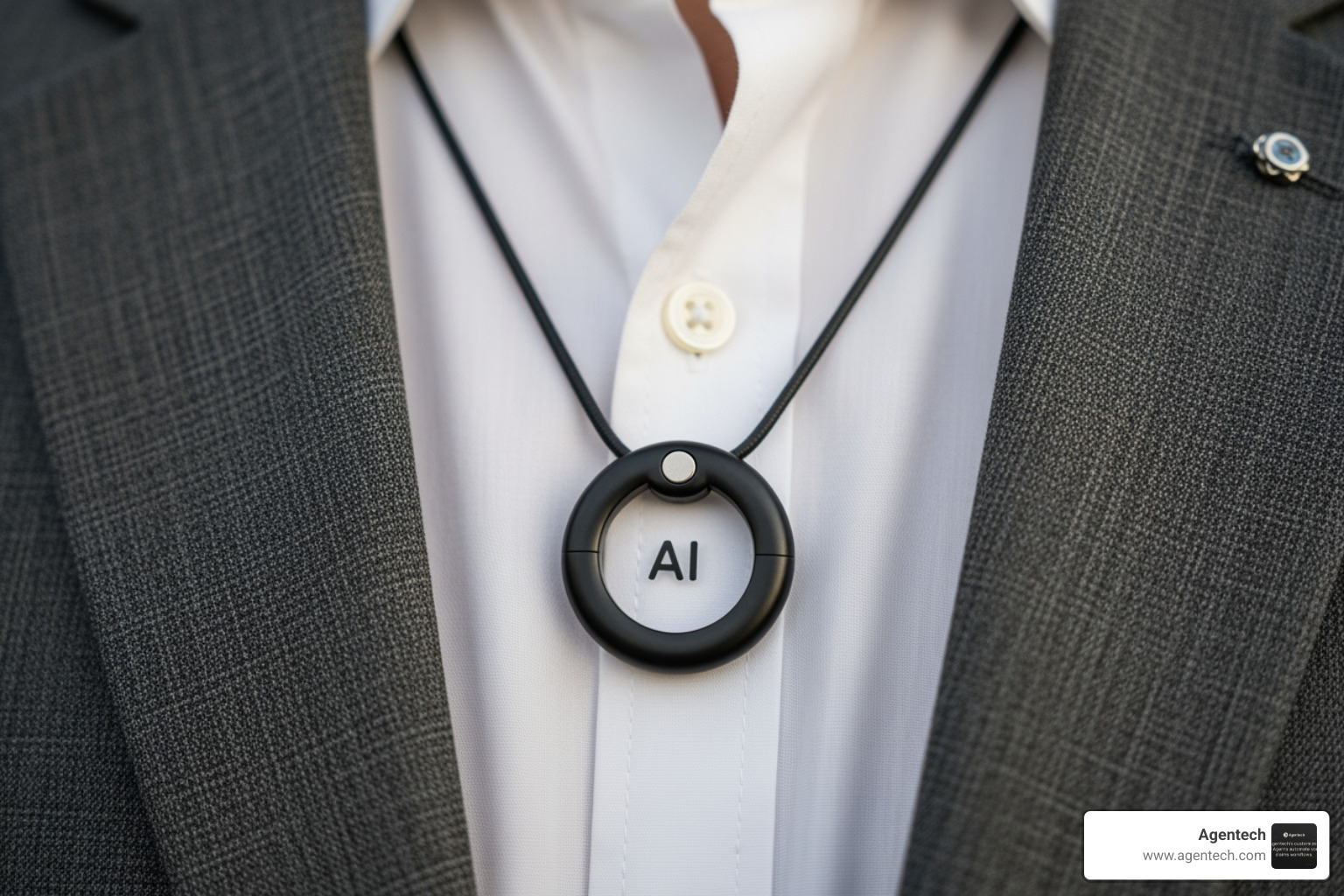
A wearable AI pendant is a small, clip on or necklace style device that passively listens to conversations, transcribes speech in real time, and uses AI to generate summaries, action items, and searchable memory logs, all without requiring you to touch your phone.
Here is a quick overview of common features buyers compare when evaluating these devices as of May 2026:
| Feature Area | What to Look For | Why It Matters for P&C Insurance |
|---|---|---|
| Battery life | All day to multi day use | Supports long field inspection schedules |
| Speech recognition | Strong diarization and noise handling | Helps separate adjuster, claimant, and witness statements |
| Privacy controls | Mute switch, consent indicators, local processing | Supports compliant field use |
| Language support | Multilingual transcription | Useful in diverse residential property and auto claim environments |
| Integration | Export to claims management software or API access | Reduces manual re entry for IA firms, TPAs, and carriers |
These devices are no longer niche gadgets. They sit at the intersection of ambient computing, voice AI, and wearable hardware, and they are starting to show up in professional field settings, including P&C insurance inspections and claims interviews.
For a busy claims manager, the core appeal is simple: stop relying on handwritten notes or memory during field visits, and let the device capture everything automatically.
I'm Alex Pezold, founder of Agentech, and my background scaling data intensive technology businesses, including a successful exit from TokenEx in 2021, gives me a practical lens for evaluating where wearable AI pendant technology delivers real workflow value versus where it is still catching up. In the sections below, I'll break down exactly what these devices can and cannot do for P&C insurance professionals.
For broader context on the category, wearable technology has steadily expanded from simple fitness trackers into professional tools for documentation, communication, and workflow support.
The Evolution of the Wearable AI Pendant
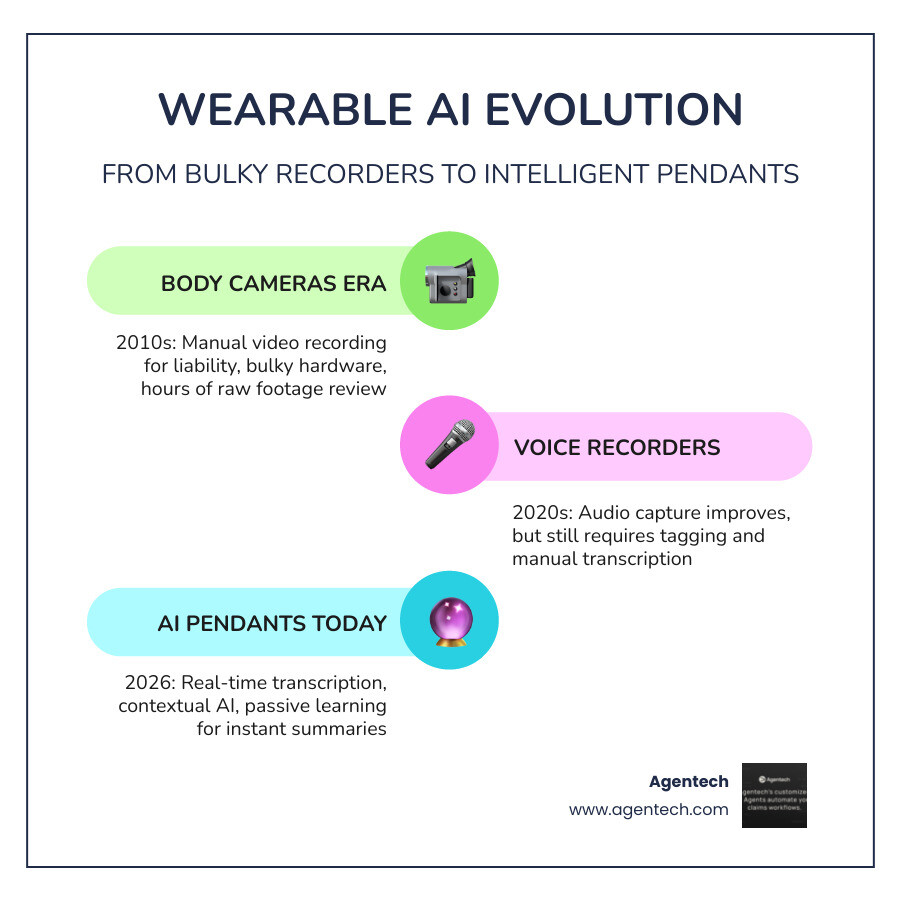
The journey of wearable technology in professional sectors has shifted dramatically over the last decade. We have moved from the era of bulky body cameras, often used for liability and raw recording, to the era of the wearable AI pendant. These modern devices do not just record audio; they understand it.
In Property & Casualty insurance, the transition to ambient context is a game changer. Earlier wearables required manual tagging or hours of review. Today’s pendants use passive learning to build an understanding of the user’s world. For example, a device might recognize the difference between a casual conversation and a formal recorded statement during a residential property inspection.
This evolution is largely driven by Retrieval Augmented Generation (RAG). By using RAG, these devices can connect the live audio they hear to existing knowledge bases. For an adjuster, this means the pendant isn't just a recorder; it's a bridge to Agentech | AI Agents for P&C Insurance that can help verify policy details or claim history on the fly. Instead of a "dumb" file sitting on a memory card, the data becomes a living part of the claims management software ecosystem.
Core Features and Technical Capabilities
What makes a wearable AI pendant different from a standard voice recorder? It comes down to the intelligence packed into the hardware. Many devices now include advanced speaker recognition, which allows the AI to distinguish between the adjuster, the claimant, and any third party witnesses. This is vital for creating accurate transcripts with proper attribution.
Furthermore, these devices are designed to handle the messy reality of the field. They use noise filtering to reduce wind on a roof or traffic during an auto claim inspection. Some devices also run compact on device models for faster processing and stronger privacy controls by reducing reliance on a constant cloud connection.
Transcription Accuracy in a Wearable AI Pendant
For P&C insurance carriers and Independent Adjusting (IA) firms, accuracy is non negotiable. If a transcript misses a key detail about a water damage source, the entire claim file can be compromised. Leading tools in this category often report high transcription accuracy in strong recording conditions.
These systems offer real time processing and can adapt to language shifts. Some wearable AI pendant tools also support a wide range of languages and dialects. This is particularly useful for adjusters working in diverse metropolitan areas, helping ensure that important details are captured clearly during a recorded statement or site interview.
Multimodal Sensing and Agent Orchestration
The latest generation of wearables has moved beyond just microphones. We are now seeing multimodal sensing that can include physiological sensors and gesture based controls for hands free operation. A simple tap can bookmark a specific moment in a conversation for later review.
This hardware can work in tandem with agent orchestration inside Agentech | Claims Management Software. Imagine finishing an inspection and saying, "Agent, draft the initial loss report," and having a structured summary waiting in your claims management software by the time you get back to your truck.
Privacy Standards and Data Security Protocols
When we talk about always listening devices, privacy is the first question everyone asks. This is especially true in the P&C insurance industry, where teams handle sensitive personal and financial data. To address this, many manufacturers have moved toward zero knowledge architecture. This means that voice data is encrypted locally on the device, and the service provider does not have the keys to listen to recordings.
Consent and Always Listening Functionality
Navigating the ethics of recording requires clear protocols. Most professional grade pendants now include permission based protection. This might include a physical mute switch or a status indicator, such as a glowing LED, to let others know the device is active. Some devices are also designed to minimize retention of raw audio, processing transcription quickly and limiting storage where privacy policies require it.
Secure Data Transit and Storage
For any data that does leave the device, end to end encryption is the standard. Using TLS tunnels, information can be moved securely to the cloud for deeper analysis. In Property & Casualty insurance workflows that may involve workers' compensation claim documentation, strong compliance controls are especially important when sensitive information is discussed. Agentech | Secure Data Protocols help ensure that the integration between these wearables and the broader claims management software environment remains secure and compliant.
Professional Use Cases in P&C Insurance
The practical application of a wearable AI pendant in the field is where the ROI becomes clear for IA firms and TPAs.
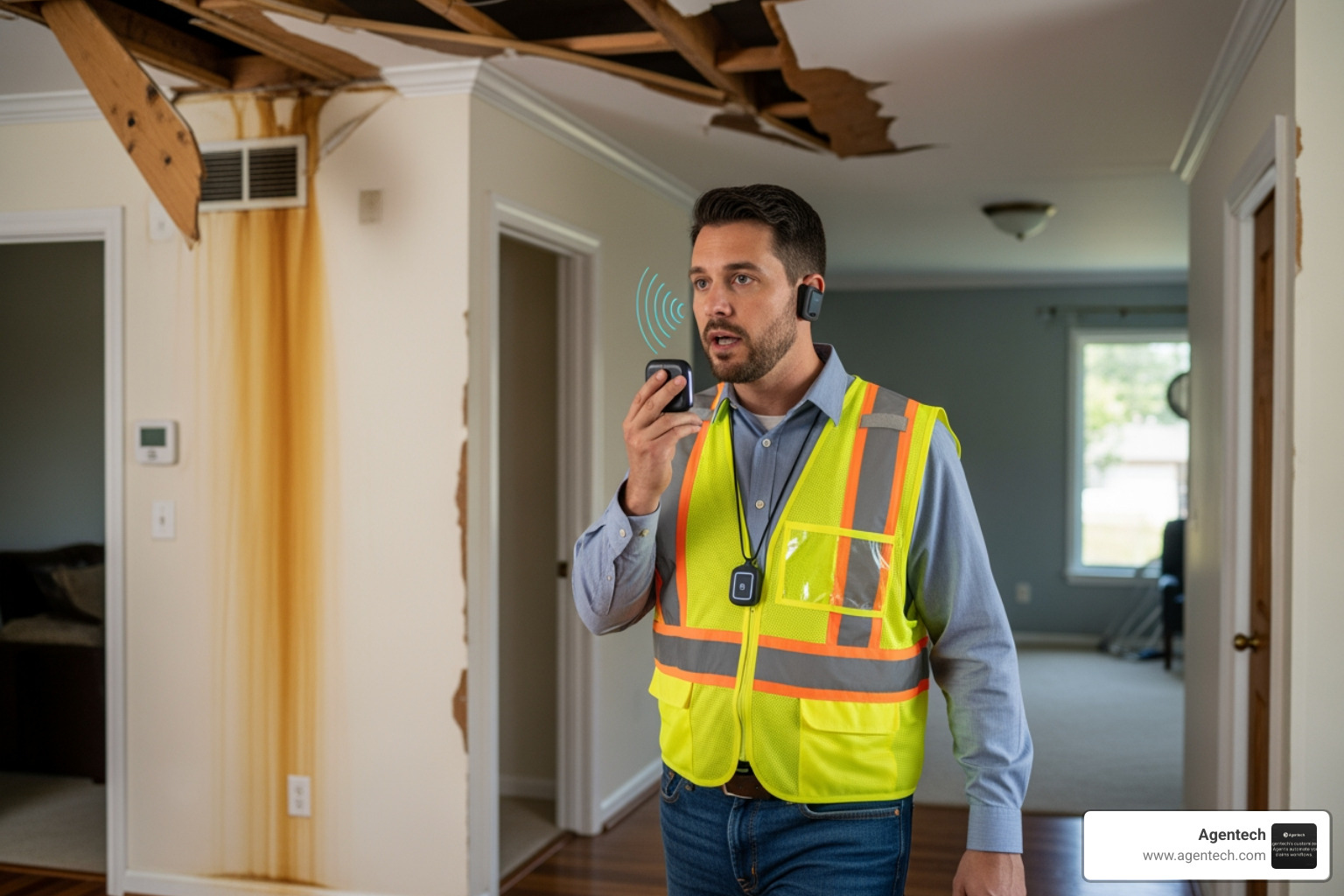
- Residential property: Adjusters can walk through a damaged home, narrating their findings out loud. The AI captures the dimensions, materials, and damage descriptions, automatically organizing them into a searchable log.
- Auto claims: During a roadside inspection, the pendant can record the claimant's statement while the adjuster’s hands are busy taking photos or inspecting the chassis.
- Workers' compensation: The device can summarize interviews with injured workers or providers involved in the claim, helping capture details about the mechanism of injury accurately for Property & Casualty insurance workflows.
- Pet insurance: For veterinary related claim handling, the pendant allows for hands free note taking while observing or handling animals.
Design Trends for the Wearable AI Pendant
The hardware itself has become much more rugged and practical. We are seeing a move toward magnetic clasps that allow the device to be clipped to a shirt, a jacket, or worn as a necklace. Durability is also improving, with many devices offering water resistance that can handle a rainy day on a roof.
Battery life has also improved. Many buyers now look for multi day battery performance so an adjuster can get through a busy field schedule with fewer charging interruptions.
Enhancing Adjuster Productivity and Recall
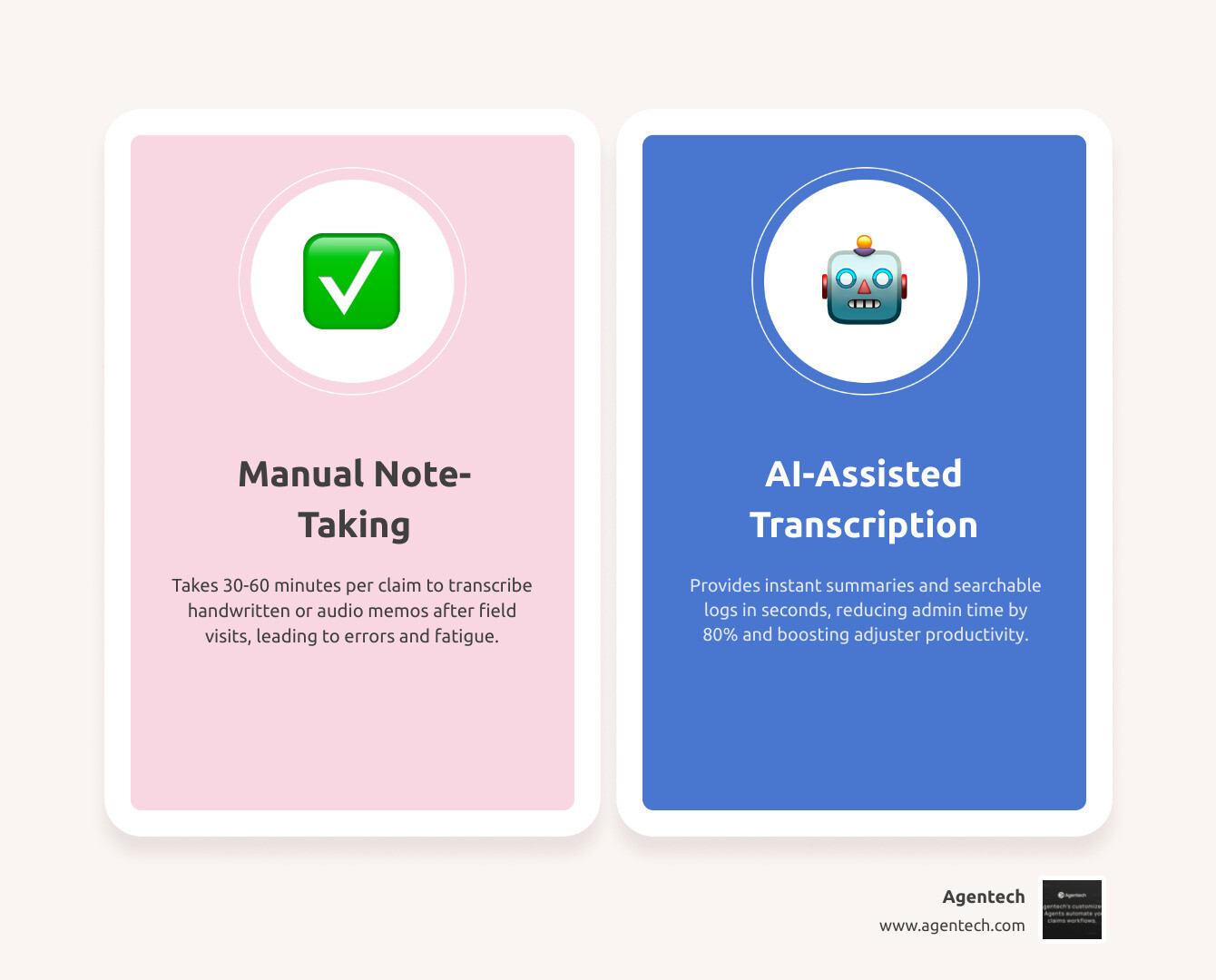
The ultimate goal of these tools is to boost productivity. By creating searchable knowledge bases from every conversation, IA firms and TPAs can reduce the time spent on administrative rework. Instead of transcribing a recorded memo later that night, the adjuster has an instant meeting summary and a list of action items.
Conclusion
At Agentech, we believe that the future of the P&C insurance industry lies in empowering humans with better tools. The wearable AI pendant is a significant part of that shift. By handling the repetitive task of documentation and organization, these devices allow adjusters to focus on what they do best: making informed, empathetic decisions.
Our AI powered automation tools are designed to work alongside this hardware, providing P&C insurance carriers, TPAs, and IA firms with the seamless integration they need to turn raw audio into actionable data within their claims management software. If you're ready to see how ambient intelligence can transform your workflow, it's time to Learn more about AI agents.
Frequently Asked Questions
How accurate is the transcription in noisy environments?
Many professional wearable AI pendant tools are designed for strong performance in challenging conditions. They use noise filtering and multiple microphones to better isolate the speaker's voice in windy or high traffic environments common in P&C insurance field work.
What are the typical subscription costs for AI pendants?
Pricing varies by vendor and feature set. Some tools use a lower upfront hardware cost with an added monthly plan, while others bundle software access into a higher annual membership. For P&C insurance teams, total cost should be evaluated alongside privacy controls, battery life, and claims management software integration.
How do these devices handle user privacy and consent?
Leading devices often use local encryption, controlled cloud transfer, and clear recording indicators such as status lights or mute buttons. For P&C insurance carriers, TPAs, and IA firms, internal consent and recording policies remain just as important as the device's technical safeguards.
Citations:
- Limitless AI Pendant Product Page, oncely.com
- WIRED Friend AI Necklace Review, wired.com
- Limitless Acquisition Announcement, limitless.ai
- Bee Product Landing Page, bee.ai
- Omi vs Limitless Comparison Blog, omi.ai
- Fieldy Product Information Page, fieldy.ai
- AIBA Technologies Landing Page, aibatech.com
- Onbody AI Product Page, onbodyai.com
- Reflecti Product Information Page, getreflecti.com
- Legend Memory AI Pendant Page, legenddevice.com
- Regal.ai RAG Technical Explainer, regal.ai
- Wearable Technology, Wikipedia, https://en.wikipedia.org/wiki/Wearable_technology