

Why Claims Management Systems Are the Backbone of Modern P&C Insurance
Claims management systems are claims software platforms that handle the full lifecycle of a Property & Casualty insurance claim, from the first notice of loss all the way through to final settlement.
Here is a quick overview of what they do and who they are for:
| What | Details |
|---|---|
| What they are | Claims software platforms that organize, track, and process P&C insurance claims |
| Who uses them | P&C carriers, TPAs, and IA firms |
| Core functions | FNOL intake, assignment, investigation, reserving, payments, and closure |
| Key benefits | Faster settlements, lower costs, fraud detection, and better policyholder experience |
| Deployment | Primarily cloud based SaaS for scalability and rapid updates |
If you manage claims for a P&C carrier, TPA, or IA firm, the pressure is real. Manual data entry slows everything down. Adjusters juggle too many tools. And every day a claim stays open costs money.
The claims management software market has grown well ahead of the broader economy, reflecting just how critical these platforms have become. According to IBISWorld research, industry value added for claims management software was projected to grow at an average of 3.8% annually, compared to 2.5% for U.S. GDP over the same period.
The technology has also changed dramatically. What started as basic financial tracking and document storage has evolved into data driven processing engines that connect to dozens of ecosystem partners, automate routine decisions, and give adjusters real time guidance on every claim.
I'm Alex Pezold, founder of Agentech AI, where we build AI workforce solutions specifically for P&C insurance claims management systems and processing workflows. Before Agentech, I founded and scaled TokenEx, one of the largest technology exits in Oklahoma's history, which gave me a deep understanding of how technology transforms complex, high volume operations. In this guide, I'll break down the essential capabilities and what actually matters when evaluating them.
The Evolution of Modern Claims Management Systems
Looking back at the history of the Property and Casualty (P&C) industry, it is clear that we have come a long way from the days of paper files and spreadsheets. Early claims management systems were little more than legacy financial tracking tools. They were designed to record notes and track payments, but they didn't actually do much to help the adjuster. They were reactive rather than proactive.
Today, we are in the middle of a massive digital transformation. Modern systems have evolved into data driven processing engines. Instead of just storing information, they analyze it. They connect with external data sources like weather reports for residential property claims or vehicle history reports for auto claims.
The biggest shift we have seen is the migration to the cloud. By moving away from on premise servers, P&C insurance carriers can now access Software as a Service (SaaS) models that offer incredible scalability. Whether you are a small Third Party Administrator (TPA) or a massive global carrier, cloud based platforms allow you to pay for what you use and scale up instantly when a major catastrophe (CAT) event hits. This shift also means faster access to new features, as updates are rolled out automatically without needing a massive IT project. To get the most out of these platforms, insurers often look for specific Claims Management Tools that can plug into their existing infrastructure.
Core Capabilities of Claims Management Systems
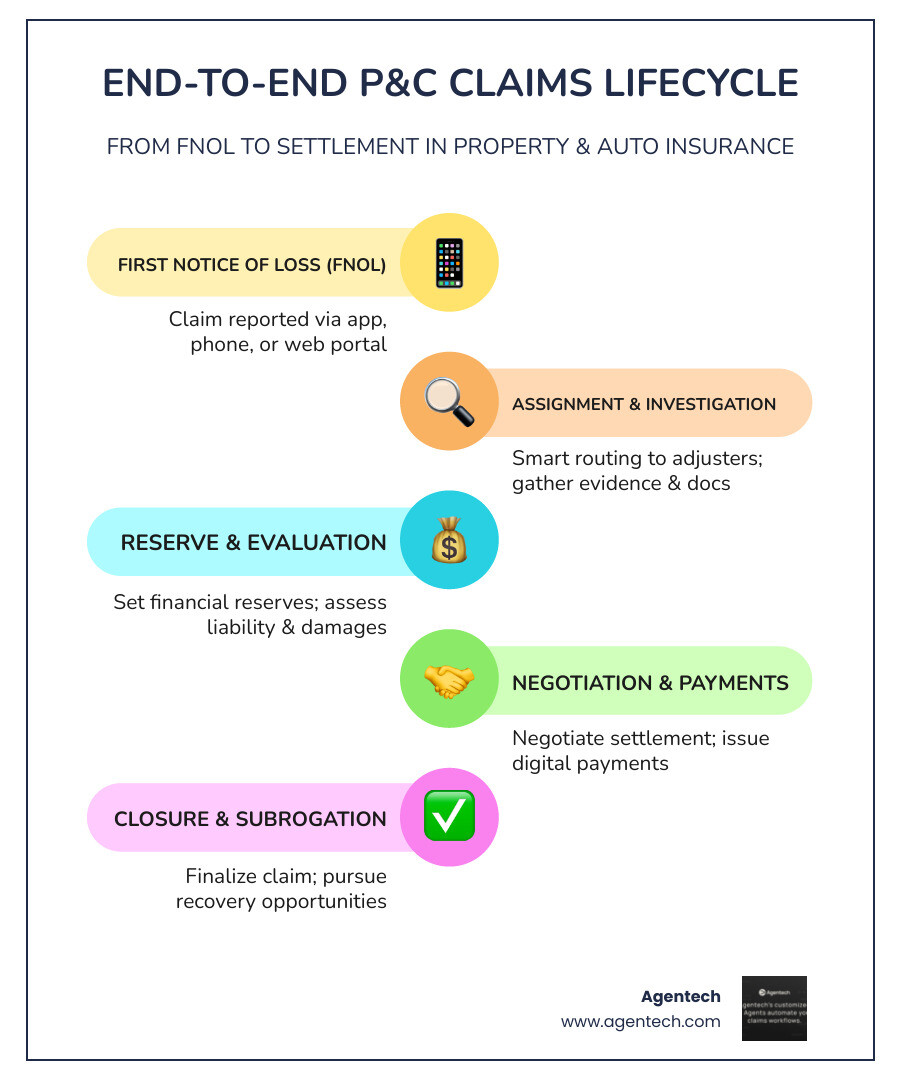
At the heart of any robust platform are several core capabilities that keep the wheels of an insurance company turning. It all starts with the First Notice of Loss (FNOL). Modern claims management systems use dynamic, wizard based questions to capture incident data accurately from the very first moment. Research shows that claims captured accurately at the start have significantly better outcomes than those that are delayed or poorly documented.
Once a claim is in the system, reserve management becomes critical. The software helps adjusters set aside the right amount of money to cover the expected cost of the claim, maintaining a complete audit trail for financial and regulatory compliance. Then there is subrogation, which is essentially the process of recovering costs from a responsible third party. This is an area where many companies lose money because adjusters are often too focused on closing the file to look for recovery opportunities. Modern Ai Driven Claims Management can automatically flag these opportunities, ensuring that carriers don't leave money on the table.
Key Features of Leading Claims Management Software
When we evaluate the top players in the market today, a few standout features separate the leaders from the laggards. One of the most important is smart assignment. Instead of a supervisor manually handing out files, the system uses rules to route claims based on an adjuster's skill set, licensing, geography, and current workload. This ensures that a complex residential property fire isn't assigned to someone who usually handles minor auto glass claims.

Document management has also seen a huge upgrade. We are moving toward a paperless environment where every photo, recorded statement, and property damage report is stored electronically and accessible 24/7. Omnichannel communication is another game changer. Policyholders now expect to interact with their insurer via text, mobile apps, or web portals. Leading claims management systems integrate these communications directly into the claim file, so the adjuster always has the full context of the conversation. Many firms are now looking for Claims Management Automation Solutions to tie these features together into a seamless experience.
Enhancing Efficiency with Claims Management Systems
Efficiency isn't just about working faster; it's about working smarter. Modern platforms use no code or low code configuration, allowing non technical managers to change workflows or add new data fields without waiting for the IT department. This flexibility is vital in a "hard market" where regulations and business needs change rapidly.
API integration and ecosystem connectivity are the lifeblood of real time processing. A modern system shouldn't be an island. It needs to talk to your policy administration system, your billing claims software, and external vendors like repair shops or veterinary networks. According to Datos Insights research, modern systems emphasize this ecosystem connectivity and faster feature access through cloud deployment. This allows for straight through processing (STP), where simple, low complexity claims can be adjudicated and paid in minutes without a human ever having to touch the file.
The Role of AI and Automation in P&C Insurance
AI is no longer a futuristic concept; it is a practical tool that we use every day to make adjusters more productive. One of the most powerful applications is predictive modeling. By looking at millions of past claims, AI can identify "sleeper claims," cases that look simple on day one but have hidden indicators that they will become expensive or litigated in the future. Detecting these early allows for proactive intervention, which can save millions in loss costs.
Fraud detection is another area where AI shines. Instead of relying on an adjuster's "gut feeling," the claims software analyzes data patterns to flag suspicious activity before a payment is made. This is essential for maintaining a healthy bottom line for P&C insurance carriers and TPAs. Proper Insurance Process Management now requires these automated guardrails to reduce rework and human error.
Future Trends in Claims Management Systems
As we look toward the remainder of 2026 and beyond, Generative AI is taking center stage. We are seeing AI assistants that provide real time guidance to adjusters, suggesting the next best action or summarizing long claim files in seconds. This doesn't replace the human. It scales their expertise.
Digital payments are also becoming the standard. We have seen systems that can issue a payment to a policyholder's digital wallet in as little as 15 seconds after a settlement is reached. Self service portals are becoming more sophisticated as well, allowing policyholders to manage their entire claim journey from their phone. Gartner Peer Insights reports that top rated systems now prioritize end to end automation to reduce manual intervention for P&C insurance carriers, focusing on a "touchless" experience for simple claims.
Overcoming Implementation Challenges in Claims Management Software
Switching to a new system is a big undertaking, and it’s not without its hurdles. Data migration is often the biggest headache. Moving decades of old claim data into a modern architecture requires careful planning to ensure nothing is lost or corrupted.
User training is equally important. Even the best claims software won't provide a return on investment (ROI) if the adjusters don't know how to use it. We've found that involving end users early in the design phase and providing hands on training can significantly speed up adoption. Finally, security and compliance are non negotiable. In 2026, any serious vendor must provide SOC 2 Type 2 compliance and robust data encryption to protect sensitive claimant information.
Deployment and Scalability Comparison
Choosing between cloud based and on premise deployment is a strategic decision that depends on your firm's specific needs. While some legacy carriers still prefer the perceived control of on premise systems, the industry is overwhelmingly moving toward the cloud.
| Feature | Cloud Based (SaaS) | On Premise |
|---|---|---|
| Scalability | Instant and unlimited | Limited by hardware |
| Maintenance | Handled by vendor | Handled by internal IT |
| Security | Managed by experts (SOC 2) | Depends on internal team |
| Initial Cost | Lower (Subscription) | Higher (Hardware/Licensing) |
| Updates | Automatic and frequent | Manual and time consuming |
For TPAs and IA firms that need to be nimble, the cloud is almost always the right choice. It allows you to enter new markets or handle a sudden surge in property, auto, pet, or workers' comp claims without having to buy new servers.
Frequently Asked Questions about Claims Management
What is the difference between claims management and administration?
This is a common point of confusion. Claims administration is the "how"—the operational execution. It involves the day to day tasks like taking the FNOL, issuing payments, and ensuring compliance. Claims management is the "why"—the strategic analysis. It involves looking at the big picture, identifying trends in your portfolio, and optimizing the entire process to reduce the total cost of risk for P&C insurance lines.
How does AI improve the claims lifecycle?
AI acts as a force multiplier for adjusters. It identifies high risk sleeper claims early, allowing for specialized handling before costs spiral out of control. It also automates the boring stuff, like document processing and data entry, so adjusters can focus on the human side of the job. In auto and property claims, AI is particularly good at spotting subrogation opportunities and potential fraud that a busy human might miss.
What are the benefits of cloud based claims management software?
The main benefits are speed and flexibility. Cloud systems can be implemented much faster than old school software—sometimes in as little as 12 weeks. They also offer 99.9% uptime and the ability to scale resources instantly during a catastrophe event. For TPAs and IA firms, this means you can provide better service to your carrier partners without a massive upfront investment.
Conclusion
At Agentech, we believe the future of insurance isn't about replacing humans with machines; it's about giving humans the best possible tools to do their jobs. Our always on AI agents are designed to handle the repetitive administrative tasks that bog down adjusters, allowing them to focus on what they do best: helping people in their time of need. By integrating seamlessly with your existing claims management systems, we help P&C insurance carriers, TPAs, and IA firms boost productivity and improve outcomes without the need for a total system overhaul. If you are ready to see how AI Agents can transform your claims operation, we are here to help you navigate that journey.
Citations:
- IBISWorld, "Claims Management Software in the US," 2025.
- Agentech, "AI Agents for P&C Insurance Automation," 2025.
- Datos Insights, "Property/Casualty Claims Management Systems," 2025.
- Gartner Peer Insights, "Insurance Claims Management System Reviews and Ratings," 2025.
- Insurance Information Institute (III), "Trends in Property and Casualty Insurance Technology," 2025.
- Deloitte, "The Future of Claims in Property and Casualty Insurance," 2025.
- McKinsey & Company, "Digital Transformation in P&C Insurance Claims," 2025.
- National Association of Insurance Commissioners (NAIC), "Technology and Innovation in the P&C Insurance Industry," 2025.
- Agentech, "The Impact of AI on Claims Management Software Efficiency," 2025.