

Why Insurance Business Process Management Is the Fix Claims Teams Have Been Waiting For
Insurance business process management is a structured approach to designing, automating, monitoring, and continuously improving the workflows that run a P&C insurance operation — from First Notice of Loss through final settlement.
Here is a quick overview of what it covers and why it matters:
| Area | What BPM Does |
|---|---|
| Claims processing | Automates intake, triage, fraud checks, and settlement routing |
| Underwriting | Speeds up risk scoring and policy issuance |
| Policy servicing | Handles renewals, endorsements, and cancellations automatically |
| Compliance | Creates audit trails and enforces regulatory rules at every step |
| Document handling | Extracts and routes data without manual entry |
If you manage claims at a P&C carrier, TPA, or IA firm, you already know the problem. Adjusters spend hours on data entry. Claims bounce between departments. Policyholders repeat their story three times to three different people. And somewhere in that friction, money leaks out.
Claims leakage alone costs insurers roughly 5 to 10% of total claims payouts. Up to 70% of IT budgets at many carriers go toward keeping outdated legacy systems alive rather than building anything better. The paperwork does not just slow things down — it costs real money, every single day.
BPM is not just another software layer. It is the operating system that connects your people, your systems, and your data so that work flows in the right direction, at the right speed, every time.
This guide will show you exactly how to put it to work.
I'm Alex Pezold, founder of Agentech AI and a builder of technology solutions that solve real operational problems — most recently in the insurance space, where I've focused on applying AI to transform insurance business process management for carriers and claims teams dealing with the exact bottlenecks described above. My experience scaling technology businesses from the ground up gives me a practical, no-fluff perspective on what actually moves the needle for busy claims managers.
The Critical Need for Insurance Business Process Management
In Property & Casualty insurance, the pressure to modernize is no longer a "nice to have" goal for the future. It is a survival requirement in May 2026. Carriers, TPAs, and IA firms are currently wrestling with a perfect storm of challenges that make traditional, manual workflows obsolete.
The primary driver for adopting insurance business process management is the sheer weight of administrative burden. When a claim for a residential property or an auto accident comes in, it often triggers a chaotic sequence of manual tasks. Adjusters find themselves hunting for documents, re-entering data into multiple systems, and waiting for approvals that sit in email inboxes.
Beyond the internal frustration, several external factors make BPM adoption critical:
- Claims Leakage: As mentioned, 5 to 10% of total payouts are lost to inefficiencies, errors, and missed subrogation opportunities.
- Regulatory Compliance: The P&C industry is one of the most heavily regulated sectors. Each state has unique rules for claim timeframes and policy language. Without a structured BPM system, maintaining a clean audit trail is nearly impossible.
- Customer Expectations: Today’s policyholders expect a retail grade experience. They want to upload photos of a car accident and see progress in real time, not wait weeks for a paper check.
According to market growth projections for BPM, the global market for these solutions is expanding rapidly as carriers realize that digitizing a bad process just gives you a fast bad process. True BPM is about re-engineering the work itself. For a deeper dive into how this fits into the broader landscape, check out our Insurance Automation Complete Guide.
Overcoming Legacy System Constraints
One of the biggest hurdles we see is the "legacy trap." Many P&C carriers are running core operations on software built decades ago. These systems are often information silos where the claims platform cannot talk to the underwriting platform.
Maintaining this outdated infrastructure is a massive drain on resources. In fact, up to 70% of IT budgets in the industry are consumed just by keeping these "zombie" systems alive. This creates significant technical debt and prevents teams from adopting modern tools. Insurance business process management acts as a conductor for this disparate orchestra. It creates a "virtual API" layer, allowing modern automation to interact with old systems without requiring a full, multi-million dollar "rip and replace" project. This is a core component of Insurance Back Office Automation.
Addressing Regulatory and Compliance Risks
In P&C insurance, if it isn't documented, it didn't happen. Compliance isn't just about following the rules; it's about proving you followed them. State regulators, especially in sensitive areas like workers' compensation or pet insurance, demand transparency.
BPM solves this by building "compliance by design." Every action taken by an adjuster or an automated system is timestamped and logged. This creates an airtight audit trail that is ready for review at a moment's notice. By automating these checks, carriers can achieve 100% compliance adherence while reducing the risk of heavy fines or reputational damage. This level of security is fundamental to modern Insurance Automation Solutions.
Transforming Core P&C Operations through BPM
When we look at the core of a P&C business, BPM provides the most value in three specific areas: residential property, auto, and workers' compensation. These lines of business are high volume and high complexity, making them perfect candidates for better Insurance Process Management.

Streamlining Claims Management Software Workflows
The claims department is the largest cost center for any insurer. It is also where the most friction occurs. A well-designed insurance business process management strategy transforms the claims lifecycle:
- First Notice of Loss (FNOL): Instead of a phone call and a paper form, customers use mobile apps to upload photos and data. BPM immediately triages the claim based on severity and type.
- Fraud Detection: AI-driven BPM analyzes thousands of claims in real time to spot suspicious patterns that a human might miss.
- Settlement Speed: By automating routine approvals and documentation, cycle times can be cut by 50% to 70%.
Using the right Insurance Workflow Automation Software allows adjusters to focus on the 20% of claims that actually require human empathy and complex decision making, while the system handles the rest.
Optimizing Underwriting and Policy Servicing
Underwriting is often a bottleneck that prevents new business from coming in the door. If a prospect has to wait days for a quote, they will go to a competitor. BPM enables "straight-through processing" for simple risks. By integrating with external data sources, the system can score a risk and issue a policy in minutes.
For policy servicing, BPM handles the heavy lifting of renewals and endorsements. If a customer adds a new vehicle to an auto policy, the system updates the records, adjusts the premium, and sends the new ID cards without an employee ever touching a keyboard. These Insurance Automation Tools ensure that the back office stays lean and responsive.
Integrating AI and Automation into the Workflow
The modern BPM landscape is powered by a suite of technologies that work together to eliminate manual labor. This isn't just about simple "if-this-then-that" rules; it's about intelligent orchestration.
The Role of AI in Insurance Business Process Management
Artificial Intelligence is the "brain" of the modern BPM system. We are seeing a massive shift toward "agentic AI"—AI agents that don't just analyze data but actually perform tasks. According to scientific research on AI in insurance, AI can add over $1.1 trillion in value to the global insurance sector annually.
In P&C insurance, this looks like:
- Intelligent Document Processing (IDP): Automatically reading and extracting data from messy contractor invoices or police reports with 95% accuracy.
- Predictive Analytics: Identifying which claims are likely to escalate into expensive litigation before it happens.
- Decision Support: Providing adjusters with "next best action" recommendations based on historical data.
This is the ultimate way to Automate Insurance Processes without losing the human touch where it matters most.
Orchestrating Human and Digital Workers
The goal of insurance business process management is not to replace adjusters, but to give them "digital teammates." BPM acts as the conductor, routing simple tasks to digital workers (RPA and AI) and complex cases to human experts.
This orchestration boosts productivity by up to 40%. When an adjuster logs in, they don't see a pile of 500 emails. They see a prioritized list of tasks that require their specific expertise. The system has already gathered the documents, verified the coverage, and flagged potential issues. This results in Insurance Workflow Automation that actually makes the job more enjoyable for the staff.
Strategic Implementation and ROI
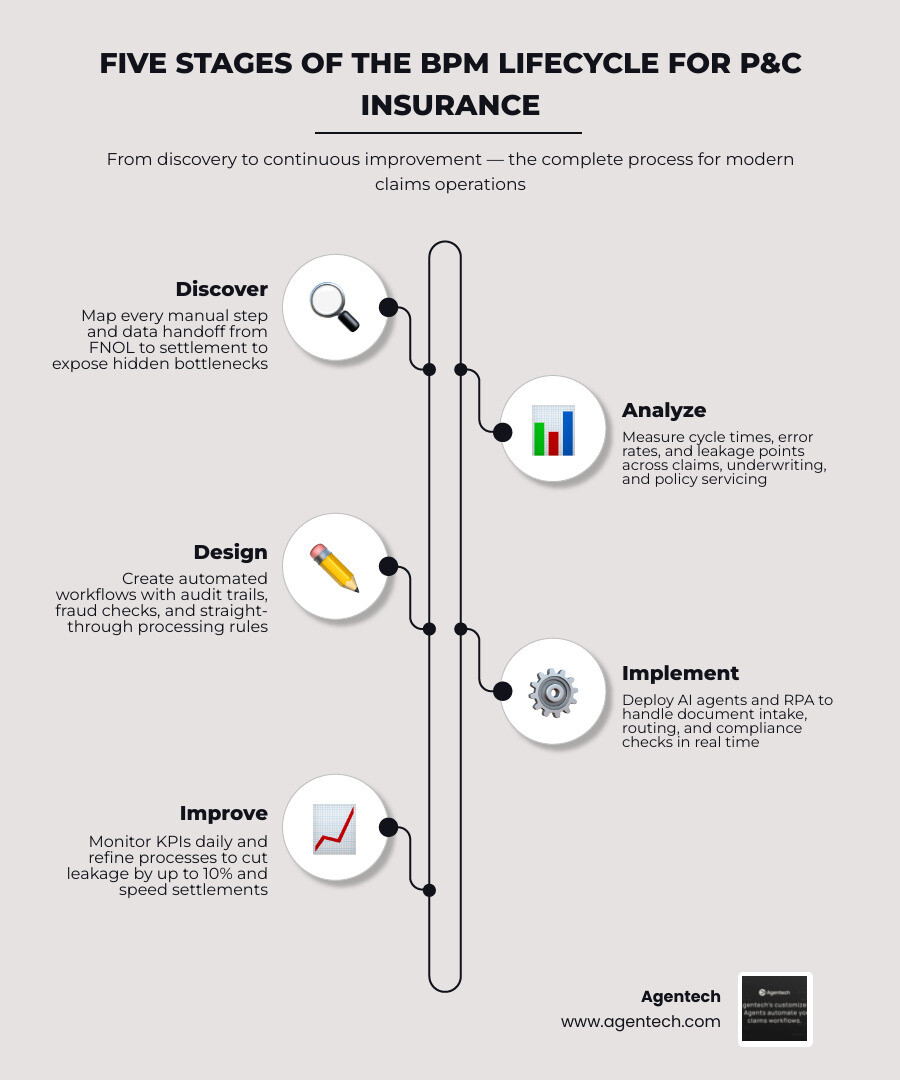
Moving from a manual nightmare to a streamlined BPM environment doesn't happen overnight. It requires a strategic approach. We recommend starting with a workflow assessment to map out your current "as-is" processes. Where are the bottlenecks? Where does the data get stuck?
| Process | Manual Method | BPM-Enabled Method | Improvement |
|---|---|---|---|
| Claim Intake | 20-30 minutes manual entry | Instant digital intake | 90% faster |
| Underwriting Cycle | 3-5 days | 2-4 hours (standard risks) | 70% reduction |
| Document Sorting | Hours of manual filing | Automated IDP & routing | 80% time savings |
| Error Rates | 5-10% due to fatigue | <1% through validation | 75% fewer errors |
Measuring ROI of Insurance Business Process Management
The return on investment for BPM is measurable and often rapid. Carriers typically see a 30% reduction in operational costs within the first few years. But the benefits go beyond just the bottom line.
Key Performance Indicators (KPIs) to track include:
- Cycle Time: How long does it take from FNOL to payment?
- Cost per Claim: Total administrative cost divided by number of claims.
- Customer Satisfaction (CSAT): Are policyholders happier with the speed and transparency?
- Employee Retention: Are your adjusters less burnt out because they aren't doing "grunt work"?
By focusing on these metrics, P&C firms can prove the value of their BPM initiatives and continuously optimize for even better results.
Frequently Asked Questions
How does BPM differ from simple workflow automation?
Simple workflow automation is usually about a single task, like sending an automated email when a form is submitted. Insurance business process management is an end to end discipline. It looks at the entire lifecycle of a process, coordinates between different systems and people, and includes tools for monitoring and continuous optimization. It is the difference between a single instrument and a full symphony.
What are the primary benefits for P&C carriers?
The biggest wins are reduced claims leakage, faster cycle times, and improved compliance. By standardizing how work is done, carriers ensure that every claim is handled according to best practices and regulatory requirements. This reduces the risk of human error and ensures that the company is operating at peak efficiency.
How does BPM address the talent shortage in claims?
The insurance industry is facing a massive talent gap as experienced adjusters retire. BPM helps in two ways. First, it captures the "tribal knowledge" of senior staff and builds it into the automated rules of the system. Second, it makes the job more attractive to new talent by removing the tedious, manual paperwork that often leads to burnout. It allows adjusters to focus on the high value, interesting parts of their roles.
Conclusion
At Agentech, we believe that the future of P&C insurance is not about choosing between humans and machines. It is about using insurance business process management to let each do what they do best. Our AI-powered tools are designed to sit right alongside your claims team, handling the administrative nightmare so your adjusters can focus on what really matters: helping people get back on their feet after a loss.
Operational excellence isn't a destination; it's a way of doing business. By embracing BPM, you aren't just fixing today's paperwork problem — you are future proofing your organization for whatever comes next.
Ready to see how digital teammates can transform your workflow? More info about AI agents is just a click away.
Citations:
- Datamatics, "Insurance Business Process Management to Accelerate Digitalization"
- Infosys BPM, "Optimising insurance business process management"
- Cflow, "Business Process Management for Insurance Companies"
- SS&C Blue Prism, "What is Business Process Management? A Guide to BPM"
- Agentech, "Mastering Insurance Process Management for Peak Efficiency"
- ISW, "Guide to Know About Insurance Business Process Outsourcing"
- Camunda, "Agentic AI in Insurance"
- Business Process Automate, "BPA for Insurance"
- DXC Technology, "DXC Assure BPM"