
Why Insurance Automation Solutions Are Reshaping P&C Insurance
Insurance automation solutions are changing how Property & Casualty carriers, TPAs, and IA firms handle everything from claims processing to underwriting. These technologies use AI, machine learning, and robotic process automation to eliminate manual data entry, accelerate workflows, and reduce costly errors.
Quick Answer: What Are Insurance Automation Solutions?
Insurance automation solutions are technologies that digitize and streamline P&C insurance operations. They automate claims processing (including FNOL intake, document classification, and damage assessment), underwriting (extracting data from submissions to assess risk and generate quotes faster), and policy administration (handling renewals, endorsements, and customer service). Key technologies include RPA for repetitive tasks, AI/ML for intelligent decisions, and Agentic AI for end to end automation. The measurable impact is significant, with firms seeing up to a 70% reduction in claims processing costs, 50% faster settlements, and 80% fewer data entry errors.
The challenges facing P&C insurance operations are significant. Claims managers face mountains of paperwork for residential property claims, auto accidents, and workers' compensation cases. Manual processes create bottlenecks, data entry errors lead to payment mistakes, and slow quote times frustrate brokers. Customer satisfaction drops when claims drag on, and the industry faces a labor shortage as experienced adjusters retire.
The cost of this inefficiency is staggering. Insurance fraud costs the U.S. $308.6 billion annually, while manual underwriting can consume 40% of an underwriter's time. However, change is underway. By 2030, McKinsey estimates that AI systems will manage over 90% of pricing and underwriting for many policies. Forward thinking P&C carriers are already seeing an 80% reduction in document processing time through automation.
This guide explains everything you need to know about insurance automation solutions. You'll learn what's driving adoption, which processes benefit most, and how technologies like Agentic AI are changing the game for claims operations in residential property, auto, pet, and workers' compensation insurance.
I'm Alex Pezold, founder of Agentech AI, where we're building the AI workforce for P&C insurance with a focus on revolutionizing claims processing through cutting edge insurance automation solutions. Before Agentech, I founded and scaled TokenEx, which became one of Oklahoma's largest technology exits in 2021.
The Driving Forces Behind Insurance Automation
The P&C insurance world is changing fast. For firms handling residential property claims, workers' compensation cases, or auto accidents, traditional methods are no longer sufficient. Insurance automation solutions are becoming essential for carriers, TPAs, and IA firms to remain competitive.

Several key factors are pushing firms to adopt automation to solve daily problems that impact profitability and employee satisfaction.
- Rising Policyholder Expectations: Customers are accustomed to instant, digital service in other industries. They expect the same speed and transparency when filing a P&C insurance claim. Long waits and manual paperwork lead to frustration and dissatisfaction.
- High Operational Costs: Manual claims processing is expensive. Repetitive tasks like data entry and document retrieval consume valuable resources. Digital solutions can reduce these operational costs by up to 40%, freeing up capital for strategic growth.
- Competitive Pressure: New, tech-savvy competitors are entering the P&C market with faster, simpler processes. Firms still relying on manual workflows risk falling behind.
- Labor Shortage: The P&C insurance industry faces a real labor shortage as experienced professionals retire. Automation helps bridge this gap by handling tedious administrative work, making jobs more appealing to a new generation of talent and allowing current staff to be more productive. You can read more in our article on Solving the Insurance Labor Crisis with AI-Driven Innovation.
- Data Accuracy and Fraud: Manual processes are prone to errors, which can lead to incorrect payouts and claims leakage. Furthermore, insurance fraud costs the U.S. $308.6 billion annually. Automation improves data accuracy and improves fraud detection by using AI to spot suspicious patterns that humans might miss, protecting your firm and keeping premiums fair.
- Adjuster Productivity and Retention: Your adjusters want to investigate complex claims and help policyholders, not perform administrative tasks. By automating the routine work, you empower them to focus on high value activities that require their expertise. This boosts productivity, improves job satisfaction, and aids in retaining valuable employees.
The bottom line is that automation solves real problems that have long affected P&C insurance operations. It provides your team with the tools to do their best work while delivering the fast, transparent service your policyholders demand.
Core P&C Insurance Processes Transformed by Automation
Insurance automation solutions can improve nearly every aspect of a P&C firm's operations. From underwriting and claims to policy administration and customer service, automation is reshaping how work gets done by targeting areas that have historically been labor intensive and prone to bottlenecks.
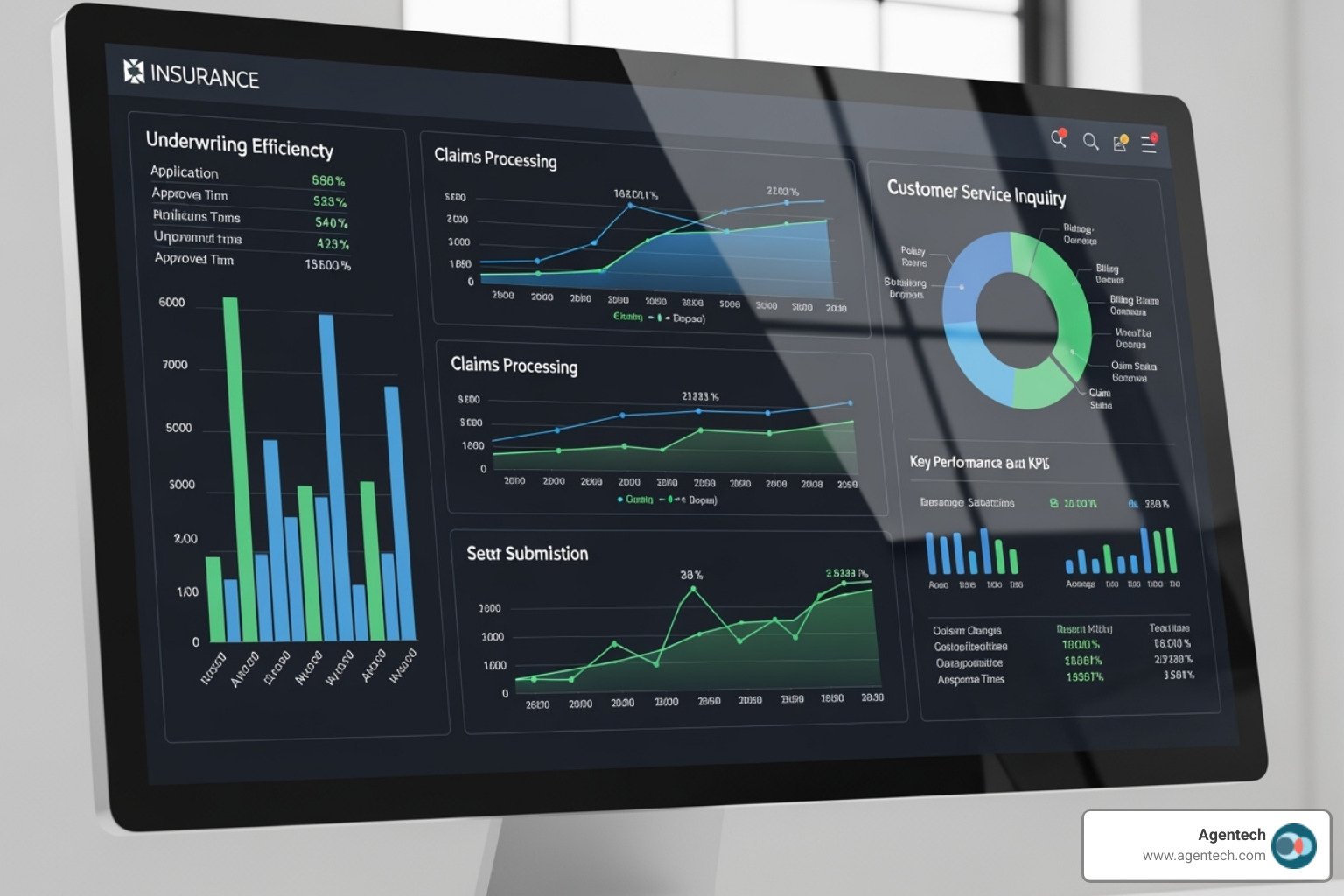
For a comprehensive look at how automation improves essential support functions, check out our article on Insurance Back Office Automation.
Streamlining Underwriting and Policy Administration
In P&C underwriting, automation excels at the data gathering and analysis portion of risk assessment.
- Automated Data Collection: Instead of manually entering data from applications and ACORD forms, automation tools ingest and structure this information automatically. This can reduce submission setup times by 80%, freeing underwriters to focus on risk assessment.
- Real-Time Risk Assessment: Machine learning algorithms analyze structured data to perform dynamic risk modeling. This leads to more accurate pricing and faster decisions for residential property, auto, and other P&C lines.
- Accelerated Quoting: With data entry automated, quote cycle times drop dramatically. Brokers get answers faster, improving quote to bind ratios and increasing premium revenue.
- Policy Issuance and Renewals: Automation generates policy documents and endorsements without manual intervention, ensuring consistency and reducing errors. It can also manage the renewal process, flagging exceptions for human review while handling straightforward renewals automatically.
McKinsey estimates that by 2030, over 90% of pricing and underwriting for individual and small business policies will be automated, a future that is already taking shape.
Revolutionizing P&C Claims Processing
The claims experience is where an insurer's promise is tested, and it's where insurance automation solutions have their most dramatic impact.
- FNOL Intake Automation: Automation captures First Notice of Loss data from any channel, verifies coverage, creates the claim profile, and routes it to the right adjuster. This saves hours per claim for residential property, auto, workers' compensation, and pet insurance. At Agentech, we've focused on perfecting this initial step. Learn more in Creating the Claim Profile.
- Automated Document Processing: AI can classify claims documents with 98% accuracy, extract key information, and standardize the data for your claims management software. This leads to an 80% reduction in document processing time. For more, explore AI Claims Processing in Insurance.
- Automated Damage Assessment: For property and auto claims, AI tools can analyze photos and videos to generate preliminary damage estimates, speeding up the assessment phase.
- Faster Settlements: By automating the key steps, claims move through the pipeline dramatically faster. Firms are seeing 50% faster settlement times, which makes a significant difference for policyholders.
These solutions integrate with the claims software adjusters already use, making the process seamless. The best AI doesn't feel like AI; it just makes the work easier. Learn more in The Best AI Doesn't Feel Like AI. It's Invisible.
A Guide to P&C Insurance Automation Solutions & Technologies
Understanding the technologies behind insurance automation solutions is key for P&C carriers, TPAs, and IA firms. Let's walk through the core components powering this change in residential property, auto, and workers' compensation operations.

- Robotic Process Automation (RPA): Think of RPA as software robots that mimic human actions for repetitive, rule based tasks like data entry between systems. It's a reliable starting point for automating simple workflows.
- Artificial Intelligence (AI) and Machine Learning (ML): AI is an umbrella term for technologies that simulate human intelligence, while ML is a subset that learns from data to make predictions. In P&C insurance, they power complex functions like risk assessment, fraud detection, and personalized pricing. Learn more in our article on Insurance Claims Machine Learning.
- Natural Language Processing (NLP): A branch of AI, NLP allows computers to understand human language. It's used in chatbots and for analyzing unstructured text in claims documents, turning emails and notes into structured data.
For a comprehensive look at how these systems work together, check out our guide on InsureTech Made Easy: Understanding Insurance Software Systems.
Traditional vs. Intelligent P&C Insurance Automation Solutions
The evolution from traditional to intelligent automation represents a significant leap in capability.
| Technology | Complexity | Decision Making | Ideal Use Cases in P&C Insurance |
|---|---|---|---|
| RPA | Low | Rule based, structured decisions | Automating data entry, claims verification, policy issuance, simple workflows. |
| AI/ML | Medium to High | Predictive, pattern recognition, learning from data | Fraud detection, risk assessment, personalized pricing, claims severity prediction. |
| Agentic AI | High | Autonomous, adaptive, goal oriented, learns and acts | End to end claims processing, complex underwriting, customer issue resolution, dynamic workflow orchestration. |
The Next Frontier: Agentic AI in P&C Insurance Automation Solutions
Agentic AI represents a fundamental shift in automation. Instead of just reacting or predicting, it takes initiative. An Agentic AI understands a high level goal, breaks it down into steps, executes those actions, and learns from the results. For a detailed explanation, visit our Agentic AI Definition page.
In your P&C operations, this means autonomous task execution. An Agentic AI can manage an entire residential property claim from FNOL to settlement. Think of these systems as AI digital coworkers that augment your human adjusters and underwriters, handling the administrative heavy lifting. This frees your team to focus on nuanced judgment calls and empathetic customer interactions. Learn more in The Future of Work in Insurance: Embracing AI Agents as Digital Coworkers.
Unlike RPA, which automates individual steps, Agentic AI orchestrates end to end process automation. This holistic approach is changing the claims experience for both your team and your policyholders, leading to faster, more accurate outcomes. See the full story in Transforming Insurance Claims: The Evolution from Generative AI to Agentic AI.
Realizing the Benefits and Navigating the Future
Adopting insurance automation solutions is a strategic business shift. The P&C carriers, TPAs, and IA firms seeing the most success approach automation with clear goals and a readiness to adapt.
Tangible Benefits for Your P&C Insurance Operations
The business case for automation in P&C insurance is proven by measurable improvements.
- Reduced Operational Costs: Companies are cutting operational costs by up to 40%, with claims processing costs dropping by as much as 70%. These savings can be reinvested into the business.
- Faster Claims Settlement: Automation can lead to 50% faster claims settlements. For policyholders dealing with a stressful property or auto loss, this speed is a critical factor in their experience.
- Improved Data Accuracy: Removing manual data entry can decrease errors by 90%. This reduces payment mistakes and provides better data for underwriting and risk management.
- Improved Policyholder Satisfaction: Faster service and clearer communication lead to happier customers and can increase revenue opportunities through better engagement.
- Increased Adjuster Capacity: By handling routine work, automation allows adjusters to manage more claims and focus on complex cases, which boosts job satisfaction and retention.
These benefits combine to transform operations. For a broader perspective, see The Future of Insurance: How AI is Changing the Game.
Overcoming Implementation Challenges
While the path to automation has obstacles, they are manageable with the right approach.
- Legacy Systems: Modern insurance automation solutions can act as middleware, connecting to existing Insurance IT Systems through APIs to minimize disruption.
- Data Security: Protecting sensitive information is paramount. Look for solutions with robust compliance standards and flexible deployment options to keep your data secure.
- Organizational Change: Communicate clearly how automation empowers employees by handling tedious tasks, and invest in training to ensure a smooth transition.
- Regulatory Compliance: Ensure any automation tool maintains clear audit trails and adheres to industry regulations. We explore this in AI in Insurance: Balancing Innovation and Regulation.
- Buy vs. Build: Most firms find that buying a proven solution accelerates time to value compared to building in-house. We dive deeper in Buy vs. Build: Navigating the SaaS AI Technology Decision.
Future Trends in P&C Insurance Automation
The evolution of automation is accelerating.
- Hyper personalization: AI will enable policies custom-fit to individual behaviors, such as auto insurance based on actual driving patterns.
- Proactive Risk Mitigation: Instead of just reacting to losses, AI will help prevent them by analyzing data to identify risks before they cause damage.
- Automated Underwriting: As McKinsey projects, AI will handle the vast majority of underwriting tasks for many policies by 2030.
- Ubiquitous AI Assistants: AI assistants will become standard tools, supporting adjusters and underwriters by providing instant information and analysis. Learn more in Virtual AI Assistants for Insurance: Meet Your New Best Friend.
Frequently Asked Questions about P&C Insurance Automation
We often hear the same thoughtful questions from P&C carriers, TPAs, and IA firms. Here are the answers to the most common ones.
How can my firm effectively implement an automation strategy?
Successful firms start small, prove value, and then scale. A practical approach includes these steps:
- Start with a Pilot Project: Choose a specific, measurable process, like automating document classification for workers' compensation claims. Pick a process where the pain points are clear, such as high error rates or backlogs.
- Build a cross functional Team: Involve people from claims, underwriting, IT, and operations. Automation is a business change, not just an IT project.
- Measure Everything: Document baseline metrics for cost, time, and errors before you start. Measure again after implementation to demonstrate clear ROI.
- Scale What Works: Once the pilot proves successful, expand the automation to similar processes and use the lessons learned to improve future rollouts. For more guidance, read Not Sure Where to Start with AI?
What is the role of data in driving P&C insurance automation?
Data is the fuel that powers insurance automation solutions. Without high-quality data, even the most advanced AI cannot perform effectively. AI and machine learning models learn from the data they are fed, so accuracy is critical. Before automating, invest time in cleaning and standardizing your data. Modern automation tools can also process unstructured data from emails and PDFs, turning it into a valuable, structured asset. Better data ultimately drives better decisions in underwriting, claims, and fraud detection. Our article Breaking Through the Data Plateau: A Strategic Opportunity explores this topic in depth.
Will automation replace claims adjusters and underwriters?
No. The goal of automation is augmentation, not replacement. We build tools to make adjusters and underwriters more effective, not to eliminate their roles. Automation is designed to handle the tedious, repetitive tasks like data entry, document sorting, and information retrieval. This frees your professionals to focus on what humans do best: complex investigations, nuanced negotiations, and empathetic conversations with policyholders. AI provides them with better information faster, so they can make smarter decisions. This approach improves job satisfaction and helps P&C firms retain top talent. The best AI feels invisible, seamlessly empowering your team to apply their skills where they matter most. As we explain in The Best AI Doesn't Feel Like AI. It's Invisible., the most effective solutions empower people.
Conclusion
The shift to automation is no longer a future concept in P&C insurance; it is a present-day reality reshaping how carriers, TPAs, and IA firms operate. The Property & Casualty landscape is being transformed by rising policyholder expectations and the clear, measurable benefits that insurance automation solutions deliver.
We've seen how automation makes underwriting faster and more accurate and how it revolutionizes claims processing for residential property, auto, and workers' compensation. The technology has evolved from simple RPA to intelligent AI and now to Agentic AI, which can act as autonomous digital coworkers to manage entire processes.
The results are compelling: operational costs drop, claims settle faster, and data accuracy improves significantly. While challenges like legacy system integration and organizational change exist, they are surmountable with a strategic approach.
At Agentech, our mission is to empower your adjusters, not replace them. We build AI agents that handle the tedious administrative work, freeing your team to focus on complex claims, empathetic customer service, and nuanced decisions that require human expertise. Imagine what your team could accomplish if they were freed from administrative burdens.
The future of P&C insurance lies in combining human expertise with artificial intelligence. This synergy transforms administrative burdens into strategic advantages and allows your team to perform more meaningful work. The technology is ready, and the business case is proven. The only question is when you will start.
Find how AI Agents can transform your claims operations: Discover how AI Agents can transform your claims operations
Citations:
- Conroy Simberg. (n.d.). Insurance fraud costs the U.S. $308.6 billion annually. Retrieved from https://www.conroysimberg.com/blog/insurance-fraud-costs-the-u-s-308-billion-annually/
- McKinsey & Company. (2020). Insurance productivity 2030: Reimagining the insurer for the future. Retrieved from https://www.mckinsey.com/~/media/McKinsey/Industries/Financial%20Services/Our%20Insights/Insurance%20productivity%202030%20Reimagining%20the%20insurer%20for%20the%20future/Insurance-productivity-2030.pdf