

Why AI Claims Agents Are Reshaping P&C Insurance
AI claims agents are autonomous software systems using artificial intelligence to manage Property & Casualty (P&C) insurance claims from start to finish. Unlike rule-based automation, these agents can reason, learn, and make decisions throughout complex workflows.
What AI Claims Agents Do:
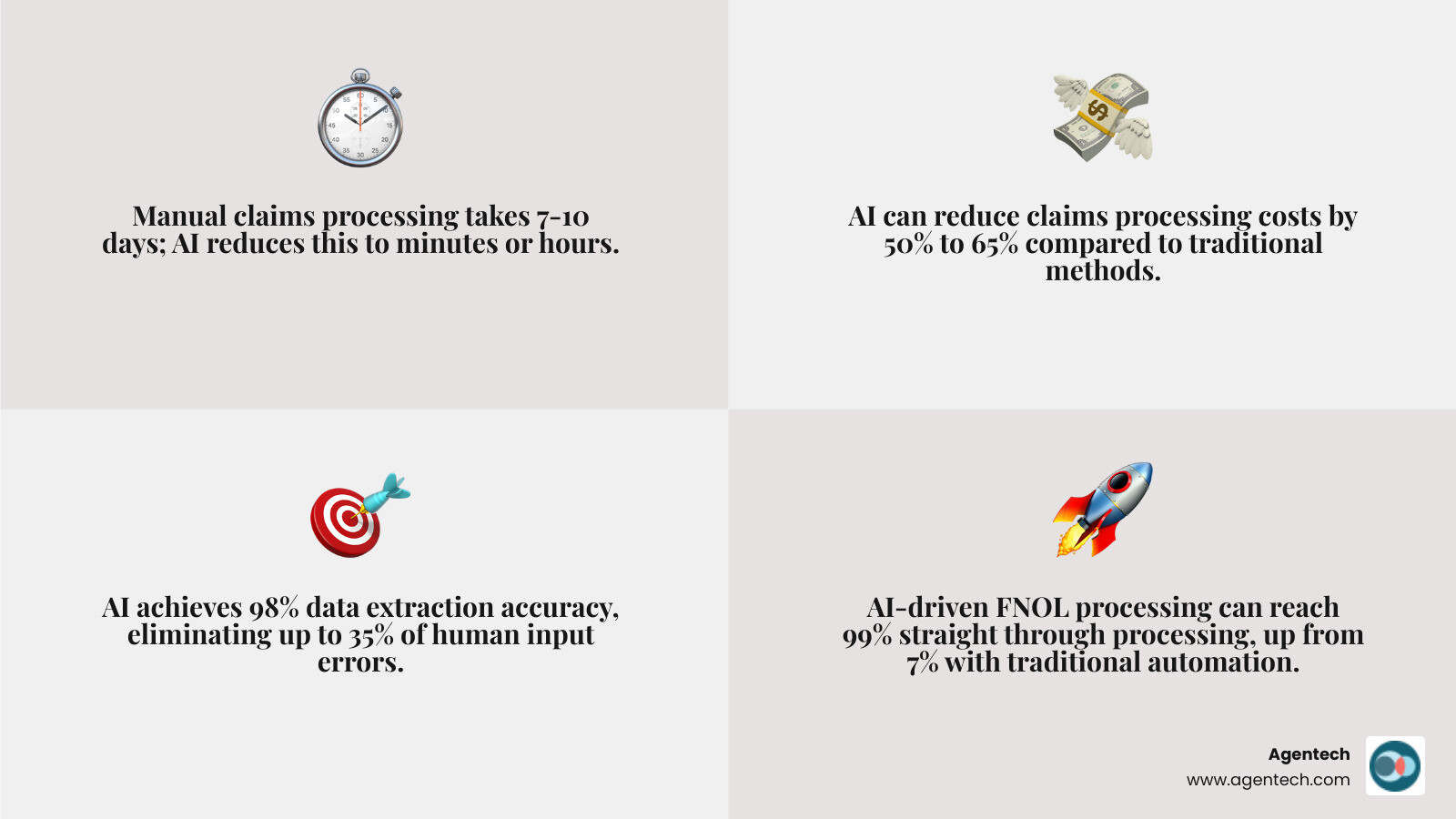
- Automate FNOL processing with 99% straight through processing rates
- Extract data from documents at over 98% accuracy
- Assess damage using computer vision and photo analysis
- Detect fraud by identifying patterns humans miss, reducing fraudulent activities by up to 40%
- Route claims intelligently based on complexity and urgency
- Communicate with policyholders through automated updates and responses
- Process settlements for straightforward claims in minutes instead of weeks
Core Benefits:
- Speed: Processing times drop from weeks to minutes
- Cost Savings: 50% to 65% reduction in processing costs
- Accuracy: Eliminates up to 35% of human input errors
- Customer Satisfaction: Faster settlements address the top complaint of 60% of dissatisfied policyholders
The P&C insurance industry faces a critical challenge: claims handlers spend about 30% of their time on low-value administrative work, while customer expectations for speed are rising. An industry report found 31% of policyholders were dissatisfied with their claims experience, citing settlement speed as the primary issue.
Traditional claims software and rule-based automation only handle the simplest cases, achieving just 7% straight through processing. The other 93% of claims require manual intervention, creating frustrating bottlenecks for adjusters and policyholders.
AI claims agents are changing this for carriers, Third-Party Administrators, and Independent Adjusting firms. These intelligent systems go beyond basic automation, understanding context, making judgments, and learning from each claim. The result is faster settlements, lower costs, and happier customers.
I'm Alex Pezold, founder of Agentech AI. We're building the AI workforce for P&C insurance, starting with claims processing in pet insurance and expanding across residential property, auto, and workers' compensation. My experience scaling a previous technology company taught me how the right tech can revolutionize traditional industries, which is what we're doing with AI claims agents at Agentech.
What Are AI Claims Agents and How Do They Work?
At their core, AI claims agents are sophisticated software entities designed to automate and improve the P&C insurance claims process. They are not simple scripts or chatbots but autonomous systems that analyze data, identify patterns, and execute tasks independently. Their "agentic" nature sets them apart from traditional AI or basic automation.
Traditional automation follows rigid rules, which is insufficient for complex P&C claims where exceptions are common. AI claims agents shine by using logic and judgment. They learn from interactions, adapt to new information, and proactively solve problems, autonomously handling exceptions that once required human intervention. As detailed in our article on Agentic AI Definition, these systems operate with autonomy, executing complex workflows far beyond simple rules and continuously learning to improve efficiency.

The Core Technologies Powering AI Claims Agents
The capabilities of AI claims agents are built upon a foundation of cutting-edge artificial intelligence technologies that empower them to process the vast amounts of data in P&C insurance claims:
- Machine Learning (ML): ML algorithms enable AI claims agents to learn from historical claims data to identify patterns, predict outcomes, and improve performance. For instance, ML models can assess claim severity and complexity to help with prioritization and routing. Our article on Insurance Claims Machine Learning explores this further.
- Natural Language Processing (NLP): P&C claims involve extensive text from emails, reports, and policy documents. NLP allows AI claims agents to understand, interpret, and generate human language. They can extract key information from unstructured text and understand customer intent for more adaptive interactions.
- Computer Vision: For P&C lines like property and auto, visual evidence is crucial. Computer vision allows AI claims agents to interpret images and videos to assess damage, verify incident details, and identify potential fraud.
- Generative AI: This advanced AI creates new content, such as drafting communications or summarizing complex documents. In claims, it can automate preparing standard mailings and generate claim summaries for adjusters.
- Predictive Analytics: By analyzing large datasets, AI claims agents use predictive analytics to forecast events. This is vital for identifying litigation risks, anticipating fraud, and optimizing reserve settings.
Together, these technologies enable AI claims agents to process structured and unstructured data, understand intent, and execute complex processes with unparalleled speed and accuracy.
Key Tasks AI Claims Agents Automate
AI claims agents automate a wide array of tasks across the P&C insurance claims lifecycle, freeing human adjusters to focus on complex cases and customer empathy.
- First Notice of Loss (FNOL): AI claims agents can process over 99% of FNOL requests straight through, using chatbots to guide customers and provide immediate acknowledgment. This reduces initial processing time from days to minutes.
- Data Extraction from Documents: P&C claims involve many documents. Our AI claims agents use OCR and NLP to convert documents like reports and forms into structured data. They categorize over 50 document types with 98+% accuracy and extract critical information like claimant name, policy number, and claim amount.
- Claim Triage and Routing: By analyzing initial claim data, AI claims agents can assess the severity and complexity of each claim. This allows for rapid prioritization and routing of complex claims to experienced adjusters, while simple claims can be expedited.
- Damage Assessment via Images and Video: Relevant for auto and property claims, computer vision analyzes photos and videos to assess damage instantly, often eliminating the need for physical inspections.
- Fraud Detection: AI claims agents analyze data sources to identify patterns that could indicate fraud, spotting abnormalities humans might miss. Some P&C insurers report a 40% drop in fraudulent activities.
- Automated Communication: AI claims agents can manage email, send automated status updates, and prepare responses, ensuring timely and consistent communication.
- Settlement Processing: For straightforward claims, AI claims agents can orchestrate payment workflows for near-instant payouts, drastically shortening settlement times. Our article on Automated Claims Processing details these capabilities.
The Transformative Benefits of AI Claims Agents
The integration of AI claims agents into P&C insurance operations is a fundamental change, with benefits rippling across the entire organization.
How P&C Insurers Gain a Competitive Edge
For P&C carriers, Third Party Administrators, and Independent Adjusting firms, adopting AI claims agents offers a significant competitive advantage with measurable improvements:
- Increased Efficiency: By automating manual tasks, AI claims agents help companies process claims faster and optimize workflows. Claims handlers spend about 30% of their time on low-value administrative work. Our agents take over this burden, freeing adjusters for high-value tasks and improving productivity by 20% to 30% for administrative work.
- Reduced Processing Costs: With faster processes and minimal manual intervention, task costs decrease significantly. Automation can reduce processing costs by 50% to 65%, directly improving the bottom line. Our article on how to Reduce Administrative Burden explores this further.
- Improved Accuracy: Human input can lead to up to 35% of data inaccuracies. AI claims agents operate with much higher precision, achieving 96% accuracy in data extraction. This means cleaner data, fewer costly reworks, and more reliable outcomes.
- Improved Fraud Detection: AI claims agents analyze large datasets to identify patterns associated with fraud that humans might miss. Some P&C insurers report a 40% drop in fraudulent activities, leading to a more efficient validation process.
- Reduced Claims Leakage: Claims leakage, typically 8% to 12%, is money paid out due to inefficiencies or errors. By improving accuracy and fraud detection, AI claims agents can significantly reduce this leakage, with leading companies achieving rates as low as 2% to 3%. Our Insurance Claims Analytics Software plays a crucial role here.
| Metric | Traditional Claims Processing | AI Claims Processing |
|---|---|---|
| Speed | Weeks to days | Minutes to hours |
| Accuracy | Up to 35% human errors | 96-98% data accuracy |
| Cost | High, $25/reworked claim | 50-65% reduction |
| Customer Satisfaction | 31% dissatisfied, 60% blame speed | Significantly improved, 62% retention |
| Fraud Detection | Reactive, human dependent | Proactive, 40% reduction |
| Straight Through Processing (FNOL) | 7% | Up to 99% |
How the Customer Experience Improves
In the competitive P&C insurance market, customer satisfaction is paramount. A good experience retains 62% of customers, versus only 19% for a bad one. With 31% of policyholders dissatisfied with claims, 60% of whom cite speed as the main issue, AI claims agents directly address these pain points:
- Faster Claims Resolution: This is the most impactful benefit for policyholders. While standard timelines take days or weeks, systems powered by AI can process a valid claim in seconds. This dramatically shortens the claims lifecycle from weeks to minutes in many cases, which is critical for customer retention.
- 24/7 Availability and Status Updates: Policyholders expect instant access to information. AI claims agents provide always-on virtual assistance, answering questions, guiding customers, and offering immediate status updates. Our article on AI Customer Service Insurance highlights these capabilities.
- Increased Transparency: Through automated communications, AI claims agents ensure policyholders are always in the loop, reducing anxiety and fostering trust.
- Higher Policyholder Satisfaction and Retention: By delivering faster, more accurate, and transparent claims experiences, AI claims agents directly contribute to higher customer satisfaction and retention, which is crucial for long-term business success.
Implementing AI: Best Practices, Risks, and the Human Role
Adopting AI claims agents is a strategic move requiring careful planning. Navigating the implementation process effectively is crucial for maximizing ROI and ensuring a smooth transition.
Navigating Risks and Implementation Challenges
Implementing AI claims agents comes with considerations that must be addressed proactively for a successful deployment:
- Data Privacy and Security: Handling sensitive policyholder information is paramount. AI claims agents must be built with advanced encryption, strict access controls, and adherence to regulations like GDPR and PCI DSS. A robust solution includes secure hosting and clear data governance policies.
- Integration with Legacy Claims Management Software: Many P&C insurers use complex legacy claims management software. Seamless integration between new AI claims agents and these existing platforms is critical. This requires robust APIs and careful planning to ensure data flows smoothly. Our insights on Core Insurance Software can guide this process.
- Managing Organizational Change: Introducing AI claims agents changes workflows and job roles, which can cause resistance. Effective change management, clear communication about AI augmenting human roles, and comprehensive training are essential for positive adoption.
- Ensuring Model Fairness and Avoiding Bias: AI models are only as unbiased as their training data. It is crucial to use high-quality, representative data and implement ethical oversight to ensure AI claims agents make fair decisions. Regular audits are necessary. The NAIC AI Model Guidance provides valuable direction here.
The Importance of the 'Human in the Loop' Model for AI Claims Agents
A common misconception is that AI claims agents will replace human adjusters. The industry's best practice is the opposite: a 'human in the loop' model that views AI as a powerful digital coworker.
- AI as a Digital Coworker: Agentech agents work alongside your team. They excel at tedious, data-intensive tasks like data extraction, document categorization, and initial triage. By offloading this work, AI becomes an invaluable assistant, boosting productivity and reducing administrative burden. Our article, The Future of Work in P&C Insurance: Embracing AI Agents as Digital Coworkers, explores this concept.
- Human Adjusters Handle Complex, Nuanced Cases: While AI handles routine scenarios with speed, human adjusters remain indispensable for complex claims that require empathy, critical thinking, and nuanced judgment.
- Ensures Ethical Oversight and Final Decision Making Authority: The 'human in the loop' model ensures adjusters retain final decision-making authority. AI assists and offers recommendations, but the ultimate call rests with a human. This is crucial for ethical oversight and maintaining the human touch. Our solutions are truly AI-Designed with Adjusters in Mind.
This partnership between human and AI claims agents creates a synergistic environment where both leverage their unique strengths, leading to superior outcomes.
Real World Impact and the Future Outlook
The impact of AI claims agents is already being felt across the P&C insurance industry, with tangible benefits and an exciting future.
Real World Examples
We're seeing significant gains from the adoption of AI claims agents:
- Accelerated Processing: One travel insurer achieved 57% automation while reducing processing time from weeks to minutes. This speed is a game changer for customer satisfaction.
- Cost Efficiency: Another P&C insurer saw claims processed twice as fast at a fraction of the cost, directly impacting their profitability.
- Specialty Line Success: Our own work with Odie Pet Insurance Implements Agentech to Automate Claims Tasking showcases how even niche P&C lines can benefit from automating tasks like indexing, FNOL, and triage.
- Fraud Reduction: Some P&C insurers have reported a 40% drop in fraudulent activities after implementing fraud detection driven by AI, saving millions of dollars.
Future Outlook
The trajectory for AI claims agents is one of continuous evolution and deeper integration into the P&C insurance landscape:
- Deeper Integration Across P&C Lines: While already successful in pet insurance, we foresee more sophisticated applications across auto, residential property, and workers' compensation. This means more nuanced damage assessments, accurate liability determinations, and personalized customer interactions powered by AI. Our article on The Future of P&C Insurance: How AI is Changing the Game offers a comprehensive look at this trend.
- Shift Towards Fully Autonomous Operations for Simple Claims: As AI claims agents become more refined, simple, low-value claims will increasingly move towards straight-through processing with minimal human intervention. This will free up adjusters to handle more complex claims.
- Proactive Claims Management: Future AI claims agents will not just react to incidents but proactively identify potential issues, offer preventative advice, and even initiate claims based on external data like weather events.
- Improved Human AI Collaboration: The 'human in the loop' model will evolve, with AI providing richer insights and more sophisticated recommendations, acting as a true strategic partner to human adjusters.
Frequently Asked Questions about AI Claims Agents
Will AI completely replace P&C claims adjusters?
No, the future of P&C insurance claims is a partnership between humans and AI. AI claims agents augment human capabilities, not replace them. Claims adjusters spend about 30% of their time on administrative work. Our AI claims agents handle these repetitive tasks with speed and accuracy. This frees adjusters to focus on complex cases, customer empathy, and strategic decisions. AI makes adjusters more valuable, lifting their role from administrative work to strategic problem-solving.
What is the expected ROI from implementing AI in claims?
The return on investment (ROI) from implementing AI claims agents is significant, benefiting P&C carriers, TPAs, and IA firms in several key areas:
- Major Cost Savings: Automation can reduce claims processing costs by 50% to 65%. By eliminating manual reworks and reducing administrative overhead, some carriers have saved millions with our technology.
- Improved Efficiency and Speed: Processing times drop dramatically, from weeks to minutes for straightforward claims, accelerating cash flow and improving productivity.
- Reduced Claims Leakage: By enhancing accuracy and fraud detection, AI claims agents help reduce claims leakage from an industry average of 8% to 12% down to a leading rate of 2% to 3%.
- Fraud Reduction: AI spots subtle patterns humans miss, with some P&C insurers reporting a 40% drop in fraudulent activities, directly protecting financial health.
- Improved Customer Retention: A better claims experience directly impacts loyalty. Since 62% of customers stay after a good experience versus 19% after a bad one, the improved satisfaction from faster, more transparent processing boosts policyholder retention and long-term revenue. Most insurers see positive returns within the first year.
How secure is policyholder data with AI claims processing?
Security is paramount when handling sensitive policyholder data in P&C insurance. Reputable AI claims agents solutions are built with security as a foundational principle. Key measures include:
- Advanced Encryption: Data is protected both in transit and at rest through robust encryption protocols.
- Strict Access Controls: Only authorized personnel and systems have access to specific data, managed through granular permissions.
- Regulatory Compliance: Solutions are designed to adhere to stringent data privacy regulations such as GDPR and PCI DSS.
- Secure Cloud Hosting: Data is stored in highly secure cloud environments that employ industry-leading security measures.
- Robust Data Governance Policies: Clear policies define how data is collected, used, stored, and archived, ensuring transparency and accountability.
Our commitment is to ensure your policyholder data remains confidential and safeguarded by continuous monitoring and adherence to the highest security standards.
Conclusion: Your Next Step in Claims Modernization
The P&C insurance landscape is evolving, and AI claims agents are a present-day necessity for competitive carriers, TPAs, and IA firms. They deliver unparalleled efficiency and accuracy, turning claims bottlenecks into streamlined, customer focused processes.
We've explored how these intelligent agents leverage advanced technologies to handle complex tasks from FNOL to settlement. The benefits are clear: reduced costs, faster resolutions, improved fraud detection, and a better customer experience that drives retention.
The most effective model is a partnership. AI claims agents act as digital coworkers, handling administrative tasks to empower your adjusters to focus on nuanced, strategic work. This collaboration between humans and AI ensures ethical oversight and lifts the entire claims operation.
By embracing this change, you can build a faster, smarter, and more customer-focused claims operation. At Agentech, we provide the tools to make this a reality, helping you open up new levels of productivity and customer satisfaction.
Learn more about our AI Agents
Citations:
- Accenture. (2022). Poor claims experiences could put up to $170B of global insurance premiums at risk by 2027, according to new Accenture research.
- Agentech. (n.d.). AI Agent for Claims Handling.
- Agentech. (n.d.). AI-Designed with Adjusters in Mind.
- Agentech. (n.d.). Agentic AI Definition.
- Agentech. (n.d.). Automated Claims Processing.
- Agentech. (n.d.). Core Insurance Software.
- Agentech. (n.d.). Insurance Claims Analytics Software.
- Agentech. (n.d.). Insurance Claims Machine Learning.
- Agentech. (n.d.). NAIC AI Model Guidance.
- Agentech. (n.d.). Odie Pet Insurance Implements Agentech to Automate Claims Tasking.
- Agentech. (n.d.). Reduce Administrative Burden.
- Agentech. (n.d.). The Future of Work in P&C Insurance: Embracing AI Agents as Digital Coworkers.
- Agentech. (n.d.). The Future of P&C Insurance: How AI is Changing the Game.
- Agentech. (n.d.). Why AI Claims Processing is Revolutionizing the Insurance Industry.