

Why Claims Management Tools Matter for P&C Insurance Operations
Claims management tools are claims software platforms designed to help P&C insurance organizations handle the entire claims lifecycle from first notice of loss through final settlement. For busy P&C insurance carriers, TPAs, and Independent Adjusting firms, these tools address critical operational challenges:
- Reduce manual data entry through automated FNOL intake and data extraction
- Streamline workflows with rules-based assignment and task automation
- Accelerate settlements by eliminating administrative bottlenecks
- Improve accuracy through centralized data and validation
- Improve compliance with built-in audit trails and regulatory reporting
- Integrate seamlessly with existing core systems via APIs
The P&C insurance industry faces mounting pressure to process residential property, auto, pet, and workers' compensation claims faster while maintaining accuracy. Manual processes create an administrative burden that drains adjuster productivity and delays policyholder resolution. Modern claims software centralizes data, automates repetitive tasks, and provides real-time visibility across the entire claims operation.
The business impact is significant. Organizations using claims management tools report faster cycle times, reduced claim leakage, and improved customer satisfaction. By eliminating duplicate data entry and manual handoffs, adjusters can focus on high-value activities like complex decision-making and customer interaction rather than administrative work.
I'm Alex Pezold, founder of Agentech AI. After a successful exit with my previous technology company, I'm now focused on building the AI workforce for P&C insurance. We help organizations leverage claims management tools and AI-driven solutions to revolutionize claims processing, transform operations, and reduce the cost of risk.
Core Features of Modern Claims Management Tools
Modern claims management tools are essential for P&C insurance operations, changing how teams handle claims from first notice to final settlement [1].

Centralized data management is the core of effective claims software, eliminating scattered data across different systems. By consolidating policy details, communications, reports, and payment history into one accessible location, adjusters can find information in seconds, saving significant time [3, 4].
Automated workflows ensure consistency by guiding each claim through a predefined process. The system triggers tasks and notifications, keeping claims moving without constant manual oversight. This maintains a consistent process for all P&C claim types, including residential property, auto, workers' compensation, and pet insurance [3].
Rules-based assignment automatically routes incoming claims to the appropriate adjuster based on claim type, complexity, and expertise. This eliminates manual assignment, balances workloads, and ensures specialists handle relevant claims, such as a workers' compensation expert receiving a workers' comp case [3].
Reporting and analytics provide clear visibility into your claims operation. These tools allow you to track cycle times, identify bottlenecks, and measure performance. For P&C carriers, TPAs, and IA firms, this data-driven approach supports smarter decisions about staffing and process improvements, answering key operational questions with data, not guesses [3].
Compliance tools help maintain regulatory adherence without extra work. The claims software automatically maintains audit trails, generates required forms, and helps meet state-specific requirements for various P&C claims, from workers' compensation filing mandates to property claim deadlines [2, 3, 9]. For a broader overview of regulatory frameworks in P&C insurance, see the NAIC resource center.
Integration capabilities are critical. A claims platform must connect smoothly with other core systems like policy administration, billing, CRM, and ERP to create a unified operation. Want to learn more about how AI is changing this space? Check out our article on AI claims processing.
Key Functionalities in Claims Management Tools
Beyond these core features, look for specific functionalities that make daily work easier:
- Automated FNOL intake and data extraction captures claim information quickly and accurately, often using AI to pull relevant details from emails, forms, or phone calls and populate your claim files automatically [3, 4]
- Dynamic, rules-based claim routing and assignment ensures each claim reaches the right adjuster based on expertise, workload, and claim characteristics [3]
- Integrated communication tools like email, SMS, and policyholder portals keep everyone connected and informed without juggling multiple platforms [3, 4]
- Document management and storage provides secure, centralized access to photos, reports, estimates, and legal documents for authorized team members [3, 8]
- Reserve and payment management with complete audit trails helps you track financial exposure and process settlements accurately [3]
- Task and activity tracking with automated reminders keeps adjusters on schedule and helps you meet service level agreements consistently [3]
- Customizable reporting and analytics dashboards let you build the specific views and metrics that matter most to your operation [3, 11]
Integrating Your Claims Management Tools
Effective integration is essential for modern P&C insurance operations. When your claims software connects with ERP and CRM platforms via open APIs, you eliminate data silos and create a single source of truth [3, 4]. This means a customer service agent can see a policyholder's full claim history in the CRM, while the finance team gets real-time payment data. This interconnected approach speeds up processing, improves accuracy, and provides necessary information to all teams when needed. To see how AI fits into this future-focused approach, explore our thoughts on designing for the future with AI.
Citations:
- Insurance Claims Management System Product Listings. (n.d.). Retrieved from provided research document.
- Tools and Resources for Claims Management. (n.d.). Washington State Department of Labor & Industries. Retrieved from provided research document.
- Claims Management Software. (n.d.). Retrieved from provided research document.
- Claims Platform. (n.d.). Retrieved from provided research document.
- ClaimsView. (n.d.). Retrieved from provided research document.
- Eliminating claims litigation leakage by providing industry-leading solutions. (n.d.). Retrieved from provided research document.
- Enterprise Insurance Claims Management Solutions For Your Business. (n.d.). Retrieved from provided research document.
The Transformative Impact of Automation and AI in Claims
Bringing automation and AI into P&C claims processing fundamentally reshapes how property & casualty insurance carriers, TPAs, and IA firms handle claims from start to finish.
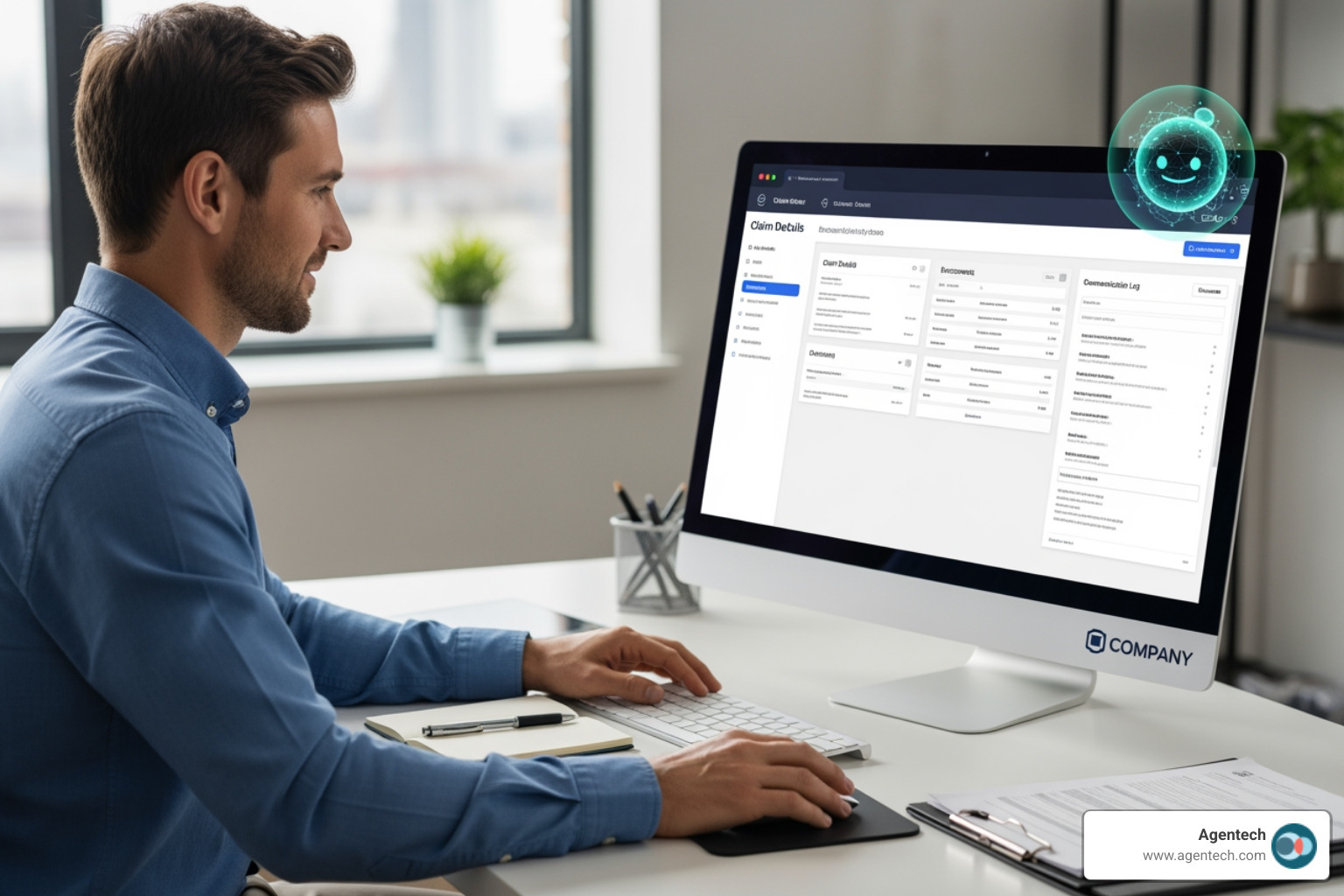
The impact on operational efficiency is immediate. AI-powered automation accelerates cycle times for residential property, auto, workers' compensation, and pet insurance claims. By handling repetitive tasks, AI also reduces claim leakage that occurs from manual oversight [3, 4].
AI eliminates manual data entry by extracting information from FNOL documents, populating claim files, and processing simple payments automatically [3, 4]. This improves adjuster productivity by freeing them from routine tasks to focus on high-value work.
One of the most tedious tasks in claims processing is creating the claim profile. Gathering data from multiple sources and entering it into systems is time-consuming. AI excels at this work. Our article on creating the claim profile with AI explores how this change works in practice.
By removing the administrative burden, adjusters can focus on complex decision-making and meaningful customer interaction. This shift improves the customer experience with faster, more personalized resolutions [4]. For a broader look at how automation transforms P&C insurance operations, check out our piece on insurance back office automation.
The cost savings are substantial too. Less manual work means cost reduction across your entire claims operation. Modern claims management tools with embedded AI and predictive models help teams make faster, smarter decisions while keeping costs under control [3].
The Rise of Agentic AI in P&C Insurance
Where this technology is heading is toward Agentic AI. Traditional automation follows a script. Agentic AI is different. It involves creating digital agents that can think, adapt, and act more like a skilled team member.
These AI agents handle tasks proactively, making decisions within set parameters and learning from each interaction. They act as an always-on colleague that can process information at incredible speed. For a deeper dive into this concept, our agentic AI definition article breaks it down clearly.
This goes beyond simple automation. We're talking about AI as digital agents that can manage multi-step workflows, communicate with external parties, and handle various aspects of residential property, auto, pet, and workers' compensation claims. The evolution from generative AI to agentic AI represents a fundamental shift in how P&C insurance operations can function.
The beauty of this approach is that human adjusters remain in control. The AI agents handle the routine work and flag anything that needs human judgment. It's a partnership that empowers adjusters to focus on what matters: the cases that require expertise, empathy, and critical thinking. Your team becomes more effective, your policyholders get better service, and your operations run smoother. That's the real promise of AI in P&C claims processing.
Citations:
- Claims Management Software. (n.d.). Retrieved from provided research document.
- Claims Platform. (n.d.). Retrieved from provided research document.
Choosing the Right Claims Management Software for Your Business
Choosing the right claims management tools for your P&C insurance operation requires defining your specific requirements. A solution for a large auto carrier will differ from one for a TPA focused on workers' compensation.
Start by analyzing your current workflows. Assess your claim volumes for residential property, auto, pet, and workers' compensation. Identify bottlenecks and pain points for your adjusters to determine what improvements are needed. These answers will shape your claims software selection process.
Scalability for growth is critical. Your claims software should grow with you, not hold you back. P&C carriers need platforms that can handle increased volume without issue [1]. TPAs need tools that simplify operations while improving client service. IA firms require flexibility to manage diverse claims across multiple clients [4].
Vendor support and training are crucial. Even the best claims software is ineffective if your team cannot use it or get help when needed. Choose vendors with comprehensive training and responsive support to ensure your adjusters can work efficiently.
Finally, understand the total cost of ownership. The initial subscription fee is just the beginning. Factor in implementation, customization, maintenance, integration, and training costs. The cheapest option upfront is not always the most cost-effective in the long run.
Key Security and Compliance Considerations
Data security and regulatory compliance are paramount. Your claims management software holds sensitive policyholder, medical, financial, and legal information. A single breach can be devastating.
Any platform you consider must meet rigorous security standards. SOC 2 certification is non-negotiable, as it demonstrates robust, audited security controls [9]. For international operations, GDPR compliance is also critical.
The claims software must maintain a comprehensive audit trail of every action. This documentation is essential for regulatory reporting and internal audits [3, 9]. Government bodies like the Washington State Department of Labor & Industries provide specific compliance resources that highlight the importance of these requirements [2].
Strong data encryption protocols must protect information both in transit and at rest. This is a baseline requirement for operating in today's P&C insurance environment [3].
Evaluating Integration and Customization
Your new claims software must integrate with existing systems to avoid the data silos and manual re-entry you want to escape.
Modern claims management tools should offer open APIs that connect seamlessly with your policy administration system, billing platform, ERP, and CRM [3]. When systems communicate, data remains consistent, and your team stops wasting time on manual data transfer. A new claim can instantly populate history in your CRM, and payments can automatically update your billing system.
The ability to customize workflows is a game changer. Look for platforms with no-code configuration options that let your business team adapt processes as needs evolve [4]. This flexibility allows you to roll out new product lines or adjust to client requirements quickly.
Sometimes the best approach combines out-of-the-box efficiency with custom quality assurance. We explore this balanced strategy in our article on A hybrid AI solution for claims automation.

Citations:
[1] Insurance Claims Management System Product Listings. (n.d.). Retrieved from provided research document.
[2] Tools and Resources for Claims Management. (n.d.). Washington State Department of Labor & Industries. Retrieved from provided research document.
[3] Claims Management Software. (n.d.). Retrieved from provided research document.
[4] Claims Platform. (n.d.). Retrieved from provided research document.
[9] Eliminating claims litigation leakage by providing industry-leading solutions. (n.d.). Retrieved from provided research document.
The Future of Claims: Emerging Trends and Technologies
The P&C insurance landscape is changing rapidly, and the claims management tools we use today are just the beginning. We're watching exciting new technologies emerge that promise to make claims processing even faster, smarter, and more customer focused [1].
Predictive analytics is becoming a game changer for P&C carriers, TPAs, and IA firms. By analyzing historical claim data with machine learning, modern systems can now forecast claim severity, predict potential litigation, and spot subrogation opportunities early [3, 7, 11]. This allows adjusters to allocate resources where they'll have the biggest impact and keep costs down.
Hand in hand with predictive analytics comes sophisticated fraud detection. AI algorithms can now scan through claim patterns and flag suspicious activity that human eyes might miss [11]. This protects carriers from significant financial losses while speeding up the investigation process for legitimate claims.
The IoT integration trend is particularly exciting for residential property and auto claims. Imagine a smart home sensor detecting water damage and automatically triggering a claim, or a connected car providing real time data about an accident [1]. This real time data helps adjusters assess damages more accurately and respond faster than ever before. This influx of information requires robust claims software to process and make sense of it all.
We're also seeing low code platforms and hyper automation gain momentum. These technologies let business teams build and deploy new automated processes without creating massive IT backlogs [1, 4]. For P&C insurance organizations, this means adapting quickly to regulatory changes and staying competitive.
Perhaps the most transformative development is the emergence of Agentic AI co workers. These are intelligent digital agents that can proactively identify issues, suggest solutions, and manage complex workflows with minimal human oversight. As we explore in The future of insurance with AI, this shift is already happening. In fact, Amazon CEO forecasts AI agents as coworkers, and we're already seeing hundreds of these AI agents working alongside adjusters in claims departments today.
This evolution enables proactive risk mitigation at a scale we've never seen before. Our systems can now spot potential problems before they become expensive issues. For workers' compensation, residential property, auto, and pet insurance claims alike, this means better outcomes, lower costs, and happier policyholders.
These technologies are being implemented right now, reshaping how P&C insurance claims are processed and setting new standards for efficiency and customer service across the industry.
Citations:
- Insurance Claims Management System Product Listings. (n.d.). Retrieved from provided research document.
- Claims Management Software. (n.d.). Retrieved from provided research document.
- Claims Platform. (n.d.). Retrieved from provided research document.
- Claims Management Software Overview. (n.d.). Retrieved from provided research document.
- Enterprise Insurance Claims Management Solutions For Your Business. (n.d.). Retrieved from provided research document.
Frequently Asked Questions about Claims Management Software
We talk with P&C insurance carriers, TPAs, and IA firms every day, and certain questions about claims management tools come up again and again. Here are the answers to what you're probably wondering too.
What is the main benefit of using claims management software?
The main benefit is a dramatic boost in operational efficiency, which leads to numerous other advantages [3].
When you implement claims management software, you immediately see reduced manual work and lower administrative costs. Claims that used to take days or weeks to process can move through your system much faster [4]. Your adjusters spend less time on data entry and more time actually adjusting claims.
Faster claim cycle times mean happier policyholders, reduced claim leakage, and adjusters who can focus on critical thinking and customer service instead of paperwork [1, 3]. It's about working smarter and letting technology handle what it does best so people can do what they do best.
How does this software improve the policyholder experience?
Claims management tools significantly improve the policyholder experience during the stressful claims process [4].
First, there's faster claim resolution. Nobody wants to wait weeks for an answer. Modern claims software can process straightforward residential property, auto, or pet insurance claims much more quickly [4]. Even complex workers' compensation cases move faster when workflows are automated.
Second, policyholders get proactive communication. Instead of wondering what's happening with their claim, they receive regular updates via email, SMS, or online portals [3]. This increased transparency reduces anxiety and eliminates frustrating follow-up calls.
Finally, submitting information becomes simplified. Digital portals and automated intake systems mean policyholders can upload photos and documents on their own schedule [3]. All of this adds up to higher customer satisfaction and retention, which matters enormously in the competitive P&C insurance market [4].
Can claims management software integrate with other business systems?
Yes, and seamless integration is one of the most critical features of modern claims management tools [3].
Modern platforms are built with open APIs specifically designed for integration with your core business systems [3]. That means your claims software can connect directly with policy administration platforms, billing systems, ERP (Enterprise Resource Planning), and CRM (Customer Relationship Management) tools [3, 4].
When your systems talk to each other, your data flows freely and accurately across your entire organization. Your adjusters can instantly pull up policy details and claims history without switching systems. Your finance team gets real-time updates on reserves and payments. Your customer service reps can see exactly where a claim stands when a policyholder calls.
This interconnectedness eliminates data silos and creates a single source of truth for each policyholder and their claims [3]. The result is maximum efficiency, fewer errors, and better decision-making across all your operations, whether you're a P&C carrier, TPA, or IA firm [3, 4]. Integration is essential for running a modern claims operation.
Citations:
- Insurance Claims Management System Product Listings. (n.d.). Retrieved from provided research document.
- Tools and Resources for Claims Management. (n.d.). Washington State Department of Labor & Industries. Retrieved from provided research document.
- Claims Management Software. (n.d.). Retrieved from provided research document.
- Claims Platform. (n.d.). Retrieved from provided research document.
Conclusion: Empowering Your Team with the Right Tools
The P&C insurance industry stands at a turning point. For P&C insurance carriers, TPAs, and IA firms handling residential property, auto, pet, and workers' compensation claims, the question isn't whether to adopt modern claims management tools but which solution will best serve your team and policyholders.
Throughout this article, we've explored how the right claims management software transforms operations. The benefits are clear: dramatic improvements in efficiency, improved accuracy across every claim, and meaningful cost savings that impact your bottom line. When you automate repetitive administrative tasks, your adjusters spend less time on data entry and more time making thoughtful decisions and connecting with policyholders.
The ripple effects extend far beyond your internal operations. Policyholders experience faster resolutions, clearer communication, and the kind of transparent service that builds lasting trust. This better customer experience isn't just a nice-to-have; it's what keeps customers coming back and recommending your services to others.
Future-proofing your operations means choosing claims management software that grows with you. Look for solutions that scale as your claim volumes increase, maintain robust security and compliance standards, and integrate seamlessly with your existing core systems. The right platform adapts to your unique workflows rather than forcing you to adapt to rigid processes.
At Agentech, we've built our AI-powered automation with a fundamental belief: technology should empower people, not replace them. Our always-on AI assistants handle the tedious tasks that bog down your adjusters, freeing them to focus on the complex, nuanced work that requires human judgment and empathy. We're not building tools to eliminate jobs; we're creating digital teammates that make your adjusters more effective and your entire operation more responsive.
The competitive advantage goes to organizations that accept this change now. While others struggle with manual processes and administrative bottlenecks, you'll be resolving claims faster, serving policyholders better, and operating more efficiently.
Ready to transform your claims operation? Explore AI-powered digital agents for your claims team and find how intelligent automation can work for you.
Citations:
- Insurance Claims Management System Product Listings. (n.d.). Retrieved from provided research document.
- Tools and Resources for Claims Management. (n.d.). Washington State Department of Labor & Industries. Retrieved from provided research document.
- Claims Management Software. (n.d.). Retrieved from provided research document.
- Claims Platform. (n.d.). Retrieved from provided research document.
- CLAIMS MANAGEMENT SOFTWARE. (n.d.). Retrieved from provided research document.
- Claims Management Software Overview. (n.d.). Retrieved from provided research document.
- ClaimsView. (n.d.). Retrieved from provided research document.
- Eliminating claims litigation leakage by providing industry-leading solutions. (n.d.). Retrieved from provided research document.
- Enterprise Insurance Claims Management Solutions For Your Business. (n.d.). Retrieved from provided research document.