

Why Artificial Intelligence SaaS is Changing Modern Business Operations
Artificial intelligence saas combines AI's power with cloud-based software delivery, creating intelligent business solutions. Here's a quick overview:
- What it is: Cloud software improved with machine learning, predictive analytics, and automation.
- Key benefits: Reduces manual work, predicts outcomes, personalizes experiences, and scales operations.
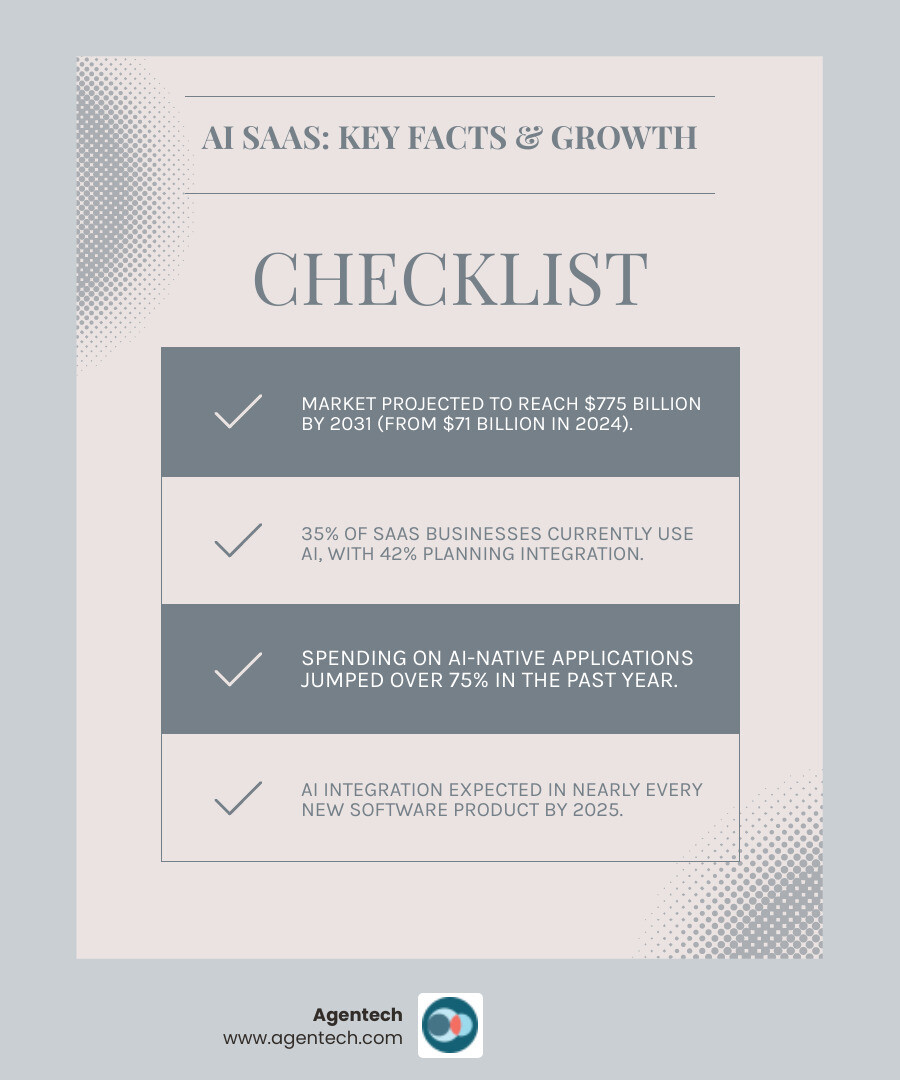
- Market growth: Expected to reach $775 billion by 2031, up from $71 billion in 2024.
- Current adoption: 35% of SaaS businesses use AI, with another 42% planning implementation.
The software industry is shifting from traditional SaaS that stores data to intelligent systems that learn, predict, and act. This change is rapid, with AI expected in nearly every new software product by 2025. Spending on AI-native applications has jumped over 75% in the past year, and 77.6% of IT leaders are upgrading their SaaS tools for AI capabilities.
For insurance claims managers, this means automating workflows to process claims in minutes, not days. Artificial intelligence saas platforms can extract data, detect fraud, and route claims automatically, improving accuracy over time.
The challenge is no longer if but how to adopt artificial intelligence saas strategically, managing risks like data privacy and user adoption.
As Alex Pezold, founder of Agentech AI, I've seen these solutions transform insurance operations. With experience scaling TokenEx and now building AI workforce solutions for insurance, I'll guide you through leveraging artificial intelligence saas effectively.
Understanding AI SaaS: The Fusion of Intelligence and Cloud Software
Think of artificial intelligence saas as the evolution of regular cloud software—but with a brain. Instead of just storing your data, these applications learn from business patterns, predict needs, and often act on your behalf.
Artificial intelligence saas combines the accessibility of cloud delivery with AI technologies like machine learning. You get traditional SaaS benefits—no servers, automatic updates, and pay-as-you-go pricing—plus intelligent automation that gets smarter over time.
The key advantages are scalability and continuous updates. As your business grows, the AI grows with you, and you always get the latest improvements without effort. For insurance professionals, this means platforms that can read documents, spot fraud, and route cases automatically, all made accessible through the cloud.
How AI SaaS Differs from Traditional Models
The difference between traditional SaaS and artificial intelligence saas is like a calculator versus a financial advisor. One performs set tasks, while the other predicts trends and offers strategies.
Traditional SaaS uses static, reactive workflows. For example, a basic claims system requires manual data entry for every case. In contrast, artificial intelligence saas is proactive. It uses data-driven decision making to understand patterns, predict outcomes, and act autonomously.
Here's how they stack up:
| Feature | Traditional SaaS | AI SaaS |
|---|---|---|
| Workflows | Static, human-driven | Dynamic learning, adaptive |
| Data Processing | Manual input, basic reports | Predictive insights, automation |
| Decision Making | Reactive, requires human input | Proactive, AI-assisted |
| Learning | No improvement over time | Continuous learning capabilities |
| Complexity | Requires in-house expertise | Reduced in-house complexity |
| Cost Model | From capital expenditure | To operating expense |
The shift from capital expenditure to operating expense is significant, as you subscribe to intelligent systems instead of buying expensive licenses. Automation at scale is another key benefit, as AI learns from every interaction to improve future decisions, handling vast amounts of work simultaneously.
Core Technologies That Power AI SaaS

Behind every smart artificial intelligence saas platform is a collection of powerful AI technologies.
Machine Learning (ML) is the foundation, using algorithms to find patterns in data to make predictions. In insurance, ML can analyze claims to identify fraud or predict resolution times, improving as it processes more cases.
Natural Language Processing (NLP) allows AI to understand human language. It powers features like automatic document analysis, extracting key information from policies or medical reports, and enables conversational AI assistants.
Predictive Analytics uses historical data to forecast future outcomes. This helps anticipate customer needs, identify risks, and optimize resources, such as predicting seasonal claim patterns.
Computer Vision lets AI interpret visual information from photos or documents. In claims, it can assess damage from images or extract data from handwritten forms, often spotting details humans might miss.
Automation engines orchestrate these technologies, turning insights into action. They can automatically route claims, send communications, or flag cases for human review based on AI analysis.
These technologies work together in artificial intelligence saas platforms to handle complex tasks while being easy to use. For a deeper look at their adoption, see the state of AI adoption across industries.
Key Benefits and Use Cases for Artificial Intelligence SaaS
When you implement artificial intelligence saas, you're not just upgrading software—you're changing how work gets done. The benefits include real operational efficiency, meaningful cost reduction, and improved customer engagement.
AI takes over tedious tasks while amplifying human capabilities. Instead of spending hours on data entry, your team can focus on strategy. Instead of guessing what customers want, you know what they need.
Key Advantages for Modern Businesses
The real power of artificial intelligence saas shows up in five key areas.
Automation of repetitive tasks delivers immediate results. AI handles data entry and document review in seconds, freeing your team to focus on high-value work. Insurance adjusters can process claims faster, and sales teams can build relationships instead of updating spreadsheets.
Predictive insights without guesswork transform decision-making. Instead of just reporting on the past, artificial intelligence saas predicts what's next. You can identify at-risk customers, anticipate maintenance needs, or detect fraud patterns before they cause damage.
Hyper-personalization at scale is now possible. AI allows you to customize experiences for thousands of customers, making every interaction feel personal and building stronger relationships.
Improved data security and threat detection works 24/7. AI monitors your systems continuously, catching threats that human analysts might miss and flagging issues instantly.
Scaling operations without losing control solves a common growth challenge. Artificial intelligence saas lets you handle increased volume without doubling your headcount, as the AI manages the workload while maintaining quality.
For businesses weighing their options, our guide on Buy vs. Build: Navigating the SaaS AI Technology Decision explores this choice further.
Real-World Applications Across Industries
Artificial intelligence saas is already delivering value across many industries.
In retail personalization, AI analyzes shopping behavior to suggest products customers are likely to buy, increasing sales and satisfaction.
Financial fraud detection now happens in real-time. AI analyzes thousands of transactions per second, stopping fraud as it occurs.
Manufacturing predictive maintenance uses AI to monitor equipment and predict failures before they happen, preventing costly downtime.
Media content recommendations keep viewers engaged by learning their preferences and suggesting content that fits their mood and schedule.
Healthcare diagnostics help doctors spot diseases earlier. AI analyzes medical images and patient data to flag potential health issues, making physicians more effective.
Insurance claims processing is being transformed from a paper-heavy process to a streamlined digital operation. Artificial intelligence saas reads documents, extracts data, and identifies fraud automatically, reducing processing time from weeks to days. This allows adjusters to focus on helping policyholders. Our article on Solving the Insurance Labor Crisis with AI-Driven Innovation details this shift.
Navigating the Challenges of AI SaaS Implementation
Implementing artificial intelligence saas isn't always smooth sailing. The biggest challenges include data privacy concerns, security vulnerabilities, and algorithmic bias. There are also technical problems like integrating with legacy systems, finding skilled talent, and keeping up with evolving regulations.
Perhaps the most difficult part is managing user expectations. AI systems need time, data, and human guidance to learn and improve.
Overcoming Implementation Problems and Risks
The good news? These challenges are manageable with a thoughtful, systematic approach.

Establishing clear governance is your first line of defense. Decide upfront who makes AI-related decisions, what ethical guidelines to follow, and how to manage vendors.
Data quality is critical because garbage in means garbage out. Invest in data validation and regular audits to ensure your AI has a solid foundation.
A phased implementation approach prevents headaches. Start with a pilot program focused on a specific challenge, learn from the experience, and then expand gradually.
Training your team is as important as the technology. Employees need to understand how AI tools will change their work, fostering excitement rather than fear.
Cross-functional alignment is key. Involve legal, operations, and end users early to prevent costly missteps and ensure business users adopt the technology.
Finally, choose your partners wisely. Work with AI SaaS providers who understand your industry's specific challenges, like the complexities of insurance claims and compliance. For more on this, see AI in Insurance: Balancing Innovation and Regulation.
Ethical Considerations: Bias, Privacy, and Accountability
The power of AI comes with great responsibility, and ignoring ethical considerations is bad business.
Transparency in AI models means being able to explain how your AI makes decisions. Stakeholders should understand the general logic, such as why an insurance claim was flagged for review.
Algorithmic bias can reflect historical patterns in data. The solution involves regular testing of AI outputs and using diverse, representative training data to ensure fairness.
Data protection compliance with regulations like GDPR or SOC 2 is not optional. Understand how your AI vendor handles and protects data.
Accountability frameworks answer who is responsible when AI makes a mistake. Clear policies on human oversight and intervention are crucial.
Addressing these ethical considerations builds user trust. In an era of data breaches and AI bias concerns, organizations that prioritize responsible AI gain a competitive advantage by treating ethics as a core part of their strategy.
The Future of Artificial Intelligence SaaS
The artificial intelligence saas revolution is just getting started. The next wave brings generative AI that creates content, agentic AI that acts independently, and the convergence of AI and IoT systems.
Low-code and no-code AI platforms are making these tools more accessible, while responsible AI practices are becoming a key differentiator.
If the first generation of artificial intelligence saas was about smart predictions, the next is about taking action. For more insights on this evolution, IBM's research shows that agentic AI is the next step forward.
The Rise of Generative and Agentic AI
The leap from traditional AI to what's next is significant. Generative AI can already create reports and draft emails, but agentic AI takes it a step further.
Beyond prediction to action means AI systems don't just analyze data—they create and implement solutions. Imagine an AI that not only flags a potential fraud case but also gathers evidence and drafts an assessment.
Autonomous agents represent a massive shift. These AI systems can reason, make decisions, and act without constant human oversight. In insurance, an AI agent could handle a simple claim from start to finish, involving humans only for complex decisions.
We're moving toward AI as digital coworkers. Soon, AI agents could handle routine digital tasks like customer inquiries and document processing, freeing you to focus on strategy.
Automating complex workflows becomes possible as AI understands context and adapts to new situations. The decision-making capabilities of these systems are evolving to handle unexpected scenarios that previously required human expertise.
How to Strategically Position Your Business for the AI-First Era
Getting ready for this AI-first future requires a shift in how you think about work, data, and business models.
Fostering an AI-ready culture starts with people. Your team needs to feel comfortable using AI and excited about its possibilities, which may involve training or hiring for new roles.
Focusing on proprietary data becomes your competitive advantage. Unique datasets reflecting your industry knowledge are gold mines for training AI systems that understand your business.
Shifting to outcome-based models makes sense as AI automates more tasks. Successful artificial intelligence saas companies are moving toward pricing based on results, like claims processed or problems solved.
Investing in AI fluency means making AI a core capability, not an add-on. Embed AI deeply into your workflows and product strategy.
Building an ecosystem of partners is essential. Collaborate with vendors, customers, and technology platforms to create seamless experiences where different AI systems work together.
The future belongs to organizations that use AI as a powerful amplifier of human capabilities, keeping people in control of important decisions.
Frequently Asked Questions about AI SaaS
You probably have questions about artificial intelligence saas—and that's normal. This technology is evolving fast. Let me clear up the most common questions I hear.
What is the main difference between AI and SaaS?
Think of AI as the brain and SaaS as the delivery method.
AI (Artificial Intelligence) is the technology that allows machines to learn and make decisions.
SaaS (Software as a Service) is the model for delivering software over the internet via subscription.
Artificial intelligence saas combines them: it's intelligent software delivered through the cloud. Instead of just storing data, it learns from it, makes predictions, and automates actions. For example, a traditional SaaS tool stores claims, but an AI SaaS tool can read them, flag fraud, and route them automatically.
How many companies are using AI in their SaaS products?
AI adoption is happening quickly. Currently, 35% of SaaS businesses already use AI, and another 42% plan to integrate it soon. This means nearly eight out of ten SaaS companies will soon be AI-powered.
Spending on AI applications jumped over 75% in the past year, and experts predict AI will be in almost every new software product by 2025. In insurance, this trend is accelerating as departments look to artificial intelligence saas to boost efficiency. AI is no longer experimental; it's becoming a core business function.
Is AI replacing SaaS?
No, AI isn't replacing SaaS—it's making it much more powerful. It's an evolution, like the shift from flip phones to smartphones. The core function remains, but the capabilities are vastly expanded.
Artificial intelligence saas gives familiar cloud applications superpowers. They don't just organize data; they analyze it for insights. They don't just wait for commands; they anticipate needs and automate tasks.
In insurance, AI doesn't replace the claims management system; it makes the system smart enough to handle routine work like data extraction and fraud detection. The adjuster remains in control of key decisions but is freed from time-consuming paperwork. The result is software that delivers far greater business value.
Conclusion: Embracing the Intelligent Software Revolution
The rise of artificial intelligence saas is a fundamental shift in how software works and businesses operate. We've moved from tools that store data to intelligent systems that learn, predict, and act.
The benefits are clear: dramatic improvements in efficiency, significant cost reductions, and the ability to deliver hyper-personalized experiences at scale. While challenges like data privacy and algorithmic bias exist, they are solvable with thoughtful planning and clear governance.
The future is even more exciting. With generative and agentic AI, we're moving toward a world where AI becomes a digital coworker, handling entire workflows autonomously.
For businesses today, adopting artificial intelligence saas is a competitive necessity. Success requires building an AI-ready culture, focusing on unique data advantages, and adapting business models to capture the value AI delivers.
This is where Agentech comes in. We understand the unique challenges of the insurance industry. Our AI-powered automation tools are built for insurance professionals, designed to make adjusters more productive, not replace them. Our always-on AI assistants handle repetitive tasks and integrate seamlessly with existing workflows, allowing adjusters to focus on complex cases and policyholder relationships.
The intelligent software revolution is here. The future belongs to businesses that blend human expertise with AI capabilities. We're excited to help insurance companies steer this change.
Ready to see how AI can transform your claims process? Explore how Agentech can transform your operations.